Wednesday, 14 December 2016

For years Pius XII has been smeared. The BBC retraction shows the tide is turning

For years Pius XII has been smeared. The BBC retraction shows the tide is turning


Pope Pius XII gives a radio broadcast from the Vatican in 1947 (AP)
Major historians such as Sir Martin Gilbert have demolished the myths first perpetrated by the Soviet Union
“Fake News”, about which we hear so much at the moment, is as old as human communication itself. It’s fuelled by Original Sin, and its birth and growth is hardly a surprise to the Church. For if anyone has felt the sting of fake news – with all its menacing consequences – it has been practising Catholics.
As Rodney Stark amply documents in his work, Bearing False Witness: Debunking Centuries of Anti-Catholic History, few institutions have been the victim of “fake news” more often than the Roman Catholic Church.
Just one of many examples is the scurrilous campaign to defame Pope Pius XII. At the end of the Second World War, Pius was praised for his moral leadership, strong opposition to Nazism, and interventions which saved many persecuted Jews.
Not long after the fall of the Third Reich, however, a new world struggle emerged, between Christianity and Communism. “In this case, legends grew,” wrote historian Owen Chadwick in The Tablet, and “propaganda fostered them – propaganda in the first instance by Stalin’s men in the Cold War, when the Vatican appeared to be part of the American anti-Communist alliance and Stalin wished to shatter the Pope’s reputation … Stalin had a political need to make this Pope contemptible.”
The Soviet propaganda against Pius was expanded by playwright Rolf Hochhuth, author of the 1963 play, The Deputy, which bitterly caricatured Pius as silent and indifferent during the Holocaust. Hochhuth energized an anti-papal campaign which reached a crescendo with the publication of John Cornwell’s Hitler’s Pope (1999).
Though the allegations against Pius XII were ably answered by eminent historians like Chadwick and Sir Martin Gilbert—as well as first-hand witnesses who worked with Pius to combat Nazism and the Holocaust – the campaign against him had a damaging effect. As Chadwick lamented: “It is still believed by many people that Pope Pius XII was a friend of the Nazis, or that he said nothing at all against racial mass murder during the War.”
Those people apparently included a BBC reporter who, during Pope Francis’s visit to Auschwitz in July, told viewers: “Silence was the response of the Catholic Church when Nazi Germany demonised Jewish people and then attempted to eradicate Jews from Europe.”
But now something remarkable has happened. After strong protests from concerned Catholics, led by Lord Alton and Fr Leo Chamberlain, the BBC’s Editorial Complaints Unit (ECU) has found that the report “did not give due weight to public statements by successive Popes or the efforts made on the instructions of Pius XII to rescue Jews from Nazi persecution, and perpetuated a view which is at odds with the balance of evidence.”
While this correction might seem like brief and passing news, for those of us who’ve fought to clear the good name of Pius XII, it constitutes a major victory.
After years of protesting outrageously slanted reports and documentaries on Pius XII’s alleged complicity in the Holocaust – and having our heavily-documented rebuttals ignored – here, at last, was progress.
When I read the BBC’s correction, I could not but help think of the impressive scholarship of men like Chadwick and Gilbert, who did so much to exonerate Pius XII, and whom I had the privilege of consulting before their respective deaths. Both of them, I am sure, would have welcomed the BBC’s about-face, especially Gilbert, whose book, The Righteous, is a comprehensive study of Christians, including Pius XII, who rescued Jews during World War II – often at great risk to themselves.
In 2003, the year Gilbert’s book was published, he granted me an extensive interview in which he methodically demolished the charges against Pius XII, emphasizing two things:
  • Not only was the Catholic Church not “silent,” during the Holocaust, Vatican Radio, authorized and sustained by Pius XII, was among the first major voices to publicly condemn Nazi atrocities against Jews and Catholics in Poland, shortly after World War II began. Hence, said Gilbert, “To assert Pius XII was ‘silent’ about Nazi mass murder is a serious error of historical fact.” Sir Martin also told me that the Pope’s Christmas message of 1942, which condemned the extermination of people based upon their “race or descent” was extremely important, because it “put the Pope squarely and publicly against the Holocaust.” Indeed, the Nazis were so infuriated by it that they denounced Pius XII as a “mouthpiece of the Jewish war criminals.”
  • Asked if he agreed with the Vatican’s 1998 declaration on the Holocaust (“We Remember”) that “hundreds of thousands” of Jews were rescued under Pius XII, Gilbert, who spent decades meticulously researching the Holocaust in archives around the world, told me that that statement was not a self-serving exaggeration, but historically accurate: “Yes, that is certainly correct. Hundreds of thousands of Jews, saved by the entire Catholic Church, under the leadership, and with the support of Pope Pius XII – would, to my mind, be absolutely correct.”
Gilbert has helped to inspire a generation of writers who have defended Pius XII with hard facts and serious research. The anthology The Pius War: Responses to the Critics of Pius XII, to which I contributed an 80,000-word annotated bibliography, collects some of the most important evidence. That anthology, in turn, has been favourably cited by many historians, notably Michael Burleigh (Sacred Causes) and Mark Riebling (Church of Spies), whose acclaimed books have only strengthened the case for Pius XII.
Today, no reputable historian takes the charges of Hochhuth or Cornwell seriously, for the evidence in Pius XII’s favour is simply too great. That a renowned news organization like the BBC now recognizes that fact marks a real turning point in the “Pius War,” and proves that the battle to rescue his reputation from fake history is finally being won.

Friday, 9 December 2016

Hans and Sophie Scholl exemplify the moral courage every Christian needs

Hans and Sophie Scholl exemplify the moral courage every Christian needs


Hans and Sophie Scholl (PA)
The siblings were executed after they distributed literature alerting people to the evil of Nazism
In her autobiography In the Beginning, which I blogged about yesterday, Irina Ratushinskaya describes an incident during her schooldays in Odessa in the 1960s, living under communism.
A pupil had splashed ink on a wall and Irina, aged 12, and a fellow pupil, a boy called Seryozha, were asked if they knew who the culprit was. Irina relates that “I began to pour out the customary lies; that I didn’t know, I didn’t see anything…” Seryozha simply answered “briefly and to the point: “I’m not going to tell you.””
Irina describes her shame at her own cowardice: “It took Seryozha’s action to make me aware of the humiliating nature of my own reaction.”
I was reminded of this early anecdote of moral courage (which helped Irina herself to be braver during future interrogations) when reading Catholics Confronting Hitler by Peter Bartley (Ignatius Press). During his detailed account of how Pius XII did everything he could to protect Jewish victims of Nazi terror, through his envoys, his nuncios and Catholic parishes and institutions in every country that Hitler invaded, he describes the White Rose resistance movement in Munich.
This is the story of a brother and sister, Hans and Sophie Scholl, both devout Christian students who, encouraged by a small group of like-minded friends and influenced by older Christian mentors, tried to make their fellow Germans aware of their Government’s barbarous activities on the Eastern front. They distributed leaflets around Munich University on 18th February 1943 criticising the government and urging their fellow-countrymen to passive resistance, “to forestall the spread of this atheistic war machine.”
Hans and Sophie were swiftly rounded up by the Gestapo, along with their friend Christoph Probst, who was married with three young children. The Scholls and Probst were given a perfunctory trial under the notorious Nazi judge, Roland Freisler, sentenced to death and beheaded at Stadelheim Prison on 22 February 1943.
Although neither of the Scholls was Catholic, Hans had been inspired by reading a sermon by the Catholic Bishop of Munster, Clemens von Galen, protesting against Nazi atrocities. “Finally a man has had the courage to speak out!” he exclaimed.
The White Rose group of students read Augustine and Aquinas and were deeply impressed by Cardinal Newman’s writings on conscience. Indeed, Christoph Probst was received into the Church just hours before his execution.
The Scholls were similarly drawn to conversion, but because of the swiftness of their sentence and execution they chose not to, for the sake of their bereft mother, a committed Lutheran lay preacher. Nonetheless, as their younger sister, Inge, observed, “Christ became for them … the elder brother who was always there, closer even than death … the truth which gave answers to so many questions, and life itself.”
When we find it hard to speak of our Christian convictions in secularist or atheist company, it is good to be reminded of the example of young people like Hans and Sophie Scholl, who were willing to face not merely ridicule for their beliefs but to lay down their lives.

Wishing Detters, Delia and Sebastian a happy and a holy Christmas

Wishing Detters, Delia and Sebastian a happy and a holy Christmas


Mystical Nativity   ... Sandro Botticelli


Wishing Detters, Delia and Sebastian a happy and a holy Christmas

from Gene

Detters can we now let bye-gones be bye-gones and demonstrate in this holy season of Christmas that we are men of good will?

Thursday, 8 December 2016

December 8: John Lennon was murdered in 1980 – 36 years ago

December 8: John Lennon was murdered in 1980 – 36 years ago


john-lennon
 “When I was 5 years old, my mother always told me that happiness was the key to life. When I went to school, they asked me what I wanted to be when I grew up. I wrote down ‘happy’. They told me I didn’t understand the assignment, and I told them they didn’t understand life.”
~John Lennon

From the Liverpool docks to the red light Hamburg streets
Down in the quarry with the Quarrymen.
Playing to the big crowds
Playing to the cheap seats
Another day in your life on your way to your journey’s end
Shine your light, move it on, you burn so bright, roll on John
~Bob Dylan

“Life is what happens to you while you’re busy making other plans.”
― John Lennon

Vatican reiterates that homosexuals shouldn’t be priests

Vatican reiterates that homosexuals shouldn’t be priests

 December 7, 2016
Vatican reiterates that homosexuals shouldn’t be priests
Priests wait for the start of a mass celebrated by Pope Francis on the occasion of the homeless jubilee in St. Peter's Basilica, at the Vatican, Sunday, Nov. 13, 2016. (Credit: AP Photo/Gregorio Borgia.)
In a new document on the priesthood, the Vatican's Congregation for Clergy has reiterated that men with “deeply rooted homosexual tendencies” shouldn’t be admitted to Catholic seminaries and, therefore, shouldn't become Catholic priests. Much more is also found in the new document.
ROME- In a new document on the priesthood, the Vatican’s Congregation for Clergy has reiterated that men with “deeply rooted homosexual tendencies” shouldn’t be admitted into Catholic seminaries and, therefore, shouldn’t become Catholic priests.
That position was initially stated by the Congregation for Catholic Education in 2005, but it was re-stated in a document released on Wednesday.
The new document, however, is hardly restricted to the question of gay priests. It deals with much more, from the value of indigenous and immigrant vocations to the importance of inoculating future priests against infection by “clericalism.”
The new text, titled The Gift of the Priestly Vocation, was dated Thursday, December 8, feast of the Immaculate Conception, and a public holiday in Italy. The full text can be found here.
The section regarding accepting men who experience same-sex attraction draws most of its content from an Instruction Concerning the Criteria for the Discernment of Vocations with regard to Persons with Homosexual Tendencies in view of their Admission to the Seminary and to Holy Orders, released by the Congregation for Catholic Education in 2005 shortly after the election of emeritus Pope Benedict XVI.
“If a candidate practices homosexuality or presents deep-seated homosexual tendencies, his spiritual director as well as his confessor have the duty to dissuade him in conscience from proceeding towards ordination,” the document released this week says, in a direct quote from the text of eleven years ago.
Just like the previous document was approved by Benedict XVI, the one released this week was approved by Pope Francis. However, in neither case were the documents signed by the pontiff, but by the heads of the Vatican department behind it.
In this case, that means Italian Cardinal Benamino Stella, prefect of the congregation, Archbishop Joel Mercier, Archbishop Jorge Carlos Patron Wong, and Monsignor Antonio Neri.
The document says when it comes to gay men who want to enter the seminary, or discover they have “homosexual tendencies” during the formation years, the Church, “while profoundly respecting the persons in question, cannot admit to the seminary or to holy orders those who practice homosexuality, present deep-seated homosexual tendencies or support the so-called ‘gay culture.’”
It also says that the Church can’t overlook the “negative consequences that can derive from the ordination of persons with deep-seated homosexual tendencies.”
The document, again, taking much of its content from the one issued in 2005, makes an exception for the cases in which the “homosexual tendencies” are only “the expression of a transitory problem - for example, that of an adolescence not yet superseded.”
In any case, however, the norms indicate that such tendencies have to be overcome at least three years before the ordination to the diaconate.
Since the 2005 document stipulating that men with ‘deep-seated homosexual tendencies’ are ineligible for the priesthood, many seminaries and programs of formation in religious orders have interpreted its language to exclude only candidates incapable of celibacy or deeply committed to gay-rights activism, as opposed to a blanket ban on all gay candidates.
It remains to be seen how the recently issued guidelines will be applied.
According to the text’s introduction, the more than 90-page document was prompted by several facts, including the teachings of the last three popes- Francis and his immediate predecessors- who have written extensively on seminarians and priestly formation.
The first draft of the document was written in the spring of 2014, and since then modified with the feedback received from several bishops conferences around the world, that read and reviewed it, along with that of Vatican departments such as the Congregation for the Evangelization of Peoples, the Congregation for Institutes of Consecrated Life and Societies of Apostolic life, and so on.
Although there are a handful of exceptions, the new guidelines have a global scope, meaning, they’re to be implemented not only by bishops’ conferences but also by religious orders and personal prelatures. However, each country is also expected to produce their own national guidelines grounded in The Gift of the Priestly Vocation.
Here are some of the other highlights from the Dec. 8 document.
First, the text stresses the importance of nurturing indigenous vocations to the priesthood, meaning priests who come from the various local cultures where the Church is present.
“The very presence of such vocations is an important element of the inculturation of the Gospel in these regions,” it says, “and the richness of their culture must be adequately respected.”
“Vocational assistance can be provided in the native language whenever necessary, placing this in the context of the local culture,” the document says.
Second, the document emphasizes the value of vocations arising from within immigrant communities.
“Vocations to the priesthood can arise from within these families,” it says, referring to migrant families, “which must be accompanied, keeping in mind the need for a gradual cultural integration.”
It adds that formation of migrant priests must be done “without underestimating the challenge of cultural differences, which can, at times, make vocational discernment rather complex.”
Third, the document emphasizes that the ultimate aim of any program of priestly formation must be configuration of the candidate to the example of Jesus Christ.
“Priestly ordination requires, in the one who receives it, a complete giving of himself for the service of the People of God, as an image of Christ the spouse,” it says. “The priest therefore is called to form himself so that his heart and life are conformed to the Lord Jesus.”
Fourth, the document calls for a “propadeutic stage” of formation, meaning an introduction to the calling to the priesthood, in part a reflection of the fact that many cultures no longer automatically transmit a sense of the meaning and role of a priest, suggesting that this introductory phase should be at least one or two years.
It specifies that this introductory period should include the sacramental life, learning the Liturgy of the Hours, familiarity with Scripture, mental prayer, spiritual reading, and also study of Church teaching through the Catechism of the Catholic Church.
Fifth, on the other end of the spectrum, the document also calls for more attention to ongoing formation, meaning the formation of priests after ordination.
“One must constantly feed the fire that gives light and warmth to the exercise of ministry,” it says, “remembering that the ‘heart and form of the priest’s ongoing formation is pastoral charity,’” quoting St. Pope John Paul II’s 1992 document Pastores Vobis.
Sixth, the document calls on local bishops to play a direct role in both soliciting and shaping vocations to the priesthood.
“The bishop should know how to establish a trustful dialogue with seminarians, so as to enable them to be sincere and open,” it says, recalling that “it is the bishop who is primarily responsible for admission to the seminary and formation to the priesthood.”
Seventh, the document says that dioceses and religious orders must be on guard not to admit potential sexual abusers to the priesthood.
“The greatest attention must be given to the theme of the protection of minors and vulnerable adults,” it says, “being vigilant lest those who seek admission to a seminary or a house of formation, or who are already petitioning to receive Holy Orders, have not been involved in any way with any crime or problematic behavior in this area.
Eighth and finally, in a vintage Pope Francis touch, the document also insists that future priests be inoculated against infection by “clericalism.”
“Future priests should be educated so that they do not become prey to ‘clericalism,’ nor yield to the temptation of modeling their lives on the search for popular consensus,” it says.
“This would inevitably lead them to fall short in exercising their ministry as leaders of the community, leading them to think about the Church as a merely human institution.”

Tuesday, 6 December 2016

An open letter to Detters

An open letter to Detters


Detters I am not going to let your bile concern me for a nanosecond. I know of course you have nothing better to do as you have been banned from the TES sine die.  


I am on cloud nine. On Wednesday 21st December I, in effect, end my teaching career. A new life as a fulltime writer ahead.


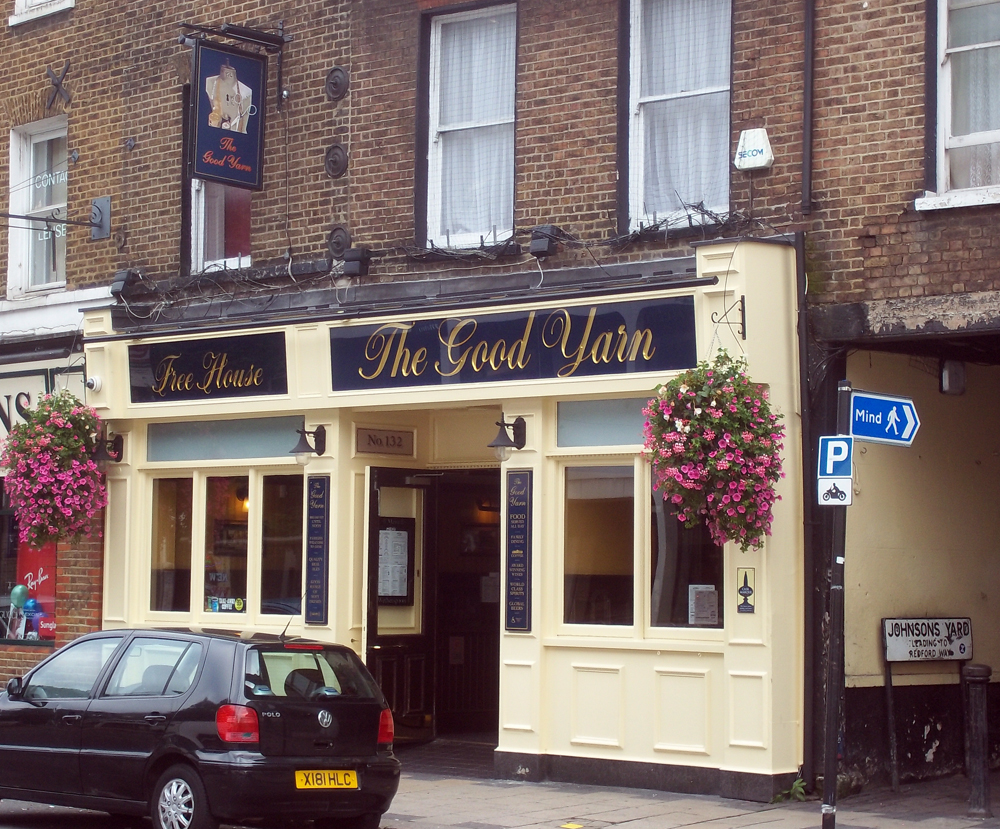
Several celebrations in the offing. A big one on Friday 16th December - and where else but the Good Yarn! Then there's my leaving speech on 21st. I am working on it and it will be a masterpiece of Hemingway-esque succinctness and Churchill-like clarity.


Life couldn't be better.


You thought that the Church of England Busybody had put me out of action permanently didn't you! I'm made of stronger stuff.


PS Don't give me this nonsense about your memoirs. They will never be published. You know that and I know that.


What a celebration there will be here on the night of Friday 16th December!

Thursday, 1 December 2016

Government urged to protect religious freedom in new Bill of Rights

Government urged to protect religious freedom in new Bill of Rights


Daniel and Amy McArthur, who were fined after refusing to bake a cake with a pro-gay marriage slogan, outside Belfast County Court (PA)

The Respublica report suggests a 'reasonable accommodation' clause to protect employees' freedom
A new report by think tank Respublica, several of whose past recommendations have influenced government policy, has suggested a “reasonable accommodation” clause for religious beliefs in law.
The report, Beyond Belief, written by James Orr, a philosophy fellow at Christ Church, Oxford, was launched this morning in Parliament. It follows a series of cases in which Christians have lost their jobs or businesses, or been otherwise penalised, for acting on their consciences, especially in disputes over LGBT rights.
Most recently, Ashers bakery in Northern Ireland was fined for refusing to bake a cake with a pro-gay marriage slogan. The decision was upheld on appeal, a widely criticised decision which gay rights campaigner Peter Tatchell described as “a defeat for freedom of expression”.
It follows similar cases, such as that of Lillian Ladele, a registrar who lost her job after asking not to preside at same-sex civil partnerships.
Beyond Belief warns that at the moment, “rights accrue not to who is right, but to whoever is the most politically connected and can persuade the state to take their side”.

It proposes a return to “the original and more reasonable account of rights, where reasonable accommodation is made once more between different minorities and nobody is more equal than anyone else.”
The report suggests that the British Bill of Rights, a piece of legislation which has been proposed by the Conservative government, could include a “reasonable accommodation” clause. A draft Bill of Rights has not yet been published.
Beyond Belief calls for the government to “set the principle of reasonable accommodation of religious belief on a constitutional footing”. Employers and public sector bodies would have to accommodate religious practice. In a similar way, the law already grants “reasonable adjustments” to some groups. For instance, Sikhs are allowed to wear a turban instead of a crashhelmet when riding a motorcycle.
The “reasonable accommodation” law would oblige public-sector employers to take steps so that religious employees were not placed in a difficult situation by their beliefs. What counted as “reasonable accomodation” might include “the degree to which an accommodation would be practical; the financial and/or other costs of implementing the accommodation; the availability of resources necessary to make an accommodation; and the degree of disruption that making an accommodation would entail.”
It explains that the clause would mean that “the employee would no longer bear the burden of proof – he would not need to show that a rule or requirement puts him at a disadvantage.
“Instead, the employee need only make a request that his religious beliefs or practices be accommodated, and the burden of proof rests with the employer to assess whether reaching an accommodation would impose an unreasonable degree of hardship.”
The report also recommends that the Equality and Human Rights Commission introduces a Religious Freedom Code of Practice, to help employers and service-providers work through difficulties over freedom of conscience. And it calls on universities to address their statutory duty to protect freedom of speech, after a series of cases in which .
The report argues that failure to protect religious freedom will harm the economy, if believers cannot engage in commerce (like running a bakery), and will hurt civil society, by making religious people less likely to volunteer. The “privatisation” of religion will also accelerate the decline in social trust, the report suggests.