Saturday, 3 June 2023


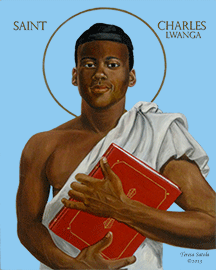
Saint Charles Lwanga and Companions. These saints were murdered for resisting demands to commit homosexual sins. Important to remember this during Gay Pride (sic) month


Saint of the Day for June 3

(d. between November 15, 1885 – January 27, 1887)


Saint Charles Lwanga and Companions’ Story

One of 22 Ugandan martyrs, Charles Lwanga is the patron of youth and Catholic action in most of tropical Africa. He protected his fellow pages, aged 13 to 30, from the homosexual demands of the Bagandan ruler, Mwanga, and encouraged and instructed them in the Catholic faith during their imprisonment for refusing the ruler’s demands.

Charles first learned of Christ’s teachings from two retainers in the court of Chief Mawulugungu. While a catechumen, he entered the royal household as assistant to Joseph Mukaso, head of the court pages.

On the night of Mukaso’s martyrdom for encouraging the African youths to resist Mwanga, Charles requested and received baptism. Imprisoned with his friends, Charles’s courage and belief in God inspired them to remain chaste and faithful.

For his own unwillingness to submit to the immoral acts and his efforts to safeguard the faith of his friends, Charles was burned to death at Namugongo on June 3, 1886, by Mwanga’s order.

When Pope Paul VI canonized these 22 martyrs on October 18, 1964, he also made reference to the Anglican pages martyred for the same reason.


“I’ll see your ‘Wakanda!’ and raise you a ‘KATONDA!'” The Feast of St Charles Lwanga, Martyr – A saint we can all take pride in!

St Charles Lwanga

“Katonda!”

This year today is in the Vetus Ordo calendar Ember Friday in the Octave of Penance.  However, it is also the Feast of St. Charles Lwanga.    That said, because of the decree Cum sanctissima we can now celebrate St. Lwanga using the 1962 on days when it is not some feast that would outweigh it.

Here is what I posted on St. Charles in the past.

If you don’t know this saint, be sure to read it.  It is powerful.


As “Pride” month continues…

Today is the feast of St. Charles Lwanga and companions, murder victims and martyrs of homosexual depravity.

Today we might also contemplate the various ways in which the State is encroaches in our lives in this regard and tries to force us to do things that are repugnant to nature and to God’s laws.

Today we should especially ask God to forgive and convert all those who in any way have contributed to or succumbed to any aspect of what is rightly called toxic “gender theory” and called demonic, due to its origin.

More on that HERE and HERE and HERE.

Today is the feast day of a saint, who died as a martyr especially because he resisted a sodomite king, who was furious that he and many children wouldn’t have homosexual sex with him.

St. Charles Lwanga and many other martyrs died between 1885 and 1887 in Uganda. They were beatified in 1920 and canonized by Pope Paul VI in 1964.

In 1879 the White Fathers were working successfully as missionaries in Uganda.  They were, at first well received by King Mutesa.

Then there came a new pharaoh, as it were.

Mutesa died and his son, Mwanga, took over.  He was a ritual pedophile.

Charles Lwanga, a 25 year old man who was a catechist, forcefully protected boys in his charge from the king’s sodomite advances.

The king had murdered an Anglican Bishop and tried to get his page, who was protected by Joseph Mukasa, later beheaded for his trouble.  On the night of the martyrdom of Joseph Mukasa, Lwanga and other pages sought out the White Fathers for baptism. Some 100 catechumens were baptized.

A few months later, King Mwanga ordered all the pages to be questioned to find out if they were being catechized.  15 Christians 13 and 25 identified themselves.  When the King asked them if they were willing to keep their faith, They answered in unison, “Until death!”

They were bound together and force marched for 2 days to Namugongo where they were to be burned at the stake.  On the way, Matthias Kalemba, one of the eldest boys, exclaimed, “God will rescue me. But you will not see how he does it, because he will take my soul and leave you only my body.”  He was cut to pieces and left him by the road.

When they reached Nanugongo, they were kept tied together for seven days while the executioners prepared the wood for the fire.

On 3 June 1886 (that year the Feast of the Ascension… therefore a Thursday), Charles Lwanga was separated from the others and burned at the stake. The executioners burnt his feet until only the charred stumps remained.  He survived.  His tormentors promised that they would let him go if he renounced his Faith. Charles refused saying, “You are burning me, but it is as if you are pouring water over my body.”  They set him on fire.

As flames engulfed him he said in a loud voice, “Katonda! – My God!”

“Katonda!”  … Better than “Wakanda!”

His companions were also burned together the same day. They prayed and sang hymns.

Charles Lwanga and companions died for their Faith and because they resisted the intrinsically evil of homosexual sex.

[…]

Charles Lwanga, pray for us!

Katonda!

st_charles_lwanga_photo

Thanks to the Great Roman™.  Here are a couple of shots of the canonization

Friday, 2 June 2023


“The next great challenge the Church is going to face is gender ideology, and it will be the ultimate rebellion against God the Creator.” Pope Benedict XVI

There it was, in New York Magazine this week, the story of a TikTok influencer who is “non-binary”: supposedly, male and female. Name, Vitus Spehar. Host of a newscast.


And so how did the magazine writer refer to this person?

Not “him,” of course, nor even “her,” but as “them.”

When this fellow/woman/they refers to himself, it’s “we.”

And so we see just how segments of our society are descending from sociopathy to silliness.

That’s not to dislike; one must love all. One must pray for everyone/them, no matter how unfavorable the atmosphere around us.

But it was interesting at several levels, firstly that idea of “them”: it gives a normal onlooker the impression of more than one person/spirit in a body. Translation: the trans stuff raises questions for the exorcist.

There was also the fact that yesterday, as the story circulated, was also the annual and glorious kick-off — never ballyhooed by the media as now — of “Gay Pride Month,” with revelry focused at that mecca of “tolerance” known as Disney.

And the rainbow? Wasn’t that the symbol of hope and God’s Love in Noah’s time — after The Flood. And does this too tell us something (i.e., where we’re headed)?

High whitewater ahead! As one Catholic site put it, “Pride (Day) Goes Before the Fall.”


Wasn’t it in Noah’s time that there was all of lasciviousness and partying and gluttony? Didn’t all the revelry lead up to the inundation?

(Try getting into a restaurant these days).

Ever mindful, should a Judeo-Christian nation be, that sodomy is what got two cities in ancient times burned to calcine ash.

    Sodomy is what got two cities in ancient times burned to calcine ash.

Most unnervingly, such is this time that “Pride Month” grabs more public notice — infinitely more — than what June really is: Month of the Sacred Heart.

One can go on. One can shake one’s head. One can wonder at how much further it could possibly go. It challenges the imagination.

One can reflect on the rise of homosexuality and the blurring of sexes and observe how the landmark gay event, the “Stonewall Riots” in New York, was the same decade that spawned radical coeds-in-construction-boots feminism.

One can also reflect back on Benedict XVI, who in 2012 told the Curia, in his last address, “When the freedom to be creative becomes the freedom to create oneself, then necessarily the Maker Himself is denied and ultimately man too is stripped of his dignity as a creature of God, as the image of God at the core of his being.”

A year after relinquishing the papacy, he also told a visiting theologian (who paraphrased him) that “the next great challenge the Church is going to face is gender ideology, and it will be the ultimate rebellion against God the Creator.”

His exact words were more like “last test.”

Wednesday, 31 May 2023

 ORIGINAL SIN


Article nine from The Anglican Thirty-nine Articles


9. Original or Birth-sin 

Original sin is not found merely in the following of Adam's example (as the Pelagians foolishly say). It is rather to be seen in the fault and corruption which is found in the nature of every person who is naturally descended from Adam. The consequence of this is that man is far gone from his original state of righteousness. In his own nature he is predisposed to evil, the sinful nature in man always desiring to behave in a manner contrary to the Spirit. In every person born into this world there is fund this predisposition which rightly deserves God's anger and condemnation. This infection within man's nature persists even within those who are regenerate. This desire of the sinful nature, which in Greek is called fronema sarkos and is variously translated the wisdom or sensuality or affection or desire of the sinful nature, is not under control of God's law. Although there is no condemnation for those that believe and are baptized, nevertheless the apostle states that any such desire is sinful.


It follows the expressing that God given nature in action cannot be sinful 

If homosexuality is God given, how can expressing that sexuality consensually be sinful?

DETTERLING


Well Detterling? I'm afraid the Anglican Thirty-nine Articles, which accept Original Sin, blows your heretical theory out of the water.

Another lesson for you here: Don't tangle with Gene on Theological/Philosophical issues or on questions of Logic. Gene read Logic and Epistemology as part of the Philosophy component of his degree.


And in any case, the Article about Original Sin is invalidated by Article 20, as follows:


20. The Authority of the Church
The church has authority to decree forms of worship and ceremonies and to decide in controversies concerning the faith. However, it is not lawful for the church to order anything contrary to God's written Word. Nor may it expound one passage of Scripture so that it contradicts another passage. So, although the church is a witness and guardian to Holy Scripture, it must not decree anything contrary to Scripture, nor is it to enforce belief in anything additional to Scripture as essential to salvation.

DETTERLING


Ha! Ha! Ha! You are really floundering now Detterling. Even you don't see that as coming near or anywhere near rescuing your position.

Yesterday you were crowing that only the Catholic Church had the doctrine of Original sin. Article 9 of the Anglican Thirty-nine Articles has torpedoed that claim!


Ergo your absurd contention 'If homosexuality is God given, how can expressing that sexuality consensually be sinful?' is completely untenable. Total Pelagianism.


I said yesterday that the Catholic church had quietly let lapse the doctrine of original sin.

DETTERLING


No. The Catholic Church teaches the Doctrine of Original sin. It has never been let lapse.

The Church of England teaches the Doctrine of Original sin - as per the 39 Articles.


Detterling when one has been defeated as comprehensively as you have been, the best thing to do is make a quiet exit from the fray. Trying to rescue yourself makes you look so undignified and pitiable.


If homosexuality is God given, how can expressing that sexuality consensually be sinful?

DETTERLING

See how wrong you were?

No sodomites shall ever enter the Kingdom of God. Got that?


[1] I said yesterday that the Catholic church had quietly let lapse the doctrine of original sin lapse quietly

DETTERLING

No. The Catholic Church has not let lapse the Doctrine of Original sin.

[2] And the C of E's proclamation of original sin as an article of faith is negated by article 20

DETTERLING

So why do the 39 Articles still contain Article 9?

Detterling you have been destroyed. You have no credibility left in this discussion. And you know it.


If homosexuality is God given, how can expressing that sexuality consensually be sinful?

DETTERLING

It is quite astonishing, even allowing for your impaired intellectual condition, that you could come out with a statement like this.


Diving Deeper into the Seven Deadly Sins

snake, serpent, apple, deception

Most Catholics are familiar with the Seven Deadly Sins, also known as the Seven Capital Sins. These are those sins that engender all other sins, hence why they are called the capital sins — because they are at the head of all other sins. You can read more in my article HERE.

Much spiritual direction, writing, and discussion have surrounded how to combat these sins, and what virtues we ought to strive after that most oppose these sins. For example, those who struggle with pride ought to pray for the grace of humility and take steps to better live out this virtue.

At some point in one’s spiritual journey, as we seek to draw ever closer to the Lord, there will come a point where we recognize that, even if we have truly done battle with our sins, there is still deep, spiritual healing that must take place to thoroughly purify of us of the seven deadly sins.

The Doctor of the Church, St. John of the Cross, explains that there is a deeply spiritual component to these sins, that they can often hide in spiritual guises, and to move further along in the spiritual life, healing is required in these areas.

I want to do a quick survey, following St. John, diving deeper into these deadly sins to suggest where we might need to seek further healing and transformation from the Lord. All quotes from St. John of the Cross come from his work The Dark Night of the Soul as quoted in Ralph Martin’s excellent work, The Fulfillment of All Desire.

Pride

Pride is not simply having a bloated sense of self or putting oneself in the place of God. Even our desire for holiness and perfection can become a source of pride. Jesus tells us to be perfect (Mt. 5:48) and in striving after perfection, we might be tempted to discouragement when we fail to be perfect as our Father is perfect.

St. John writes,

Sometimes they minimize their faults, and at other times they become discouraged by them, since they felt they were already saints and they become impatient and angry with themselves, which is yet another fault.

While we must strive after moral perfection, our reason must be purely to please God. It is possible, however, that our desire for perfection and sanctity is more self-indulgent than it is a desire for the Lord.

St. John continues,

They are often extremely anxious that God remove their faults and imperfections, but their motive is personal peace rather than God. They fail to realize that were God to remove their faults they might very well become more proud and presumptuous.

We ought to consider the question, ‘Why do we want to be perfect?’ If for the sake of God and not for our own sake, then we ought to be humble in the face of our imperfections, patiently awaiting the Lord’s healing.

Envy

The sin of envy, for many, connotes an extreme form of greed — it is a desire for something that someone else has. While envy does include this, a more exact understanding of envy is sorrow at someone else’s good. Envy isn’t wanting your neighbor’s car; envy is being upset or frustrated that your neighbor has a car that you don’t have.

St John of the Cross shows that envy can exist in the spiritual life as well. He writes:

In regard to envy, many of them feel sad about the spiritual good of others and experience sensible grief in noting that their neighbor is ahead of them on the road to perfection, and they do not want to hear others praised. Learning of the virtues of others makes them sad. They cannot bear to hear others being praised without contradicting and undoing these compliments as much as possible.

These scathing words surely ring true. It really can hurt to see when someone else is closer to God, more spiritually mature, and receiving more praise for their goodness and success in the spiritual life. This hurt, despair, and frustration at another’s spiritual good is envy.

To combat this, we must be grateful for the spiritual blessings the Lord has bestowed upon us. We must also pray for the grace to see that another person’s spiritual good does not hurt us or take away from us, rather, it helps build up the Body of Christ and in so doing benefits us.

Avarice

Whereas envy tends to focus on the person who has something we wish we had, avarice or greed focuses on the coveting of that good itself. It might come as a surprise, but it is indeed possible to be greedy of spiritual goods as well.

Whether is always seeking more spiritual advice, or the newest edition of a theological tome, or perhaps simply another icon to place in a room — spiritual avarice is an inordinate desire for spiritual goods and the seeking of spiritual consolation in these things rather than in God.

St. John of the Cross writes of those enraptured by spiritual avarice, “They weigh themselves down with over-decorated images and rosaries… they prefer one cross to another because of its elaborateness.”

I, for one, can see this sinful inclination in my own life and recognize how tempting it is because these prayerful and holy objects are in fact good and helpful. Having good books and holy items is of course good (and sometimes necessary) for growth in the spiritual life. The temperate possession and desire for these items are not being discouraged, rather, St. John is pointing out that we can make idols out of anything, even holy things.

St. John explains that “true devotion comes from the heart and looks only to the truth and substance represented by spiritual objects” and we must remind ourselves of this frequently. The goal is not more images and rosaries, the goal is God. We do not need more spiritual things, we need more of Him.

Wrath

Just as it is easy to lose our tempers and become angry in sensible ways, such as being cut off in traffic, or when someone makes a mistake that causes us trouble, it is possible to become angry in our spiritual lives.

St. John of the Cross points out two main ways this can happen. We can become angry with others when we see them sinning and falling short of spiritual perfection. St. John says these people are “setting themselves up as lords of virtue” and much opposed the virtue of meekness.

Another way that the deadly sin of anger can take root in the spiritual life is in anger with ourselves. St. John writes,

Others in becoming aware of their own imperfections grow angry with themselves in an unhumble impatience… They want to become saints in a day… They make numerous plans and great resolutions, but since they are not humble and have no distrust of themselves, the more resolves they make the more they break, and the greater becomes their anger. They do not have the patience to wait until God gives them what they need, when he so desires.

Like in the antidote to pride, we must ask the Lord to give us patience as we strive for perfection in his holy time. Our moral perfection is for Him and not for our own peace or satisfaction. Anger in the face of our imperfections only further distances us from the Lord.

Lust

Even those who have mastered the virtue of chastity can still suffer from temptations to lust and sins of the flesh. In fact, St. John of the Cross points out that, though surprising, lustful temptations can commonly appear during prayer and spiritual exercises.

The reason for this can perhaps be seen in the strong connection between the spiritual and the sensory. We often experience joy and consolation in our spiritual practices in a sensible and emotional way. For those who don’t have strong enough control over the sensible reactions in the spiritual life, there is a greater possibility of experiencing these lustful desires and temptations.

St. John also points out that this is a tactic of the devil, to lead people away from prayer: “To make them cowardly and afraid, he brings vividly to their minds foul and impure thoughts…the devil excites these feelings while souls are at prayer, instead of when they are engaged in other works so that they might abandon prayer.”

Of course, it is necessary to resist the devil and be persistent in our prayers, precisely in the face of these temptations. The Lord will continue to purify these desires and raise them up to the pure charity that is of him.

Gluttony

Gluttony involves the excessive desire and consumption of food and drink. In the spiritual life, there can also be an overemphasis on the feelings that come from our prayer to the extent that the feelings, and not God, become our focus. Spiritual gluttony is the excessive desire for spiritual feelings rather than God himself. It is possible that our spiritual readings, prayer, fasting, almsgiving, and ministry activity become more about making us feel good than being about the Lord and his will.

Of spiritual gluttons, St. John says, “Their only yearning and satisfaction is to do what they feel inclined to do… They think that gratifying and satisfying themselves is serving and satisfying God.”

It is very dangerous to assume that the pious and holy things we want for ourselves are the same things the Lord wants for us. Are we setting aside an hour of spiritual reading in the morning because the Lord is calling us to do it, or because it feels good to us and is easier than starting the work of the day? Are we fasting three times a week because we’ve discerned the Lord is asking these sacrifices of us or because we like the physical benefits of fasting?

The best and most effective prayers and devotions will always be the specific ones the Lord is inviting us to do. The danger of spiritual gluttony is a good reminder to constantly and consistently ask God to confirm our spiritual practices are in alignment with his will.

Sloth

Sloth is often equated with laziness but can be even better defined as sorrow in the face of good. Just as laziness can be extremely tempting and prevalent in our sensible lives so too in our spiritual lives. Spiritual sloth, or a deep sorrow in the face of spiritual goods, can become quite tempting as the Lord withholds some of the feelings and consolations in prayer that he might have previously given.

St. John explains,

Regarding spiritual sloth, those beginners usually become weary in exercises that are more spiritual and flee from them since these exercises are contrary to sensory satisfaction. Since they are so used to finding delight in spiritual practices, they become bored when they do not find it… They either give up prayer or go to it begrudgingly.

Like spiritual gluttony, spiritual sloth can stem from the desire for the feelings and consolation associated with prayer rather than for the Lord. This is precisely why God will at times remove these feelings and consolations, not as a punishment, but to purify our hearts and remind us why we are praying in the first place.

Again, we must ask the Lord to purify our hearts, for a deep purification is the only way to heal these spiritual deadly sins. When we recognize more aridity in our prayer, we must remind ourselves that this is when we are closer to God, we must embrace the dry wood of the cross that we are carrying, knowing the Lord is permitting this for our good.


Tuesday, 30 May 2023


What did Saint Paul have to say about the Arsenokoitai? Quite a bit actually...


Romans 1:26-27

New International Version

26 Because of this, God gave them over to shameful lusts. Even their women exchanged natural sexual relations for unnatural ones. 27 In the same way the men also abandoned natural relations with women and were inflamed with lust for one another. Men committed shameful acts with other men, and received in themselves the due penalty for their error.


1 Corinthians 6:9-10.

New Revised Standard Version.

Do you not know that wrongdoers will not inherit the kingdom of God? Do not be deceived! Fornicators, idolaters, adulterers, male prostitutes, sodomites, thieves, the greedy, drunkards, revilers, robbers—none of these will inherit the kingdom of God.


1 Timothy 1:8-11

...we know that the Law is good, if one uses it lawfully, understanding this, that the Law is not laid down for the just but for the lawless and disobedient, for the ungodly and sinners, for the unholy and profane, for those who strike their fathers and mothers, for murderers, the sexually immoral, men who practice homosexuality [arsenokoitai], enslavers, liars, perjurers, and whatever else is contrary to sound doctrine, in accordance with the gospel of the glory of the blessed God with which I have been entrusted.