
A Boomer, But An Augustinian: On Magnifica Humanitas
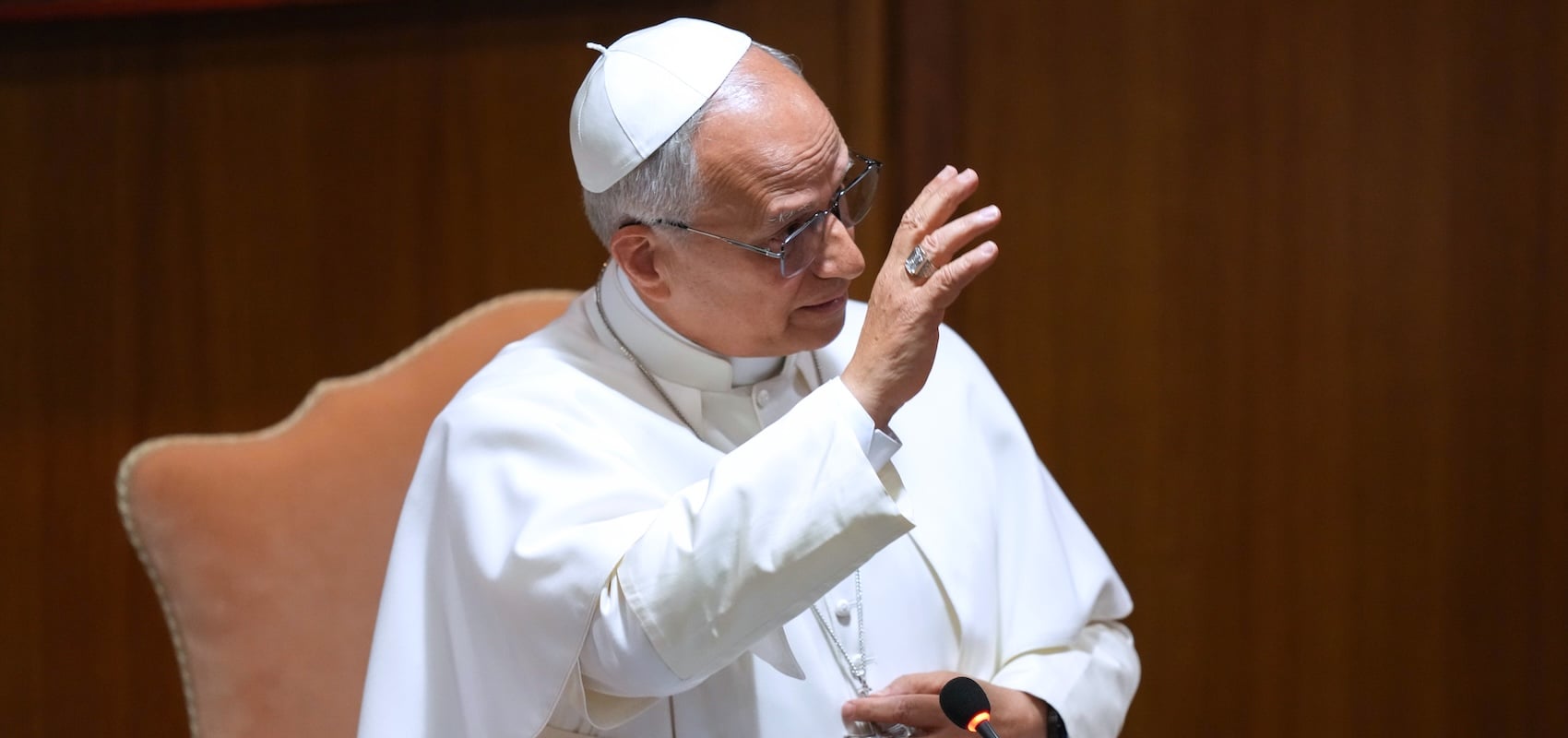
Pope Leo XIV’s first encyclical, on safeguarding the human person in the time of artificial intelligence, begins with the Tower of Babel (Gen. 11:1–9). Babel represents the grandiosity of our technological age, of attempting to surpass our creaturely nature and thereby preclude communion with God. Limitations are integral to human dignity; they are to be cherished and protected, not wished away. There is thus an inherent grandeur to being human, and particularly to organic, human intelligence.
The natural capacities with which we are endowed as creatures of God are relational, and therefore moral and spiritual. Unlike the machine, we have conscience, we experience love and loss, we acquire wisdom, we exercise compassion and undergo suffering for others. Crucially, such things are indispensable for communion with God in Christ. Hence, Magnifica Humanitas declares, “We must lovingly safeguard the grandeur of humanity bestowed upon us and revealed in its fullness in Christ, the splendor of which no machine can ever replace.”
Today’s Babel, Leo writes, is the “technocratic paradigm” within which technology becomes “the standard by which everything is judged,” and all is reduced to the logic of “efficiency, control and profit.” Then, “the fullness of life is equated with having more, reducing weakness, eliminating uncertainty and exerting total control.” Even our own lives are treated as machines we can code as we will, seeing ourselves “as a project to be optimized rather than as persons called to relationship and communion.” (If anyone doubts this, I’d happily direct them to the contents of my social media algorithm.)
On the societal level, the technocratic paradigm results in a “culture of power.” This is when the logic of the machine runs wild, there is a limitless arms race to develop the most sophisticated AI, shadowy non-state actors exert unrestrained transnational influences, technology provides ever new forms of weaponry, and multipolar geopolitics increasingly degenerates into war.
Cherishing the grandeur of creaturely limits, by contrast, brings the promise of a “civilization of love.” This will arise, says Leo, not “from a single or spectacular gesture, but from the sum total of small and steadfast acts of fidelity that serve as a bulwark against dehumanization.” We’re encouraged by the pope to use technology for building a civilization of love. The point is to apply a “spiritual, ethical and political framework” to questions of whether, how, and when technological developments should be utilized.
The document explains the principles of Catholic social doctrine to this end. The idea is that we’ll stop capitulating to anything machines offer, and instead ask to what degree some new development can foster human dignity, a commitment to the common good, subsidiarity and solidarity, and so forth.
Pope Leo notes that when societies without a sound ethical and spiritual framework encounter new technologies, everything is “governed only by technocratic thinking and presented as necessary and inevitable, ultimately imposing rules shaped by those who control data, infrastructure and computing power.” Working in a university, I saw this firsthand when AI first appeared. We were told that questioning its use was futile: The only option was an uncritical embrace.
Magnifica Humanitas presents the antidote. Families, schools, and the broader culture are encouraged to impart the dispositions necessary to use technology appropriately. The passages in question deserve much careful, collective reading by those involved in any such context.
As Pope Leo’s first encyclical, this document perhaps sets the tone for subsequent papal teachings. It is a work of balance and deliberation that displays heartfelt concern for the dehumanizing aspects of contemporary life and puts a particular accent on peacemaking and the horror of war.
This is also a pope for whom Church unity is given special emphasis, with little hint of factionalism or intra-ecclesial point-scoring. At the center of this impetus is the Eucharist, which challenges the technocratic paradigm by building and strengthening profound communion, human and divine. In discussing this point, Leo quotes his own papal motto: In Illo uno unum.
As an outwardly focused encyclical, aimed at all people of good will, it seems the pope’s valuing of unity applies also to the human race and not just the Church. Solidarity is described as “the concrete recognition that the future of each individual is connected to the future of all.” Fraternity is presented as global and universal—“not merely an aspiration of believers” but “a social and political reality to be embodied in communal choices and endeavors.”
Such statements undoubtedly serve as important reminders of the capacious breadth of Christian anthropology. Recent years have, however, made some of us wary of how universalized and global initiatives can function as just another expression of a culture of power, and correspondingly appreciative of how national expressions of political will sometimes bring welcome disruption.
One wonders if institutions like the U.N., for example, are really the most adequate safeguarders of human creatureliness, given their position on abortion and gender ideology. As the pope himself notes, one of the dangers of technology is a universal “homogenization” of identity, something not unrelated to the concerns that drive many populist movements worldwide.
Pope Leo still interprets “transnational institutions” more favorably. Maybe this is as much generational as anything. It is no coincidence that the Vatican II document quoted most frequently here is Gaudium et Spes. Even the young Ratzinger famously said this constitution was in danger of seeming “guileless” and “downright Pelagian” in its 1960s-style optimism.
Nonetheless, Leo is orientated by Pelagius’s great adversary, St. Augustine. For the Bishop of Hippo, political optimism or utopianism was precluded by the way he distinguished the ecclesial and political realms as two cities; the City of God, centered on the love of God (amor Dei), and a City of Man, centered on pride and self-love (amor sui).
Confusing the human polis with the City of God is a likely outcome of Pelagian presumption, enacting what Eric Voegelin called “the immanentization of the eschaton.” Pope Leo seems sensitive to this. He makes clear that the City of God is, properly speaking, the Heavenly Jerusalem of Revelation 21—a gift of divine grace, not something we can achieve by human endeavor or political initiatives.
In other words, Pope Leo XIV may be a Boomer, but he is a decidedly Augustinian Boomer. This promises that Magnifica Humanitas’ affirmation of our God-given grandeur, over against the overbearing grandiosity of the machine, will have the impact it should on those younger generations that need to hear it the most.

No comments:
Post a Comment