Tuesday, 9 July 2024


The earthquake called Elvis started today!

70 years ago in Memphis' Sun Studios, a truck driver cut a song, changed the world


The Internet tells us that there are two ways to measure an earthquake. One is to measure the magnitude or the size of it, another graphs the intensity of the eruption. As far as we know, nobody has ever brought a seismograph inside the dusty building at 706 Union Avenue in Memphis, Tennessee but if they had in the summer of 1954, it would have been interesting to see what it read when this soft-spoken truck driver showed up and over the next few months turned American popular music upside down.

     An odd-shaped building with very unusually hand-tiled ceilings installed by Sam Phillips himself, Sun Studios is exactly what you might imagine a hole-in-the-wall studio looks like. There’s a tiny entrance area, barely wide enough for a desk, then in the actual studio area, barely enough room for three or four musicians, there’s an old piano in there with worn-out keys (probably thanks to the fingers of Jerry Lee Lewis), an assortment of black and white photos on the walls and on the tile floor, a little black “X” precisely where the microphone stood waiting for the sounds coming out of that truck driver’s pouty mouth.   

The King - the one and only Elvis Presley recorded his first song - "That's All Right" today in Memphis 70 years ago

The building used to be an automobile glass repair shop with a tin ceiling. After Phillips bought it, he installed acoustic tiles and, according to an article in Popular Mechanics, worked precisely to get the sound just so. Former Sun Studio engineer Corey Webber told the magazine “the sound changes depending on where you place instruments…even if you are moving them just a few feet.”

   Visiting the actual studio a couple years ago, they conclude the tour by playing an original Sun Studio recording, in this case, Carl Perkins’ “Blue Suede Shoes.” Everyone in the room, of course, had heard the song before, probably hundreds of times but here, it just leaped out of the speakers as if it actually belonged right there, which, of course, it did. It was created there, in the very spot where we all were standing and it occupied the air in a way that was arresting, rousing, thrilling.

As we listened and looked around, it wasn’t much of a leap to imagine yourself up in that control booth, hearing that tune for the first time, knowing you had a stone-cold, rock-solid, toe-tapping No. 1 hit! (It was actually Take Two!)
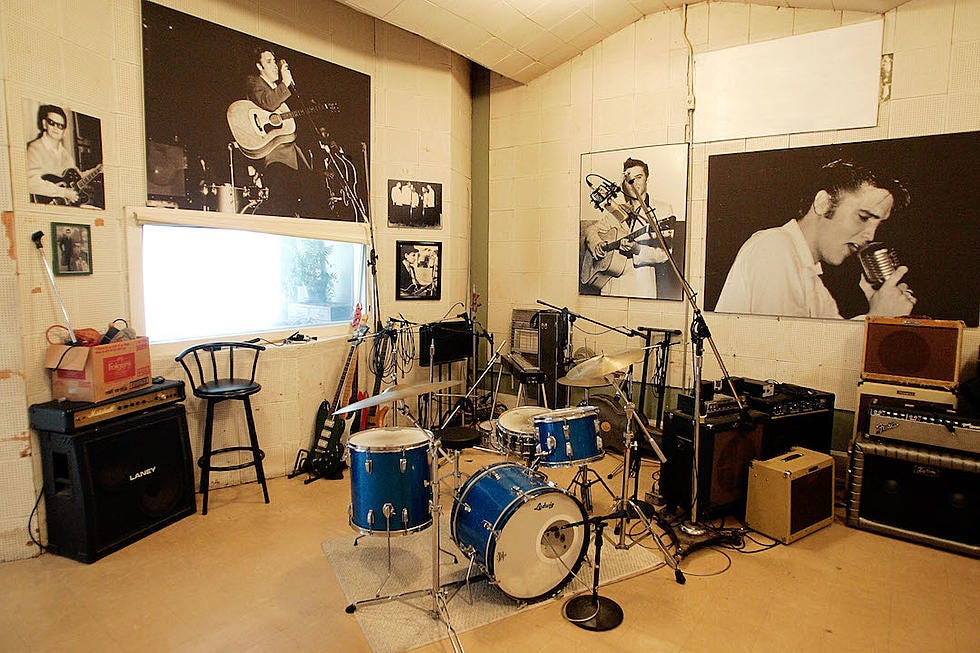
 

   An X on Sun Studio’s floor marks where Elvis’ mike was set. Bob Dylan knelt and kissed it.

Go back about a year before “Blue Suede Shoes” and here is Sam Phillips up in the tiny control booth in the evening after Independence Day, 1954. Isn’t that fitting, right AFTER Independence Day? Elvis Presley was freed and in turn, freed all of us.

Below him, a 19-year-old Elvis Presley, a truck driver for Crown Electric with a passion for music, stands before the microphone, frustrated after running through his personal catalog of songs and not really impressing anybody. This was his chance and he was blowing it.

With time and patience running out, Elvis begins beating his guitar to an old blues tune he loved, “That’s All Right, Mama,” a simple, nondescript tune written by Arthur “Big Boy” Crudup, an African-American blues singer, someone that Phillips later admitted he was shocked Presley, a poor white kid, knew.

   Phillips heard something in Presley’s spontaneous presentation, got bass player Bill Black and guitarist Scotty Moore to follow him and they ended up cutting the number as Elvis’s first Sun single. The song, as shocking a source for a revolutionary tune as you could imagine, was exactly that.

On the evening of July 8, that one-sided single came whistling out of radio speakers tuned to Dewey Phillips’ “Red, Hot and Blue” show on WHBQ and everything changed. As Peter Guralnick explained in the first half of his superb two-volume Presley biography “Last Train To Memphis,” the song was a hot connection. “The response was instantaneous,” he wrote. “Forty-seven phone calls, it was said, came in right away, along with fourteen telegrams? – he played the record seven times in a row, eleven times, seven times over the course of the program. In retrospect, it doesn’t really matter; it seemed all of Memphis was listening as Dewey kept up his non-stop patter…”

   “Forty-seven phone calls, it was said, came in right away, along with fourteen telegrams? – he played the record seven times in a row, eleven times, seven times over the course of the program. - Immediate response to “That’s All Right”

Even now, 70 years later, the depth of such an immediate response to a record is startling. Can you imagine any song by any artist now or ever generating such an instant reaction, even with all the technological advantages we have available to us? It was as if entire cities all across America had kept their late-night radios on for years and years, hoping for some sort of sign or message of hope, excitement, jubilation, anything to shake things up.
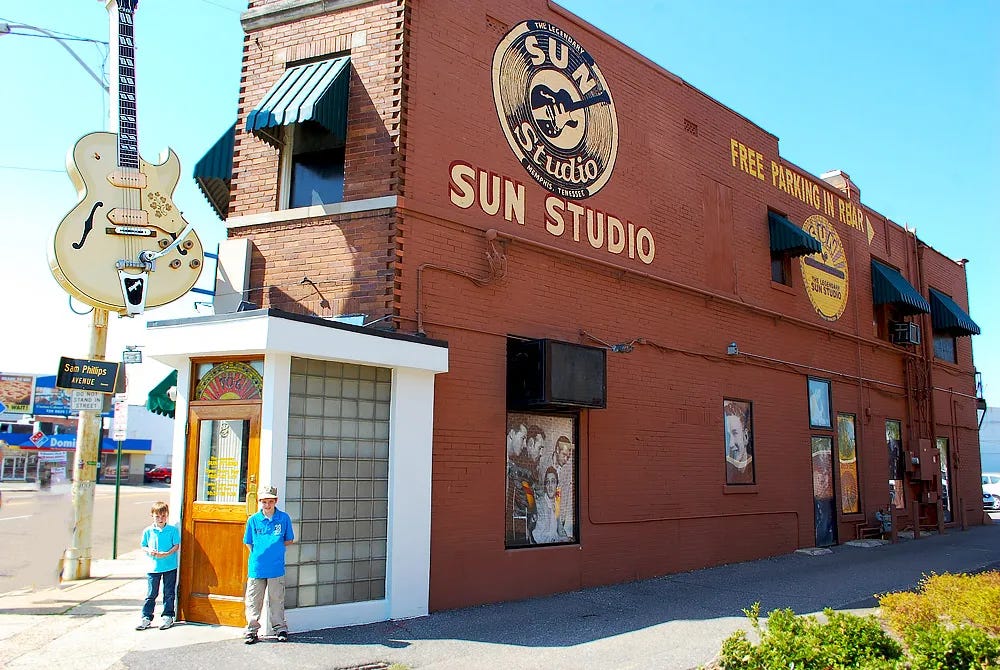
    

The unusually shaped Sun Studios building in Memphis is where it all started.

Yet, here it came one warm summer night, out in the middle of the country, Memphis, Tennessee. And as Jerry Lee Lewis would later sing into that same Memphis microphone a year or two later, across the city there was “A Whole Lotta Shakin’ Going On.” It was Elvis Presley.

    You have to remember that in 1954, only a little over half the population owned TV sets. The Presley’s didn’t even have their own telephone line. Faceless, pictureless radio still ruled. You had to listen. And pay attention.

     The Billboard charts showed America was listening to Elvis Presley. With five hit songs in 1956’s top 15 (“Heartbreak Hotel” – 1., “Don’t Be Cruel” – 2., “Hound Dog” – 5.), four in 1957 (“All Shook Up” – 1., “Too Much” – 9, “Teddy Bear” – 14, “Jailhouse Rock” – 16.) Elvis Presley was a phenomenon.

   Almost before you knew it, here was this swiveling kid Presley on national TV, shakin’ his hips, sneering his way through an assortment of exciting, ground-breaking, earth-shakin’ tunes that shocked, thrilled, irritated, delighted viewers from coast to coast. Guralnick summed up precisely how it felt: “Elvis hit like a Pan-American flash.”

   The impact of that Presleyquake was felt all over. In Freehold, New Jersey, a seven-year-old Bruce Springsteen was watching. He wrote about it in his memoir “Born To Run” as if it had happened the day before. “Ladies and gentlemen…Elvis Presley” Springsteen wrote, precisely remembering the moment. “Seventy million Americans that night were exposed to this hip-shakin human earthquake. A fearful nation was protected from itself by the CBS cameramen, who were told to shoot “the kid” only from the waist up. No money shots! No shifting, grinding, joyfully thrusting crotch shots. It didn’t matter. It was all there in his eyes, his face, the face of a Saturday night jukebox Dionysus, the shimmying eyebrows and rocking band. A riot ensued.”

   In Hibbing, Minnesota, Robert Zimmerman, later to be known to the world as Bob Dylan, felt it, too. “When I first heard Elvis’ voice, I just knew that I wasn’t going to work for anybody; and nobody was going to be my boss,” he wrote. “Hearing him for the first time was like busting out of jail.”

    Just outside of London, future Rolling Stone Keith Richards felt a similar jolt. “But the one that really turned me on, like an explosion one night, listening to Radio Luxembourg on my little radio when I was supposed to be in bed and asleep was “Heartbreak Hotel.” That was the stunner. I’d never heard it before, or anything like it. I’d never heard of Elvis before. It was almost as if I’d been waiting for it to happen. When I woke up the next day, I was a different guy.”

  Over in Liverpool, England, John Lennon listened and knew his destiny, too. "Nothing really affected me until I heard Elvis,” he said. “If there hadn't been an Elvis, there wouldn't have been The Beatles. Before Elvis, there was nothing.” 

Seventy years ago yesterday. In Sun Studios. In Memphis, Tennessee.


Matthew 9:32-37
Ask the Lord of the harvest to send labourers to his harvest

The Harvest,

Painting by Vincent Van Gogh (1853-1890),

Painted in June 1888,

Oil on canvas

© Van Gogh Museum, Amsterdam

Gospel Reading

A man was brought to Jesus, a dumb demoniac. And when the devil was cast out, the dumb man spoke and the people were amazed. ‘Nothing like this has ever been seen in Israel’ they said. But the Pharisees said, ‘It is through the prince of devils that he casts out devils.’


Jesus made a tour through all the towns and villages, teaching in their synagogues, proclaiming the Good News of the kingdom and curing all kinds of diseases and sickness.


And when he saw the crowds he felt sorry for them because they were harassed and dejected, like sheep without a shepherd. Then he said to his disciples, ‘The harvest is rich but the labourers are few, so ask the Lord of the harvest to send labourers to his harvest.’


Reflection on the painting

Vincent van Gogh's "The Harvest," is a captivating portrayal of rural life infused with the artist's characteristic passion, colour and intensity. Completed in June 1888 during van Gogh's prolific period in Arles, France, the painting captures the essence of the agricultural landscape with typical expressive brushwork. We see a group of labourers toiling in the fields under the radiant glow of the sun and against a backdrop of rolling hills and a vast expanse of sky. The painting shows the plain of La Crau, outside Arles, with, in the distance, the Alpilles mountain range. Van Gogh completed ten paintings and five drawings in just over a week at this point, until a heavy storm brought the harvest season to an end. A week after he painted this painting, the landscape was completely different: all harvested - the golden yellows of the wheat replaced by the brown textures of the soil.


In our Gospel reading today, we read that, while God's power was evident through Jesus' labours, he recognised the importance of having additional labourers join him in the work. Hence, he urges his disciples to "ask the Lord of the harvest to send labourers to his harvest." This call entails both active participation in the labour and fervent prayer for more workers beyond themselves. While traditionally interpreted as a call to pray for vocations to the priesthood and religious life, we now understand it as a broader invitation from Jesus.


The risen Lord requires a diverse array of labourers to work in God's harvest today. Each disciple, regardless of his or her vocation, is indispensable, and all baptized individuals are summoned to contribute their efforts. The harvest remains plentiful, necessitating a full and varied workforce. Therefore, it is incumbent upon all of us to ensure that Jesus' mission of proclaiming God's kingdom, both in word and deed, remains vibrant and relevant today. We are all called to be co-workers with the Lord.

by Father Patrick van der Vorst

Monday, 8 July 2024


Matthew 9:18-26
The woman with the haemorrhage touched Jesus' cloak

Christ healing the woman with a haemorrhage,

Catacombs of Marcellinus and Peter, three kilometres southeast of Rome, ancient Via Labicana,

4th century AD

© Christian Art

Gospel Reading

While Jesus was speaking, up came one of the officials, who bowed low in front of him and said, ‘My daughter has just died, but come and lay your hand on her and her life will be saved.’ Jesus rose and, with his disciples, followed him. Then from behind him came a woman, who had suffered from a haemorrhage for twelve years, and she touched the fringe of his cloak, for she said to herself, ‘If I can only touch his cloak I shall be well again.’ Jesus turned round and saw her; and he said to her, ‘Courage, my daughter, your faith has restored you to health.’ And from that moment the woman was well again.


When Jesus reached the official’s house and saw the flute-players, with the crowd making a commotion he said, ‘Get out of here; the little girl is not dead, she is asleep.’ And they laughed at him. But when the people had been turned out he went inside and took the little girl by the hand; and she stood up. And the news spread all round the countryside.


Reflection on the catacomb painting

In this morning’s gospel reading, we see two distinct individuals approaching Jesus in their time of need: a synagogue official on behalf of his daughter and, on her own behalf, a woman with a haemorrhage. The manner in which they approach Jesus differs significantly. The synagogue official makes a very public plea, bowing low before Jesus and openly expressing his need. In contrast, the woman approaches Jesus privately, silently touching the fringe of his cloak and speaking only to herself. Each of us has a unique way of relating to the Lord, just as we have unique ways of relating to others.


Both the synagogue official and the woman demonstrated faith, but they expressed it in very different ways. Our faith unites us as a community, yet it does not suppress our individuality. In the gospel, Jesus responds generously to both the public plea of the synagogue official and the private act of the woman. He makes no distinction between them, responding equally to their needs and cries for help. Both forms of prayer, the prayer for our own needs and the prayer for others, are expressions of our faith in the life-giving touch of Jesus.


Our artwork, in the Catacombs of Marcellinus and Peter, Rome, depicts Christ healing the woman with a haemorrhage. The story of this woman is told on all three Synoptic Gospels: Matthew 9:22, Mark 5:25-34 and Luke 8:43-48. These gospel accounts are far more detailed than the 4th-century catacomb image we are looking at. The woman had to push her way through a crowd following Jesus as he made his way to the home of the synagogue official whose daughter was dying. After she touched the hem of his garment, Jesus asked who had touched him. His disciples, puzzled, protested that the crowd was too dense to single out any one person. Only then did Jesus turn and speak to the woman. The suppression of these details is typical of 4th-century images. Images tended to focus on a singular detail and leave out any non-essential narrative elements.

by Father Patrick van der Vorst

Friday, 5 July 2024


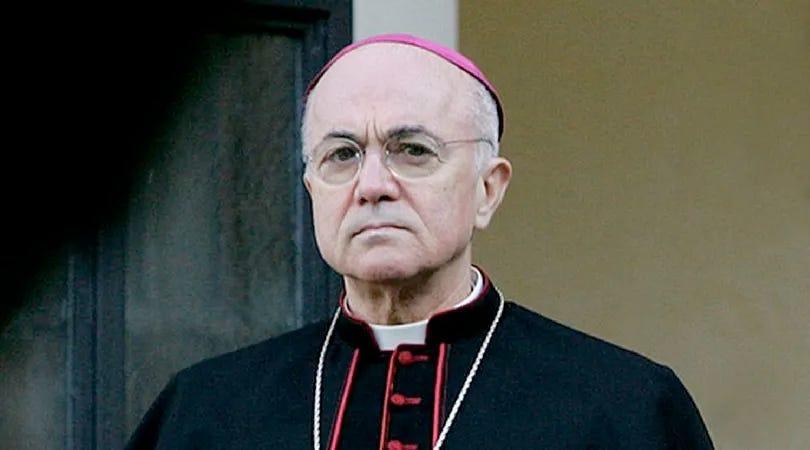
The Vatican doctrine office announced Friday that it had found Archbishop Carlo Maria ViganĂ² guilty of the canonical crime of schism and declared his automatic excommunication.

Archbishop Carlo Maria ViganĂ².

A July 5 statement from the Holy See press office said that the verdict of the Dicastery for the Doctrine of the Faith (DDF) was reached on Thursday and communicated to the former papal nuncio to the United States Friday.

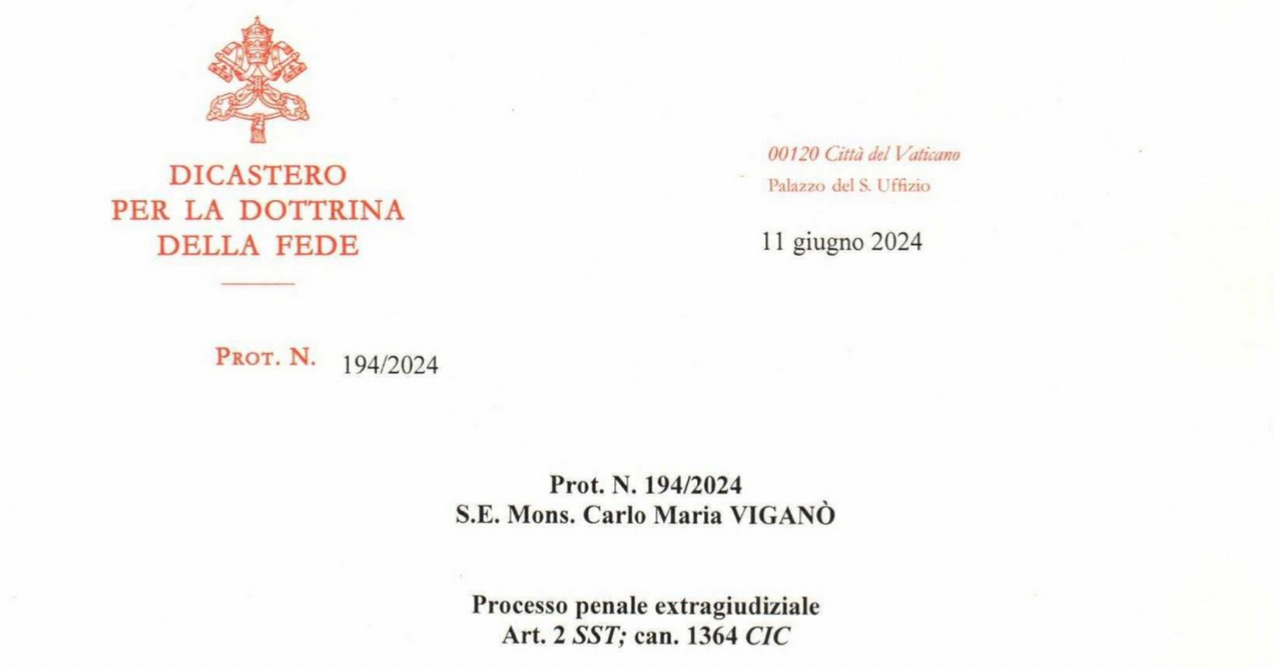
The statement said: “On 4 July 2024, the congress of the Dicastery for the Doctrine of the Faith met to conclude the extrajudicial penal process referred to in canon 1720 CIC against the Most Reverend Carlo Maria ViganĂ², titular Archbishop of Ulpiana, accused of the reserved delict of schism (canons 751 and 1364 CIC; art. 2 SST).”

“His public statements manifesting his refusal to recognize and submit to the Supreme Pontiff, his rejection of communion with the members of the Church subject to him, and of the legitimacy and magisterial authority of the Second Vatican Council are well known.”

The statement added: “At the conclusion of the penal process, the Most Reverend Carlo Maria ViganĂ² was found guilty of the reserved delict of schism.”

“The dicastery declared the latae sententiae excommunication in accordance with canon 1364 § 1 CIC.”

“The lifting of the censure in these cases is reserved to the Apostolic See.”

The archbishop had not responded publicly to the declaration by press time.

The outspoken former Vatican diplomat announced June 20 that he had received a citation in an extrajudicial process, authorized by the congress of the DDF’s members on May 10. 

According to the citation, dated June 11, the DDF’s senior membership voted to proceed with ViganĂ²’s prosecution via an abbreviated extrajudicial process, as opposed to a full canonical trial. 

The citation also ordered the former Vatican ambassador to appear at the dicastery in Rome to answer the charges on June 20, either in person or via formal legal representation.

The charge of schism is defined by canon law as the “refusal of submission to the Supreme Pontiff or of communion with the members of the Church subject to him.”

According to the decree of citation sent to ViganĂ², the archbishop was accused of making “public statements resulting in a denial of the elements necessary to maintain communion with the Catholic Church: denial of the legitimacy of Pope Francis, breaking of communion with him, and rejection of the Vatican Council II.”

The dicastery is authorized to judge cases of crimes against the faith, as well as the most serious crimes against morals and the sacraments, and by special papal mandate can judge those who would otherwise be subject only to the Bishop of Rome, including cardinals, patriarchs, papal legates, and bishops.

ViganĂ², a prominent critic of Pope Francis and Vatican Council II, and an outspoken supporter of Russian president Vladimir Putin, issued a lengthy statement June 20 in response to his citation for schism, which he called a “badge of honor.”

“It is no coincidence that the accusation against me concerns the questioning of the legitimacy of [Pope Francis] Jorge Mario Bergoglio and the rejection of Vatican [Council] II: the Council represents the ideological, theological, moral and liturgical cancer of which the Bergoglian ‘synodal church’ is necessary metastasis,” the archbishop wrote.

The citation to appear before the DDF was, the decree said, ViganĂ²’s opportunity to inspect the evidence against him, in line with canonical procedure for an extrajudicial process. 

An extrajudicial process — not to be confused with an extralegal process — is an abbreviated canonical disciplinary procedure that can be used when the evidence gathered during a formal preliminary investigation is sufficiently clear, such that a full canonical trial is not merited.

In such cases, the accused’s rights to legal representation, to see the evidence against them, and to make their own defense remains intact, but several rounds of formal trial procedure are omitted. 

The same extrajudicial process was used in the case of former cardinal Theodore McCarrick, who was accused of several acts of sexual abuse and was laicized as the result of the process.

In ViganĂ²’s case, the canonical penalty attached to the crime of schism is the declaration of a latae sententiae excommunication, which can have added to it other penalties, including a prohibition or order concerning the schismatic’s place of residence, removal from ecclesiastical office, and prohibition on the exercise of ministry.

Loss of the clerical state is not ordinarily a penalty imposed for schism, since the law presumes first the application of “medicinal penalties,” intended to effect the offender’s repentance and which can be lifted later. 

But canon law states that laicization, which is a perpetual penalty, can be imposed for schism if the person found guilty is judged to be obstinate in their crime, or “the gravity of scandal demands it.”

ViganĂ² appeared to affirm the substance of the charges against him in his response to them, in which he suggested Pope Francis and Vatican Council II represent a cancer in the Church. 

Having been charged with breaking communion with the pope, who he referred to in his press release as “Jorge Maria Bergoglio,” ViganĂ² said: “I believe that the very wording of the charges confirms the theses that I have repeatedly supported in my interventions.”

In a June 28 statement, ViganĂ² underlined that he did not recognize “the authority of the tribunal that claims to judge me, nor of its prefect, nor of the one who appointed him.”

The DDF decree noted that if the archbishop declined to appear in Rome June 20, as directed, or send a duly appointed canon lawyer, he would have a canonist assigned to defend him ex officio by the dicastery.

ViganĂ² confirmed June 21 that he did not answer the charges in person.

The archbishop, who left office in 2016, emerged as a strident and increasingly erratic critic of the Church and hierarchy in the wake of the 2018 Theodore McCarrick scandal.

After first issuing a lengthy “testimony” in which he claimed to have repeatedly warned Vatican superiors about McCarrick, including Pope Francis, he later became an outspoken supporter of then-president Donald Trump, appearing via video link at several “Stop the Steal” rallies in the wake of the 2020 presidential election, which he called “the most colossal electoral fraud in history.” He also urged resistance to the “deep state” and “New World Order.”

Since then, he has been described as living “in seclusion” in an undisclosed location from which he issues regular “declarations” via the internet and makes occasional appearances on cable television in which he has denounced Pope Francis and Vatican Council II.

In 2022, ViganĂ² broke with his previous support of Trump, and issued a lengthy statement on the Russian invasion of Ukraine in which he recognized Moscow as the “Third Rome,” and described the sees of Rome and Constantinople as “deserted and silent,” and “hostage to apostates.”

The archbishop hailed Russia as having “an epochal role in the restoration of Christian civilization, contributing to bringing the world a period of peace from which the Church too will rise again purified and renewed in her ministers.”