Friday, 7 May 2021


Thoughts on a Life Worth Living
by charles j. chaput
henry holt & company, 272 pages, $25.99

Samuel Johnson once famously quipped, “Depend upon it, sir, when a man knows he is to be hanged in a fortnight, it concentrates his mind wonderfully.” Thankfully, Archbishop Charles Chaput is not the subject of such a drastic sentence; but he is that rarest of people—the man who is acutely aware of his own mortality and, now in his mid-seventies, sensitive to the fact that his days are numbered. In a year when COVID revealed how few of us are willing to accept the reality that death comes for us all at some point, his new book, Things Worth Dying For, is both refreshing and sobering. And his basic point is simple: For life to be worthwhile, we must believe that there are indeed things for which it is worth dying.   

The evidence for this is all around. Why is it that so many people from affluent, comfortable backgrounds have been attracted by groups like ISIS? Why does material prosperity prove so unsatisfying? Why is it that the more things we seem to possess, the less significance we seem to have? The answer, according to the archbishop, is that we are made to be more than consumers. We are spiritual beings, and only when we acknowledge that and live in its light can we truly find meaning in life. It also means a humble acknowledgment that the world does not revolve around us, that our ultimate meaning is to be found in God and his truth alone, and that there are therefore greater things, things indeed worth dying for, that need to shape our lives.

This book is a collection of discrete essays with a cumulative force. Each addresses a different topic. Not all are “spiritual” in the conventional sense of the word. The archbishop is a good son of Augustine and understands well that the Christian is a member of two cities, and that there are earthly loves that are important. Thus, he includes a chapter on patriotism, a term which was a virtue when I arrived in the USA two decades ago and is now regarded by our cultural elites as a euphemism for nationalism. But as the archbishop points out, patriotism, properly understood, is one example of how we acknowledge something bigger than us as individuals; something for which we might sacrifice ourselves for the greater good. 

The same is true of the family, upon which the archbishop writes in moving terms. And, of course, he also points to the Church, the place where human beings acknowledge the ultimate truth: that we are finite creatures made in the image of a transcendent God. In placing these three at the center of his vision of what it means to be human, the archbishop touches on a deep truth. He also identifies the three institutions most under assault in our current cultural moment. The triumph of selfish individualism requires their destruction or at least profound revision—with, as this book makes clear, devastating costs. We still want to believe life is worth living, and yet we have torn down the three things that would make it so. No wonder we now have the chaos of identity politics, surely a desperate search for significance in a world we have rendered fragmented and trivial.

This book is vintage Chaput: firm but never less than gracious and kind. It is not polemic by anger, but polemic by beauty: The archbishop argues for nation, family, and Church by pointing to the riches that each represent, not by bad-tempered excoriation of those who seek to dismantle them. The reader sees an archbishop who is truly a pastor and not merely a pen-pushing administrator.   

Of course, as a Protestant, I disagree with plenty here. The usual suspects, one might say: the Mass, purgatory, Mary, the papacy. But that should not stop Protestants from reading this book. There is wisdom, sweetly and gently expressed, on every page, touched with that power that only comes from the pen of a man aware that he is approaching the end of his pilgrimage. From reflections on mortality rooted in the psalms, to thoughts on friendship framed by insights from the Lutheran Gilbert Meilaender and the Anglican C. S. Lewis, this book will help us all to think about the important things in life—the things worth dying for—from a deeply Christian perspective, even at the points where we Protestants need to put our thoughts in very different terms.   

As I read this book, I recalled my own favorite “Chaput moment.” Some years ago I heard him lecture on the decline of Christianity. In the discussion afterward, someone in the audience suggested that the Church needed to change to attract young people. The archbishop’s response was blunt: the reason young people are leaving the Church, he declared, is because their parents had taught them church attendance was not important. “Every time you take your children to a ball game rather than church on a Sunday,” he said, “you teach your children that church is less important than sport.” In the terms of this book, one might say that such parents are teaching their children that Christianity is not worth dying for. And that is surely one of the great tragedies of our age, as this book makes clear.

Reviewing a book by a friend who is also someone one respects is always a daunting task. But in this case, it was easy. Archbishop Chaput writes as he is—a faithful pastor and a gracious Christian. He and I share many loves in common, from the theology of the ecumenical creeds to the movie Casablanca and the poetry of Dylan Thomas. And just as surely, we disagree on many important issues. But I have never read him or heard him without pleasure and profit, and this book is no exception. If, as Chaput says, true friendship involves reinforcing each other in virtue, the archbishop is a friend indeed.

Carl R. Trueman is professor of biblical and religious studies at Grove City College and senior fellow at the Institute for Faith and Freedom.

First Things depends on its subscribers and supporters. Join the conversation and make a contribution today.

Click here to make a donation.

Click here to subscribe to First Things.

Tuesday, 4 May 2021


I don't believe a day goes by that I don't fantasize about Delia Detterling. She really is a gorgeous bit of stuff.


I know some ultra feminists don't like me calling Delia a 'bit of stuff'. I don't care.


GENE


The Feast Day of the  English Martyrs


On Tuesday 4th May we celebrate the feast of the English Martyrs, and call to mind not only the forty priests, religious and lay men and women canonised by Pope Paul VI in 1970, but the further two hundred and forty-two declared ‘blessed’ and those many unknown Catholics who died defending the faith in a period of around 150 years following the Reformation.

For most of us practising our faith in this country today, the idea of laying down our lives for the supremacy of the Pope, the unity of the Church, and the Holy Sacrifice of the Mass, is a remote concept. True the Church here has its struggles - where does it not - but few of us would worry about persecution unto death and it is for this very reason that today’s feast is of such importance. It reminds us of the selfless sacrifice made by so many that the faith might live in England through the shedding of their blood, and of the continuing sacrifice made by so many in others in less tolerant areas of the world today.

Much has been written on the sufferings of these martyrs; they often endured trials that are difficult for us to dwell upon today and yet their sacrifice was not in vain. Quoting Tertullian, Pope Paul VI in his homily at the canonisation of the forty martyrs wrote; “‘The blood of Christians is the seed that is sown.’ As it was with the shedding of Christ’s own blood, so it is with the sacrificial offering of her Martyrs in union with His: a source of life and of spiritual fecundity for the Church and the entire world.”

As it was then, so it is today; the sacrifice of the martyrs, united to the ultimate sacrifice of Christ, goes far beyond the geographical constraints of nation states and the limits of their own time, to provide a rich source of spiritual life and nourishment upon which the Church can draw in times of peace and travail.

Prayer:

Lord have mercy on us.

Christ have mercy on us.

Lord have mercy on us. Christ hear us.

Christ graciously hear us.

God the Father, Have mercy on us.

God the Son, Redeemer of the world, Have mercy on us.

God the Holy Spirit, Have mercy on us.

Mary, Queen of Apostles, Pray for us.
Mary, Queen of Martyrs, Pray for us.

St John Houghton, Pray for us.
St Richard Reynolds, Pray for us.
St Augustine Webster, Pray for us.
St Robert Lawrence, Pray for us.
St John Stone, Pray for us.
St Cuthbert Mayne, Pray for us.
St Edmund Campion, Pray for us.
St Ralph Sherwin, Pray for us.
St Alexander Briant, Pray for us.
St John Payne, Pray for us.
St Luke Kirby, Pray for us.
St Richard Gwyn, Pray for us.
St Margaret Clitherow, Pray for us.
St Margaret Ward, Pray for us.
St Edmund Gennings, Pray for us.
St Swithun Wells, Pray for us.
St Polydore Plasden, Pray for us.
St Eustace White, Pray for us.
St John Boste, Pray for us.
St Robert Southwell, Pray for us.
St Henry Walpole, Pray for us.
St Philip Howard, Pray for us.
St John Jones, Pray for us.
St John Rigby, Pray for us.
St Anne Line, Pray for us.
St Nicholas Owen, Pray for us.
St Thomas Garnet, Pray for us.
St John Roberts, Pray for us.
St John Almond, Pray for us.
St Edmund Arrowsmith, Pray for us.
St Ambrose Barlow, Pray for us.
St Alban Roe, Pray for us.
St Henry Morse, Pray for us.
St John Southworth, Pray for us.
St John Plessington, Pray for us.
St Philip Evans, Pray for us.
St John Lloyd, Pray for us.
St John Wall, Pray for us.
St John Kemble, Pray for us.
St David Lewis, Pray for us.

Let us pray.

Oh God, in whom there is no change or shadow of alteration, you gave courage to the Holy Martyrs. Grant unto us, we beseech you, through their intercession, the grace to always value the Holy Mass. May we be strengthened to serve you in imitation of the courage of these Holy Martyrs. We ask this through Jesus Christ, Your Son, who lives and reigns with You in the unity of the Holy Spirit, forever. Amen.


Giacometti and Gormley: The Art of Being

It’s rather fitting that his month, two sculpting greats, Alberto Giacometti and Antony Gormley, open solo shows in Hong Kong. Although born half a century apart, no two sculptors work has shared so much in common or drawn so much comparison.

Alberto Giacometti, Head of a Man, (Lotar I), c. 1964-65,  © 2014 Alberto Giacometti Estate.
Alberto Giacometti, Head of a Man, (Lotar I), c. 1964-65, © 2014 Alberto Giacometti Estate.

There are a few names in sculpture that have endured above all and had the power to capture the public imagination generation after generation, and impact the development of the sculptural form: Michelangelo, Rodin, Henry Moore. Standing out amongst the dozens of art exhibitions cropping up this spring in Hong Kong are the solo shows of two other sculptors, one a modern master, and the other a contemporary supernova who has already firmly established himself both critically and publicly. Gagosian will be exhibiting ‘Giacometti Sans Fin’, a collection of materials and works by Swiss sculptor, painter and draughtsman, Alberto Giacometti, from the Giacometti Foundation. Meanwhile White Cube will exhibit the work of recently knighted British sculptor Antony Gormley, as well as unveiling a special large-scale public installation in Hong Kong to coincide with Art Basel HK in May.

It’s not just the celebrated nature of their work and careers that piques one’s interests. Neither needs much introduction; their works are iconic and celebrated internationally, both in the market and with the public. Giacometti is one of the highest selling sculptors, if not modern artists, on the auction market. His ‘L’Homme qui March I’ (1961), is one of the most expensive works bought at auction, selling at a 2010 Sotheby’s auction for USD$104.3 million. Three months later, ‘Grand Tête Mince’ (1955), a bronze bust, sold for USD$53.3 million. For a still living contemporary artist, Gormley’s work doesn’t fare too badly either; a smaller life-size model of ‘Angel of the North’ (1996) brought in USD5.57 million at a 2011 Christie’s auction, and demand for his work is so great that his galleries frequently have waiting lists. What is interesting, and rather apt, is that their shows coincide. Born half a century apart and influential in their respective artistic milieus, no two sculptors work has shared so much in common or drawn so much comparison.

Alberto Giacometti, 'Foule à un Carrefour',  Lithographie, Collection Fondation Giacometti, Paris © Estate Giacometti, 2014
Alberto Giacometti,
‘Foule à un Carrefour’,

Collection Fondation Giacometti, Paris

© Estate Giacometti, 2014

Alberto Giacometti Annette assize (petite), 1956, Collection Fondation Giacometti, Paris. © Estate Giacometti (Fondation Giacometti and ADAGP, Paris) 2014
Alberto Giacometti
Annette assize (petite), 1956, Collection Fondation Giacometti, Paris.
© Estate Giacometti (Fondation Giacometti and ADAGP, Paris) 2014

Surface similarities are glaringly obvious. Giacometti and Gormley both model their work on the human figure. While Gormley often uses his own image, a tall bean-pole of a body, to model his forms, Giacometti’s works are a reductive abstracted human form. But upon closer inspection, it becomes evident that Gormley and Giacometti’s repetitive forms are a dialogue with space and time, and a meditation on the human condition.

Giacometti came to prominence in the post-Second World War period, a one time surrealist influenced by primitive art hobnobbing with artists such as Joan Miro and Picasso. In the 1950s when abstract painting dominated in Europe and America, and modernity rejected the body, Giacometti’s singular dedication to the human form returned the human figure to art in the post-war period. He became an innovator of sculpture with his whittled down and ravaged, eroded, human forms, representative of the condition of modern man. His solitary figures, frozen in momentum, stretched out and flattened, are shrouded in solitude, anxiety, and doubt. Although the works themselves have bulkiness and mass carved away from them, the surrounding space is pregnant with the presence of the work, or filled with tension as the figures stand facing the unknown. Works like the iconic ‘L’Homme qui Marche I’, are frozen mid walk, inscribed with temporality. Time in space and the struggle of man is suggested through this eternal movement forward.

The works resonated with the post-war audience, but these abstracted silent lone figures speak of the existential drama of mankind still. It is his ability to “channel the energy of living subjects in his work”, says director of the Giacometti Fondation, Veronique Wiesinger, that makes Giacometti’s work so enduring and iconic. He is able to express “the fundamental quality of being human, once it is stripped of emotions and personal history and local culture; the interaction of all things and beings in the universe; the impermanence of everything, objects and living beings alike,” she continues.

In Gagosian’s exhibition, opening on 13 March, the gallery will be presenting texts, drawings, photographs, and archival documents from this period in Giacometti’s life and career that have never been seen until now, and of course several sculptures. The exhibition is based on Paris Sans Fin an artist’s book containing 150 unsigned original lithographs composed by Giacometti between 1957 and 1962, and published posthumously in 1969. The book contains lithographs of bistros the artist haunted, and friends such as philosopher Jean Paul Sartre. The author, Herbert Lust, a pioneering collector of Giacometti graphics and close friend of the artist, described the book as “the artist’s last testament to his own life and to modern art”. What we also get with Giacometti Sans Fin is an insight into Giacometti the artist, not just the artworks.

Where Giacometti’s work looks into an existential void, Gormley’s engages with the world in awe. For Gormley, a Turner prize-winner who almost became a monk, the body is a vehicle through which he can explore man’s spirituality and represents the opportunity for engagement and meditation. But the works are also a dialogue with the environment and space in which they are placed; it is the space in and around the works that fills them with purpose and meaning. In an era where man has lost touch with nature, Gormley draws our attention back to it. His works, like ‘Angel of the North’ encourages communion with the surrounding space. Stretching 54 metres across a hill in Gateshead, the winged human figure is Britain’s largest sculpture, a monolithic architectural totem overlooking the landscape. There is something pagan and primal about visiting this work, like taking a trip to Stonehenge.

Gormley’s work is about engagement and the joy of looking and contemplating. By interacting with the work, the viewer becomes part of the piece. Such is the case with ‘Model’, a giant recumbent body composed of 100 tons of steel and measuring 105ft long and 18ft high, which visitors could walk through. Or ‘One & Other’ (2009), a project in which 2,400 people took it in turns to spend an hour on top of the Fourth Plinth in Trafalgar Square, becoming the work themselves. In States and Conditions, Hong Kong, Gormley’s upcoming Hong Kong show, the artist draws on the city’s dense urban condition in a play with the gallery’s architecture. The sculptures perfectly illustrate Gormley’s preoccupation with space and time, and like his previous works, encourage a dialogue with the viewer. ‘Murmur’ (2014) a large scale cuboid multiple ‘space frame’ fills the entire ground floor gallery allowing viewers just a small passage between the surrounding walls and the void contained inside the sculpture. It is a work that requires the body of the viewer to complete its story. Other works, like ‘Secure’ (2012) and ‘Transfer’ (2011) unconventionally occupy the space between wall and ceiling, or are suspended from the ceiling. The sculptures interfere with and animate the gallery’s architecture while at the same time challenging the viewer’s understanding of the space and the body in space. Gormley presents the human body as play, and “an endless source of happiness” says one London collector. “There is a combination of fragility and power, which I find amazing. For me he is the modern Giacometti. I don’t know any other contemporary sculptor that works so well on the human body.”

The antithesis of the heroic sculpture, both Giacometti and Gormley present figures that are faceless, anonymous, and devoid of statements of power or status quo. It is the body stripped of ego, stripped of detail, minimal yet wholly expressive at the same time. They are works about the state of being, a meeting of the artist’s subjectivity and the viewer’s experience. It is this simplicity that has made these two artists’ work so influential and sought after.

Giacometti Without End at Gagosian Gallery
13 March- 21 April, 2014
7/F Pedder Building, 12 Pedder St
Central, Hong Kong
http://www.gagosian.com

States and Conditions, Hong Kong at White Cube
28 March- 3 May, 2014
G/F, 50 Connaught Rd, Central, Hong Kong
http://www.whitecube.com

Antony Gormley 'Transfer', 2011, © Antony Gormley Photograph by Stephen White, London
Antony Gormley
‘Transfer’, 2011,
© Antony Gormley
Photograph by Stephen White, London
Antony Gormley 'Form', 2013, © Antony Gormley Photograph by Stephen White, London
Antony Gormley
‘Form’, 2013,
© Antony Gormley
Photograph by Stephen White, London

Monday, 3 May 2021

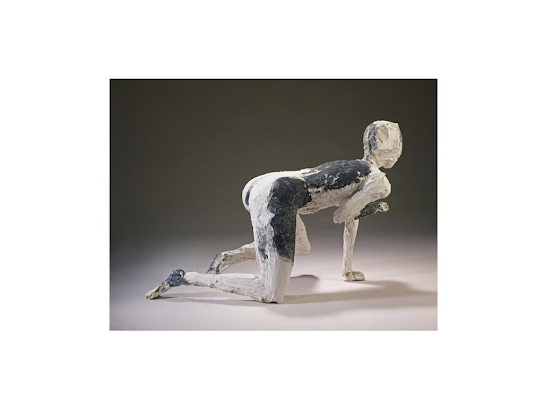
 My sculpture: 'HOMAGE TO DELIA'


'HOMAGE TO DELIA'   ...   by  Gene Vincent  2021

Sunday, 2 May 2021

 Geoffrey Boycott weighs in on the Detterling debacle


The cricket commentator and campaigner for women's rights and campaigner for the victims of domestic violence, Geoffrey Boycott, has issued the following statement:

'So Detterling has escaped into hiding. Let's not forget his wife Delia in all this. She is the one who has to stand her ground and take the flack. It's always the women who suffer.

If Margaret Thatcher was Prime Minister today Detterling would be behind bars by now.'

Geoffrey Boycott

Campaigner for women's rights 

and campaigner for the victims of domestic violence

Saturday, 1 May 2021


Politicizing the Eucharist

On April 14, America magazine, as part of its ongoing series, The Conversation with America Media, published an article by Archbishop Samuel Aquila: “For the church to live in eucharistic coherence, we must be willing to challenge Catholics persisting in grave sin.”

Archbishop Aquila argued that eucharistic coherence demands that those who partake of the Eucharist, including Catholic politicians, are to be in communion with the Church. That is, they must adhere to the Church’s fundamental doctrinal and moral teaching.  Not to do so would contravene St. Paul’s exhortation: “Whoever, therefore, eats the bread or drinks the cup of the Lord in an unworthy manner will be guilty of profaning the body and blood of the Lord. Let a man examine himself, and so eat of the bread and drink of the cup. For anyone who eats and drinks without discerning the body eats and drinks judgment upon himself.” (1 Cor 11:27-30)

Within a few hours after Archbishop Aquila’s article was published, Cardinal Blase Cupich wrote a letter to him criticizing his article. The Cardinal’s critique was in no way relevant to what Archbishop Aquila wrote, though it did allow him to fabricate a criticism whereby he could express his displeasure.  Nonetheless, the letter did serve a positive end, for it enabled the Archbishop to write a “clarification” to ward off any ambiguity concerning the point he was making.  In so doing, the Archbishop was able to develop his point even more strongly.

Now, the interchange between Archbishop Aquila and Cardinal Cupich is part of a larger discussion – that of offering Holy Communion to Catholic politicians even though it is well known that they approve and promote behavior contrary to the Church’s teaching, such as abortion, contraception, euthanasia, same-sex “marriage,” and various forms of gender ideology.

Some bishops argue that such Catholic politicians should not be refused Communion, for to do so would politicize the Eucharist.  The refusal on the part of bishops or priests would indeed cause a political and media fuss, and prudence may suggest, in certain circumstances, that Communion should not be refused.  An argument could easily be made, however, that refusal should be made so as to avoid scandal and protect the integrity of the sacrament.

To refuse to give Holy Communion to dissident Catholic politicians, however, is not to politicize the Eucharist.  The politicizing of the Eucharist occurs in the act of the Catholic politician presenting himself or herself to receive Communion even though he or she is well aware that to do so is contrary to what the Church teaches.  Those who are objectively in the state of mortal sin, or who dissent from or promote contrary positions to the Church’s fundamental dogmatic or moral teaching are forbidden to receive the body and blood of Jesus, for they have made themselves unworthy to do so.

Thus, such Catholic politicians, in presenting themselves, are using – and so abusing – the Eucharist for seemingly political purposes – to present themselves as “devout” Catholics.  Therein lies a threefold irony.

First, those who are unquestionably devout Catholics do not need to identify themselves as such – it is evident to all that they are.  Everyone knows that they believe and uphold, and even promote, all that the Church teaches.  When they sin against God’s commandments as taught by the Church, they go to Confession, resolve to amend their lives, and so obtain sacramental absolution.  Such Catholics are devout without needing to trumpet it.

*

Second, when a dissident politician declares that he or she is a devout Catholic, one immediately perceives that something is awry.  Catholic politicians emphasize their devotedness – and their supporters echo the declaration – because there is something about their behavior that is suspect.

Appearances notwithstanding, it is claimed, there’s no problem here.  While they may affirm and promote abortion, same-sex relationships, etc., they are, NONETHELESS, “devout” Catholics.  How do they manifest their devotedness?   They go to Communion!  Ironically, such Catholic politicians do the very thing that no truly devout Catholic would ever do.  The very “devout” action they perform, that of receiving Holy Communion, is an enacted declaration that they lack authentic Catholic devotion.

The third irony is that no one is fooled by this charade, except maybe the self-deluded politician.  Faithful Catholics know that there is an irreconcilable disconnect between what is being held by such Catholic politicians and their receiving Communion.  And they see that it’s the dissenting Catholic politician who is politicizing the Eucharist.

The motives behind such moves may vary. Politics itself is, to some degree, an essential motivation.  To be religious in America is still a good thing – it wins votes.  Votes are also won by holding and promoting non-Catholic policies.  Of course, these stances are contradictory, but then politicians are not known for consistency.

There may, nonetheless, be a deeper motivation.  Although one may uphold and promote what is contrary to the Catholic faith, deep down within one’s heart and mind there could be the inerasable belief that Jesus is the one Savior and that the Catholic Church is the one true Church.  To be “Catholic,” then, is essential to one’s salvation, for to receive Jesus in the Eucharist is to be truly in communion with he who saves.

Thus, one claims to be a devout Catholic and receives Communion in the hope that, somehow, someday, it will all work out. This comes dangerously close to a sentimental “Catholic” superstition – which is the most charitable interpretation of why dissident Catholic politicians insist on receiving Holy Communion.

What should most concern the Church is that such Catholic politicians do not simply hold many things that are in opposition to the Catholic faith, but they also actively attack, through the laws they propose and enact, the Catholic Church, the very church to which they claim devotion.

In the end, what cannot be denied in all this deception, is the work of the devil.  He, above all, wishes to politicize the Eucharist – to reduce it to political marketing. Nothing could be more deceptive than “devout” Catholic politicians wreaking havoc on the Catholic Church and Catholic bishops approving such devilish behavior.

The Catholic faithful must pray, therefore, not only for the conversion of so-called “devout Catholic” politicians, but also for the Lord’s protection of his Holy Church.


*Image: The Institution of the Eucharist by Ercole de’ Roberti, c. 1490s [National Gallery, London]