MISSION STATEMENT ... To celebrate where it's deserved! ... To take the Michael out of institutions and individuals where it's deserved! ...
Recently I had occasion to prepare my gravestone epitaph:
GENE...
Educator, Novelist,
Humanitarian and Humorist
- TO KNOW HIM WAS TO LOVE HIM -
Rest in Peace
....... But while I am still walking the earth do not hesitate to contact me at:
bobbyslingshot8@gmail.com
The Irish prime minister said doctors and nurses would be able to opt out but not publicly funded institutions
Ireland’s Taoiseach has said that hospitals with a Catholic ethos will be required to perform abortions after new legislation comes into effect.
Leo Varadkar told the Dáil that individual medics and healthcare workers will be able to opt out but that this opt-out will not extend to publicly funded hospitals.
Two of Dublin’s biggest hospitals are owned by religious orders. The St Vincent’s Healthcare Group, which includes St Vincent’s University Hospital, is owned by the Sisters of Charity, while the Sisters of Mary own the Mater Hospital.
The government is drafting legislation that will allow abortion on demand for up to 12 weeks of pregnancy and in certain cases up to 24 weeks.
Varadkar was responding to a question from the socialist Solidarity politician Mick Barry, who lamented that Ireland had “church-controlled schools, church-controlled hospitals … Ireland lags behind and the Government lags behind.”
Varadkar said: “It will not … be possible for publicly funded hospitals, no matter who their patron or owner is, to opt out of providing these necessary services which will be legal in this state once this legislation is passed by the Dáil and Seanad [senate].
“I’m happy to give you that assurance.”
He added: “That legislation will allow individuals to opt out based on their consciences or their religious convictions but will not allow institutions to do so.
“So, just as is the case now in the legislation for the Protection of Life During Pregnancy Act 2013, hospitals like for example Holles Street, which is a Catholic voluntary ethos hospital, the Mater, St Vincent’s and others will be required, and will be expected to, carry out any procedure that is legal in this state and that is the model we will follow.”
Major new venture in the offing... [updated] Many thanks all for your emails. I have decided to add a few more name suggestions - and to delete UXBRIDGE ÜBER ALLES. I like that name but I am fearful that it might attract unsavoury far right nutters.
Been
planning out something new and exciting with Tony of The Big Saloon. Tony will be taking early
retirement in 2020. We have discussed a joint venture - opening a coffee
bar in Uxbridge.
We
have even got as far as planning the name. Below are some suggestions. I
would be grateful if readers would email or post a comment of their
favourite from among these proposed names.
In a 7-2 vote, the Supreme Court ruled in favour of Masterpiece Cakeshop
In a 7-2 decision on June 4, the Supreme Court sided with a Colorado baker in a case that put anti-discrimination laws up against freedom of speech and freedom of religious expression.
Justice Anthony M. Kennedy, writing for the majority, said the Colorado Civil Rights Commission had violated the Constitution’s protection of religious freedom in its ruling against the baker, who refused to make a wedding cake for the same-sex couple.
Justices Ruth Bader Ginsburg and Sonia Sotomayor dissented.
Kennedy noted the case had a limited scope, writing that the issue “must await further elaboration.” Across the country, appeals in similar cases are pending, including another case at the Supreme Court from a florist who didn’t want to provide flowers for a same-sex wedding.
The ruling in Masterpiece Cakeshop v. Colorado Civil Rights Commission stems from the case argued before the court last December from an incident in 2012 when Charlie Craig and David Mullins asked the Colorado baker, Jack Phillips, to make a cake for their wedding reception. Phillips refused, saying his religious beliefs would not allow him to create a cake honouring their marriage.
The couple filed a complaint with the Colorado Civil Rights Commission, which decided the baker’s action violated state law. The decision was upheld by the Colorado Court of Appeals. The Colorado Supreme Court wouldn’t take the case, letting the ruling stand. The US Supreme Court agreed to hear the case.
During oral arguments at the high court, many questions came up about what constituted speech, since the baker claimed he should have freedom of speech protection.
The ruling’s opinion honed in on the argument of free speech and religious neutrality, saying the baker’s refusal was based on “sincere religious beliefs and convictions” and when the Colorado Civil Rights Commission considered this case, the court said, “it did not do so with the religious neutrality that the Constitution requires.”
The court opinion also noted the delicate balance at stake in this case, saying: “Our society has come to the recognition that gay persons and gay couples cannot be treated as social outcasts or as inferior in dignity and worth. For that reason, the laws and the Constitution can, and in some instances must, protect them in the exercise of their civil rights. The exercise of their freedom on terms equal to others must be given great weight and respect by the courts. At the same time, the religious and philosophical objections to gay marriage are protected views and in some instances protected forms of expression.”
But delving further, the court deemed the specific cake in question was an artistic creation, not just a baked good. It said, “If a baker refused to sell any goods or any cakes for gay weddings, that would be a different matter,” noting that the state would have a strong case that this would be a denial of goods and services going beyond protected rights of a baker.
Here, the court said the issue was the baker’s argument that he “had to use his artistic skills to make an expressive statement, a wedding endorsement in his own voice and of his own creation.”
The court opinion goes on to say that as Phillips’ contention “has a significant First Amendment speech component and implicates his deep and sincere religious beliefs. In this context, the baker likely found it difficult to find a line where the customers’ rights to goods and services became a demand for him to exercise the right of his own personal expression for their message, a message he could not express in a way consistent with his religious beliefs.”
The US Conference of Catholic Bishops filed a friend-of-the court brief in support of the baker, joined by the Colorado Catholic Conference, Catholic Bar Association, Catholic Medical Association, National Association of Catholic Nurses-USA and National Catholic Bioethics Center.
After oral arguments were presented late last year in this case, the chairmen of three USCCB committees issued a statement saying: “America has the ability to serve every person while making room for valid conscientious objection.”
The committees’ statement also said it hoped the court would continue to “preserve the ability of people to live out their faith in daily life, regardless of their occupation,” noting that artists “deserve to have the freedom to express ideas — or to decline to create certain messages — in accordance with their deeply held beliefs.”
The failed abortion survivor whose mum thought she was dead
Melissa Ohden: 'My mother tried to abort me
When Melissa Ohden was 14 she learned a shocking secret - her mother had tried to abort her. She was saved by a nurse who heard her crying as she lay among medical waste at a US hospital. This is the story of her survival, and of the mother who thought she was dead.
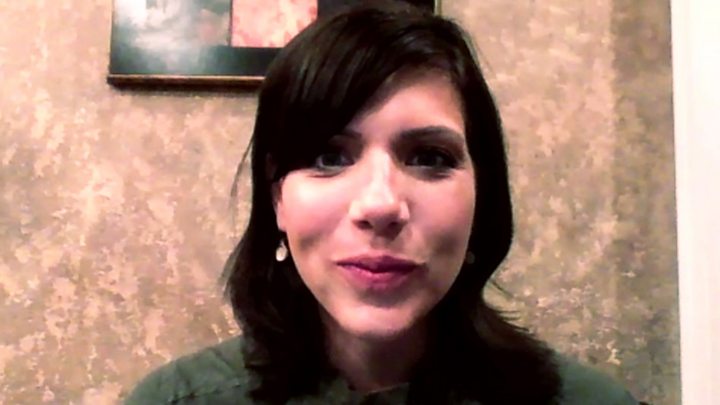
"I grew up knowing I'd been born prematurely, that I had been adopted," Melissa Ohden, now 41, tells the BBC's Victoria Derbyshire programme.
"What I didn't know was that there was this great secret behind all of this. That I should have been delivered dead, and instead I was born alive."
In 1977, in a hospital in the US state of Iowa, Melissa's 19-year-old mother had undergone an abortion using a toxic saline solution over five days.
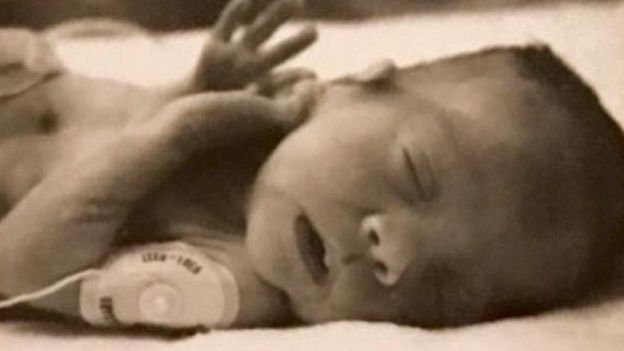
At eight months old and weighing less than three pounds (1.3kg), Melissa was placed among medical waste.
That was, until a nurse heard her weak cries and slight movements.
Melissa was rushed to an intensive care unit, where - against the odds - she survived.
Doctors thought she would be blind, and at one stage believed she had a fatal heart defect.
But she has gone on to live a perfectly healthy life, being brought up by an adoptive family.
"It is astonishing", Melissa admits. "I pinch myself some days."
Image copyrightMelissa OhdenImage caption Doctors thought Melissa would be left with long-lasting health problems Melissa - who has written a book about her experiences - says she only found out she was an abortion survivor when her sister in her adoptive family let it slip during an argument.
"You know Melissa, at least my biological parents wanted me," she had shouted, without thinking.
At first Melissa was confused, but as the realisation kicked in - and she sat down with her adoptive parents - it led to a downward spiral in her mental health.
"I turned my pain upon myself," she explains. "It was a lonely place.
"I developed an eating disorder, struggled with alcohol abuse. I didn't want to be me."
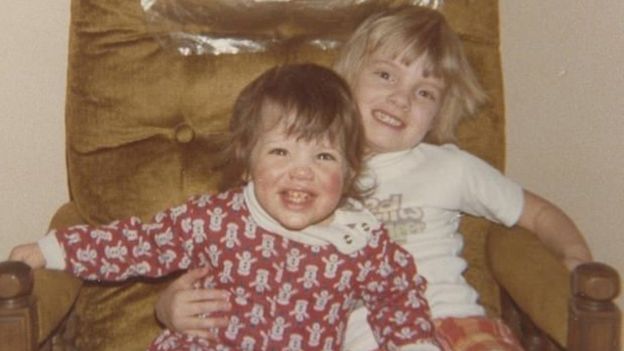
Image copyrightMELISSA oHDENImage caption Melissa with her sister The pain continued to build, until five years later - aged 19 - she took the bold decision to track down the mother who had aborted her.
It was a process that took more than a decade, but eventually she found her - and discovered a truth that shocked her.
"The biggest secret truly is that my birth mother had spent over 30 years of my life believing I had died that day at the hospital.
"She was not told I survived. It was kept a secret from her," she says.
"I was placed for adoption without her ever knowing.
"She never knew if it was a little boy or a little girl she had delivered."
It was for this reason that when the two first met face-to-face, three years after they had begun emailing, Melissa was most struck by the "regret" in her mother's eyes, which she says haunted her for some time.
She struggles to describe the moment they first met, but says "it was absolutely surreal.
"It was one of those defining moments of your life."
Image caption Melissa was a teenager when she discovered the truth But the shocks continued to come.
Her birth mother, Ruth, told her she had never wanted to have an abortion, and that she had been put in a position of feeling forced to go through with the termination.
"What I learned was my grandmother - her mother - was a prominent nurse in the community, and that the local abortionist was a friend of hers.
"Together they literally forced the abortion on my birth mother against her will.
"They were able to bypass the hospital regulations and procedures that my birth mother would have had to go through.
"So people at the hospital thought it was her choice, and she had no opportunity to fight back."
Melissa's survival had been even more unlikely as her grandmother, who worked at the hospital where she was born, had instructed her colleagues to "leave the baby in the room to die" that day - a fact she had openly admitted among family members.
"It's not been easy for me to live with," Melissa says, reflecting on her grandmother's comments. "But I'm not angry with her. We all make mistakes in this life. I don't hold that against her.
"My heart breaks for her," she continues, "because I will always wonder what it was in her life that made her take that decision on mine."
'One of the luckiest'
In fact, Melissa insists she is "one of the luckiest people in the world", to firstly have survived, and then to have both her adoptive parents and her birth mother in her life.
By complete chance, Melissa and her birth mother now live in Kansas City, as well as one of her half-sisters.
They see each other "as often as we possibly can", Melissa says, with joy.
"My biological family is a huge part of my life."
It means that having seen the regret in her mother's eyes on that first meeting two years ago, she now gets "to experience her joy".
This country of ours is no sand bank, thrown up by some recent caprice of earth. It is an ancient land, honoured in its archives of civilization, traceable into antiquity by its piety, its valour, and its sufferings. Every great Europen race has sent its stream to the river of Irish mind. Long wars, vast organizations, subtle codes, beacon crimes, leading virtues, and self-mighty men were here. If we live influenced by wind and sun and tree, and not by the passions and deeds of the past, we are a thriftless and a hopeless people. —Thomas Davis
Happy is the one who seizes your infants and dashes them against the rocks. — Psalm 137
On Thursday I had a strange sense that the day had the tenor of a Holy Saturday—a day lifted out of history. Except that here, history seemed to have gone into reverse: the Resurrection behind, Calvary in front. On Friday, the Irish people climbed Calvary backwards, in the name of progress.
If you would like to visit a place where the symptoms of the sickness of our time are found near their furthest limits, come to Ireland. Here you will see a civilization in freefall, seeking with every breath to deny the existence of a higher authority, a people that has now sentenced itself not to look upon the Cross of Christ lest it be haunted by His rage and sorrow.
Two out of three of those who voted—66.4 percent—said Yes to the removal of the right-to-life protection of the unborn child in the Irish Constitution. When you think of it in actual words, it is dizzying: just one in three voters—33.6 percent—wished this protection to continue. The world’s media called it a “landslide for abortion,” but before that it was a landslide for leaving the unborn child—every unborn child—defenseless against assault from outside. When you factor in the fact that roughly one in three of those entitled to vote did not do so (turnout was 64.1 percent), this unprecedented measure passed with approximately just 42.5 percent of the electorate voting for it. Only one constituency, Donegal in the Northwest, voted No, and this by a tight margin—51.87 percent for No; 48.13 percent for Yes.
For the first time in history, a nation has voted to strip the right to life from the unborn. The victims of this dreadful choice will be the most defenseless, those entirely without voice or words. This is the considered verdict of the Irish people, not—as elsewhere—an edict of the elites, imposed by parliamentary decree or judicial fiat. The Irish people are now the happy ones who dash their own children against the rocks.
Now that we have come to the end of a long and ugly battle, I can say that none of this surprises me. The tenor of the contest has been so nauseating that the deepest parts of my psyche had begun to anticipate this outcome. It was little things: the frivolity of the Yes side: “Run for Repeal”; “Spinning for Repeal”; “Walk your Dog for Repeal”; “Farmers for Yes”; “Grandparents for Repeal,” which ought to have been “Grandparents for Not Having Grandchildren.” This, like the same-sex marriage referendum in 2015, was a carnival referendum: Yessers chanting for Repeal, drinking to Repeal, grinning for the cameras as they went door-to-door on the canvass of death.
Today, Ireland dances on the graves of little children. It is a country where freedom means the right to do just about anything you please, without risk of consequences.
On the day of the vote, the media gave us a picture of our Taoiseach, Leo Varadkar, grinningly dropping his vote into a ballot box, over the headline: “All the lads in the gym are voting yes.”
It is the epitaph of the country I grew up in, the only one I had to call home, this ancient land, traceable into antiquity by its piety, its valor, and its sufferings. This fool we are obliged to call Taoiseach (Chieftain), this man without qualities—who entered the last election three short years ago as “pro-life”—has led my people into a hell beyond imagining.
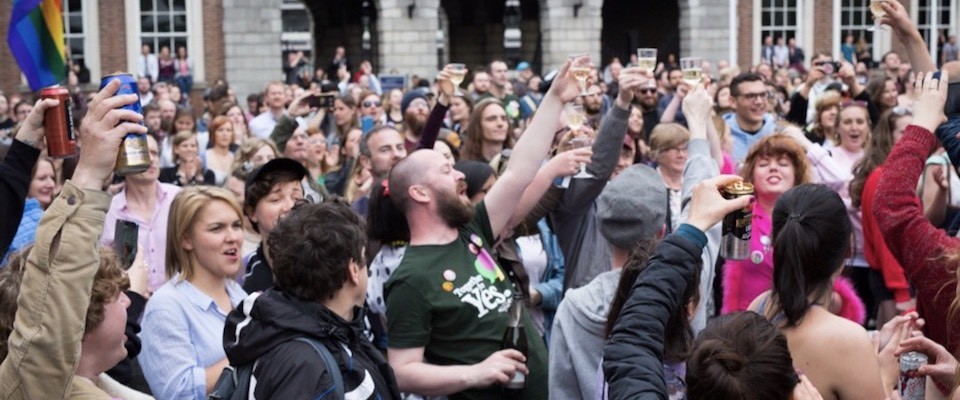
On Wednesday, two days from polling day, Varadkar, with his typical disingenuousness, called for no public celebrations if the vote turned out a Yes. But Saturday evening in the yard of Dublin Castle saw thousands of citizens dancing, cavorting, weeping, screaming—as they were entertained by the musical group Voices 4 Repeal. The leader of Sinn Fein, the political wing of the now disbanded Irish Republican Army, declared: “It’s been a long time coming. This is about women’s right. We deserve to celebrate.” When Varadkar and his health minister arrived, they were greeted by chants of their Christian names.
How did we get here? The spiritual reconstruction of Ireland that took place after the Famines of the 1840s placed mothers at its center: the moral instruments by which Irish families were to be brought back to the straight and narrow. Women were placed on a pedestal, their actions or demands immune from questioning by mere men. Add two dashes of feminism and you have an unassailable cultural force, which has now attained its apotheosis. “Trust women,” one of the many fatuous Yes slogans demanded. Trust women to kill their own children?
The cancer at the heart of modern Irish culture is unbelief in anything that is not negotiable in the manner of currency. But that was the diagnosis up until last Friday. May 25 will go down as the beginning of the final stage of the disintegration: the carting of the human in Ireland from the spiritual to the material level, with the country that was once the jewel in the crown of European Christianity affirming that a baby is the mere chattel of her mother.
The Church, with the exception of a sprinkling of pastorals, was tactically absent. This reticence is understandable in respect of the public realm: The leveraging of antipathy towards Catholicism is a core element of the pro-abortion strategy. What was unforgivable was that this silence extended to pulpits. The Association of Catholic Priests, a kind of theo-ideological trade union, intervened to criticize a minor trend of pro-lifers delivering homilies during Masses.
For years, people abroad have teased me about the Island of Saints and Scholars, asking when we’re going to send them more monks. Usually they’re only half joking, the scale of Ireland’s disintegration being by no means fully understood beyond her shores. It falls to me to disabuse them of their romantic ideas about my country. Friday last should at least have the benefit of henceforth saving me that trouble.
In his book How the Irish Saved Civilization, Thomas Cahill writes that “the Irish, who were just learning to read and write, took up the great labor of copying all of western literature,” thus becoming the “conduits through which the Greco-Roman and Judeo-Christian cultures were transmitted to the tribes of Europe, newly settled amid the rubble and ruined vineyards of the civilisation they had overwhelmed.” He praises the monks “who single-handedly re-founded European civilisation.”
This is the Ireland of popular imagining. We now know it to be a legend long past its use-by date. The Irish of today are more likely to be among the looters and book-burners, the barbarians who value nothing but what is expedient. Indeed, on May 25, Ireland might be said to have put a match to one of its own most sacred texts, Bunreacht na hÉireann, the Irish Constitution, of which the fateful Article 40.3.3, which recognized “the right to life of the unborn, … with due regard to the equal right to life of the mother,” will soon be replaced by a fundamental right to kill any unborn child whose mother demands it. We now lead those razing the remnants of a Christian civilization that treasured the weak into the sandy ground. John Waters is an Irish writer and commentator, the author of nine books, and a playwright.
Daniel McArthur and his wife Amy McArthur of Ashers Bakery arrive outside the Supreme Court sitting in Belfast (Getty Images)
Later this year the Supreme Court will reveal its judgment on the Ashers saga. It will have far-reaching consequences
A simple but important religious freedom case has reached the Supreme Court. Ashers, a bakery in Belfast, appealed against a £500 damages award under British and European Union laws for discrimination on sexual orientation grounds. Its owners, who are devout Presbyterians, had declined to provide a cake decorated with the words “Support Gay Marriage” to an activist wishing to celebrate Northern Ireland Anti-homophobic Week.
The main legal argument turned on whether refusing to reproduce a pro-gay message desired by a gay activist discriminated against the latter if the bakery would have refused to provide it for anyone, straight or gay; and if so, whether this compromised freedom of speech or religion as defined by the European Convention on Human Rights.
We expect a result later this year. But despite the beguiling Ulster tones of barrister David Scoffield QC on behalf of the bakery (which you can catch on the Supreme Court’s website), this is not the most interesting feature of the affair. The moral and social stakes are, in fact, higher.
Upholding the decision, and thereby restricting protection of conscience to the limited exceptions state law provides (for example, in abortion), has wide implications for religion generally, affecting Catholics as much as Presbyterians. In order to avoid suit for religious discrimination, for instance, a Catholic religious printer could presumably not refuse to produce a book of Muslim apologetics, or a Catholic screen-printer a T-shirt promoting Richard Dawkins’s The God Delusion.
More importantly, this case raises in unusually stark form the issue of how the law ought to treat individual conscience. The Catholic answer is clear. The legitimacy of the state’s call for obedience depends on its respect in return for the need for individuals to be guided by their own conscience, at least where that conscience is not opposed to morality or Church teaching. Requiring people to do or say something contrary to that conscience is unacceptable.
Unfortunately, most discrimination lawyers – and discrimination law is an area where secularism is even more in evidence than elsewhere – say exactly the opposite. Conscience for them is opposed to, and needs to be mistrusted by, the state.
As the original judge in the present case revealingly put it, she found the bakery’s plea an unacceptable attempt to “allow a religious belief to dictate what the law is”.
Furthermore, we see in the Ashers saga a bleak contrast between two different views of equality and non-discrimination. For Catholics equality is, as the Catechism makes clear, a means to the good in the form of a recognition of our common creation in the image of God. Conversely, the objection to discrimination against anyone – black, gay or whatever – is that it amounts to a denial of it. Viewed as such, there is no need for any religious or conscientious exception: it is self-evident that by refusing a person’s request to do or say something contrary to revealed truth, we are affirming, not denying, his ability to follow the dictates of right conscience.
By contrast, the predominant secular view, much in evidence in the Ashers decision so far (and shared by most legal and EU commentators), is essentially amoral and egoistic. Everybody must be given an identical right to choose how to satisfy his desires. A third party who denies this, or who refuses to do for one person what he would have done for another, ipso facto infringes that right. As for religion and conscience, these are seen as antagonistic to equality. They are accommodated in grudging exceptions, to be grudgingly applied.
But what of Ashers Bakery? A legal decision in its favour would obviously be welcome. But it would leave the broad question of conscience hanging.
If the decision goes against Ashers, any hope must lie in legislation.
Two proposals have already appeared. An initiative in Northern Ireland from the Democratic Unionist Party’s Paul Givan, which Catholics should consider supporting, would overtly allow genuine religious conscience to be weighed in the balance in discrimination claims of this sort. Unfortunately, however, the other parties in Northern Ireland have, to their discredit, opposed this root and branch.
Alternatively, there was an interesting proposal, floated in this magazine in 2015 by John Duddington, to have discrimination law require parties to make reasonable adjustments to take account of religious sensibilities. That proposal applied to employers. But there is no reason why the same thing should not be required of claimants, by providing for a defence to any discrimination claim insofar as the claimant failed to make reasonable adjustment for matters of conscience (for example, in the Ashers case by not insisting on an inscription after he knew of the bakery’s religious scruples).
There is little doubt that there is much public sympathy for Ashers Bakery. Quiet pressure added to prayer may be surprisingly effective.
Andrew Tettenborn is a professor of commercial law at Swansea University
This article first appeared in the June 1st 2018 issue of the Catholic Herald. To read the magazine in full, from anywhere in the world, go here




:format(jpeg):mode_rgb():quality(90)/discogs-images/A-56830-1395652336-8246.jpeg.jpg)