Monday, 26 April 2021


In his recently translated essay Theses Towards a Trinitarian Ontology, Klaus Hemmerle (1929–1994) writes that Christian theology has long been an “almost unnoticed” guest at the feast of philosophy. Theologians have always had ontological interests and have sometimes made creative contributions to the study of ontology, but they’ve often depended on premises borrowed from non-Christian systems. As a result, Christianity hasn’t shaped ontology as a whole or thoroughly reconceived ontology on a distinctively Christian basis. With modern philosophy in disarray, Hemmerle argues, it’s a propitious time for Christianity to take “a leading or epoch-making role in thinking.” That is the ambitious aim of his brief, programmatic essay, first written in 1975 as “an extended birthday card” to Hans Urs von Balthasar.

“Ontology” sounds forbidding, but what Hemmerle has in mind is fairly straightforward. A Christian ontology asks, “In what way are the fundamental human experiences and fundamental understandings of God, the world, and human beings altered when faith in Jesus Christ breaks in upon them?” Suppose the gospel is true. How does that good news affect our beliefs about who God is, what kind of world we live in, and what human life is all about?

In a move reminiscent of Karl Barth, Hemmerle begins by reflecting on revelation. God’s word precedes human words, since he creates speaking beings by his word. Yet God’s word also follows human words. If God wants to make himself known to human beings, he must speak humanly. By speaking our language, the God who spoke first humbles himself, takes second place, and even allows his word to be mangled and distorted. But God’s word couldn’t reach its hearers at all without passing through this humiliation. God’s word communicates—God’s word is God’s word—only as it passes through a process of “both relinquishment and elevation.”

The form of revelation unveils its content. A God who humbles and elevates himself in revelation is a God who glorifies himself in humility, a God “identical with Himself in going beyond Himself, in giving away.” The self-revealing God is a God of self-giving love. God gives himself to us in his Son, and this self-gift isn’t a mere role God happens to play. His self-gift reveals the eternal life and being of God as Father, Son, and Spirit. In the light of this disclosure, we discern that self-gift is the basic reality of everything else, too: “Everything fulfills itself and brings that which is its ownmost to perfection by entering into its relatedness, into its being-beyond itself, into its self-having as self-giving, into its character as to and for each other.”

Thus, from the viewpoint of Trinitarian ontology, Being itself has to be reimagined. Ancient ontology assumed that Being is what persists in a world of change. Trinitarian ontology insists instead on the primacy of love; love endures. Love is action, an out-going from the self to the Other. Within a Trinitarian ontology, the verb becomes the “new substantive.” Things aren’t most fully themselves when they’re at rest, unchanging, alone. Being isn’t isolated stasis. Beings exist and fulfill themselves not by holding back, but by giving. For created things as for God, “self-having [is] self-giving.” Things are what they are, they possess themselves, in action, in motion, and in relation, in the movement of love. Love is the very “rhythm of Being.”

That rhythm is triple. Language provides an apt illustration. Language exists only in the action of communicating, and communication is a process with a triple origin: The speaker initiates speech and is responsible for it, yet he couldn’t speak without language and he wouldn’t speak unless there were a listener to hear and respond. The “poles” of speaker, language, and listener don’t exist at all outside their mutual relationships in the process of conversation. Speakers don’t exist independently of the language they speak and the hearers they address, nor does language exist without speakers and hearers, nor hearers without speakers speaking language. Yet the poles don’t collapse into each other. Speaker, language, and listener remain distinct.

Hemmerle discovers the same triadic structure in play: I am fulfilled as a player by playing, but I can’t play without a game and other players. Relationship and process aren’t eddies on the surface of an immutable underlying substance. In a Trinitarian ontology, process and relationship go all the way down and all the way up, because God himself is the original rhythm of eternal love.

Within a Trinitarian ontology, Hemmerle argues, some perennial dilemmas of philosophy can be dissolved or resolved. Take the opposition of inner and outer, a fundamental crux at least since Descartes. How does the inner mind connect with the world outside? If being is the rhythm of self-giving love, the dichotomy disappears. Mind comes to its perfection as mind not by isolating itself but by reaching beyond itself into the external world and accepting the outer world into itself. In the happening that is the rhythm of being, the seemingly polar opposites of inner and outer are in a mutually dependent relationship, yet without being absorbed into each other. 

Trinitarian ontology teaches that creation dances to the same rhythm as the Triune communion of persons. But Hemmerle emphasizes that he’s not suggesting we could arrive at Trinitarian insights from a purely immanent investigation of creation. The Trinitarian shape of reality is revealed, and it can be seen only by those who enter into the rhythm. A Trinitarian ontology of love implies an epistemology of love, for reality is known only to lovers.

Peter J. Leithart is president of the Theopolis Institute.

First Things depends on its subscribers and supporters. Join the conversation and make a contribution today.

Click here to make a donation.

Click here to subscribe to First Things.


Is the President Catholic?

Voters understandably doubt Biden’s Catholic convictions

April 20, 2021 | 6:59 am
devout

Written by:

Damian Thompson


Statistics released by Pew Research illustrate the extent to which the religious faith of President Joe Biden, a practicing Catholic, is a source of profound division between Democrats and Republicans.

To quote Pew: ‘Nearly nine in 10 Democrats (88 percent) says that Joe Biden is at least “somewhat” religious; just 36 percent of Republicans agree.’ On the face of it, the Democrats are right. This is a man who attends Mass every Sunday, and whose faith has helped him through the unthinkable tragedy of losing his young first wife and one-year-old daughter when their car was hit by a tractor in 1972.

Biden’s surviving son, Beau, was injured but survived; he died from a brain tumor, aged 46, in 2015. Biden mentions his Catholic faith often enough for the average Republican to know about it. So how do we explain that 63 percent of them think he’s either ‘not too religious’ or ‘not religious at all’?

Tal Kopan, Washington correspondent of the San Francisco Chronicle, popped up on Twitter to say: ‘This is fascinating — Biden goes to church every week and is known to be a devout Catholic.’ The word ‘devout’ is the sticking point here. In media parlance, Catholics are devout and Protestants are staunch.

Since Biden took office, however, ‘devout Catholic’ has become a political shibboleth. For liberal media commentators, it’s a vocal genuflection to the President. But for many Republicans and traditional Catholics — and the overlap between the two is huge — it’s accompanied by eye-rolling or a snicker. Devout Joe Biden? Give me a break.

The truth is complicated and awkward. Biden may indeed be devout, depending on what you mean by the word. In 2015, shortly after his son died, the then-vice president appeared on The Late Show with Stephen Colbert, another Catholic, and quoted Kierkegaard: ‘Faith sees best in the dark.’

He said Catholicism gave him ‘an enormous sense of solace…I go to Mass and I’m able to be alone. I say the rosary. I find it be incredibly comforting.’ And then, as his host expressed sympathy, he gracefully turned the tables and reminded the audience that as, as a boy of 10, Stephen Colbert lost his father and two brothers in a plane crash.

I remember watching the interview at the time and thinking: this is not faked. And what a shame that Biden is too old to be president. I knew that he dissented from Catholic teaching on abortion, but it wasn’t hard to put that thought to the back of my mind.

So it was disturbing to realize, during the 2020 campaign, that Joe Biden didn’t just have the conventional liberal Catholic reservations about banning very early abortions, or those when the mother’s life is at stake. He now takes an extreme pro-choice position: abortion on demand, at any stage, for any reason whatsoever.

Not only that, but as president he intends to wipe out the First Amendment rights of pro-life Christians who refuse to participate in or cooperate with the provision of abortion. And other ‘conscience rights’ of religious believers are also threatened. This is the deal that Biden signed in order to get the nomination.

From an orthodox Catholic point of view, President Biden’s views on the sanctity of life are repellent. Moreover, conservative-leaning people of faith generally feel that his administration is coming after them with un-American zeal (though perhaps you can hear echoes of colonial New England in the Democrats’ passion for witch-hunting). These days, conventional churchgoers across the Catholic-Protestant divide tend to vote Republican, and many Republicans identify strongly with America’s Christian heritage, albeit often from the comfort of their beds on Sunday mornings.

Biden, for them, is the unlikely, grandfatherly figurehead for the cold-hearted secularism of his Vice President, Kamala Harris, and the campus thought police who lionize her. This conservative anger, tinged with confusion, is what’s showing up in these Pew statistics. If Biden is telling his rosary beads with one hand while signing away the conscience rights of Christians with the other, then they’re damned if they’re going to tell a pollster he’s religious.

Even if he is. Here’s the thing. You can hold devoutly to your personal faith. You can also be a Catholic, which Biden certainly is. But are you therefore a ‘devout Catholic’? Beware of false syllogisms. Last time I checked — and under this pontificate, you do have to keep checking — there were no devout Catholics who advocated abortion up to birth; only very bad ones.

By Damian Thompson

Damian Thompson is an associate editor of The Spectator


Post office scandal: Ex-boss quits director jobs after scandal. She is also stopping her duties as an ordained Church of England minister!


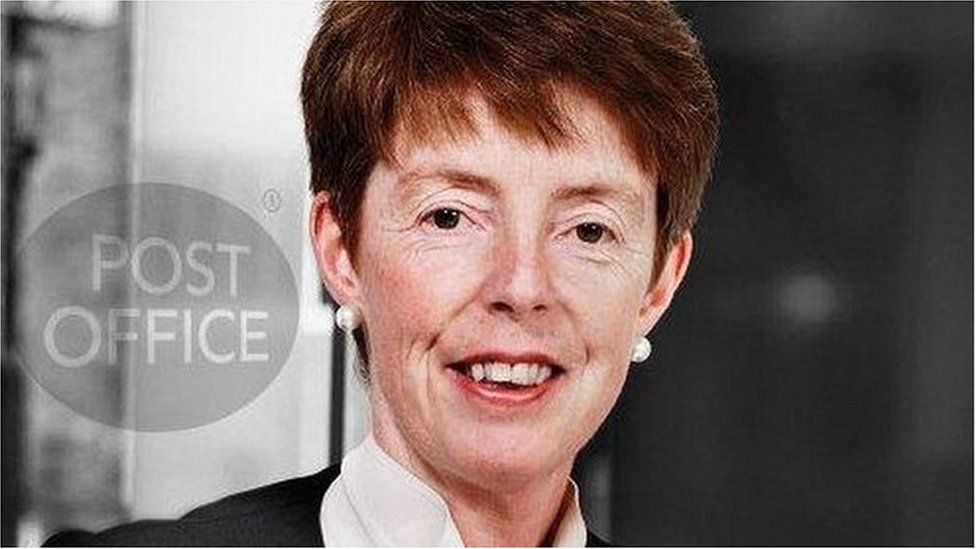
Paula VennellsIMAGE COPYRIGHTPOST OFFICE

The former chief executive of the Post Office has quit her roles on the boards of Morrisons and Dunelm following the IT scandal which led to the wrongful convictions of former postmasters.

The supermarket announced Paula Vennells would leave after serving as a non-executive director since 2016.

She is also relinquishing her non-executive position at home furnishing retailer Dunelm with immediate effect.

She is also stopping her duties as an ordained Church of England minister.

Ms Vennells was chief executive of the Post Office between 2012 and 2019.

On Friday, 39 former Post Office workers saw their criminal convictions overturned by the Court of Appeal.

They were based on the flawed software system Horizon which showed shortfalls in their accounts where they did not exist. The IT system was installed in 1999 under former chief executive John Roberts.

Other appeals are expected to follow in what is the most widespread miscarriage of justice in the UK's history.

Dunelm's chairman Andy Harrison said: "We respect Paula's decision to step down from the Board and I would like to thank her for the positive contribution she has made to the business since her appointment in September 2019."

The chairman of Morrisons, Andrew Higginson, said: "Paula has been an insightful, effective and hardworking non-executive director, and, on behalf of the Board, I want to thank her for her significant contribution over the last five years."

More than 700 people were wrongly convicted of offences of theft, fraud and false accounting, in prosecutions between 2000 and 2014, and some of them were imprisoned.

Questions had being raised about the behaviour of Post Office directors during this time, and Ms Vennells faced calls to have her bonuses clawed back and be stripped of her CBE title, which had been given for "services to the Post Office and to charity".

'Truly sorry'

In a statement issued on Sunday evening, Ms Vennells, an associate Anglican minister in Bromham, Oakley and Stagsden, Bedfordshire, said she would be stepping back from her "regular parochial duties".

Ms Vennells said: "It is obvious that my involvement with the Post Office has become a distraction from the good work undertaken in the Diocese of St Albans and in the parishes I serve.

"I have therefore stepped back with immediate effect from regular parish ministry, and intend to focus fully on working with the ongoing government inquiry to ensure the affected subpostmasters and wider public get the answers they deserve."

She said she had informed the Bishop of St Albans of her decision and was "truly sorry" for the "suffering" caused to the sub-postmasters who had their convictions overturned.

The Bishop of St Albans, the Right Reverend Dr Alan Smith, said that his father had been a sub postmaster, adding: " I express my distress at the miscarriage of justice that so many sub-postmasters have suffered."

He said: "I am aware that there are still legal processes and inquiries to take place during which it is right that Ms Vennells stands back from public ministry."

On Friday, Ms Vennells said she was fully supporting the government's inquiry and that it would be "inappropriate" to comment further while it was ongoing.

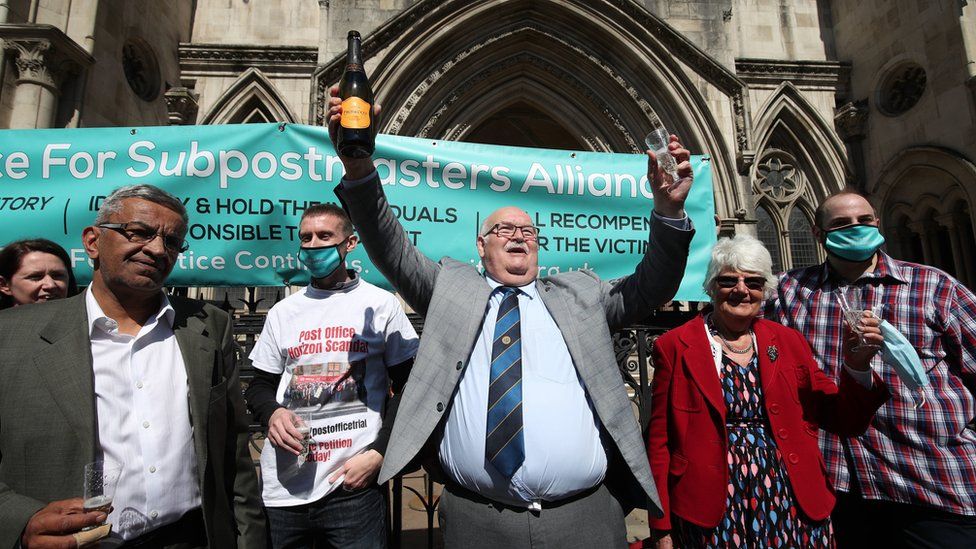
Tom Hedges (centre)IMAGE COPYRIGHTPA MEDIA
image captionTom Hedges (centre) was one 39 former postmasters celebrating as their convictions were quashed on Friday

The Horizon IT system, installed by the Post Office in branches across the UK, was flawed from the start.

At the Court of Appeal on Friday, Lord Justice Holroyde said the Post Office "knew there were serious issues" and had a "clear duty to investigate".

But the Post Office "consistently asserted that Horizon was robust and reliable" and "effectively steamrolled over any sub-postmaster who sought to challenge its accuracy".

Those affected have long called for a judge-led, full, public inquiry, rather than the government's own inquiry which is set to report in the summer.

The Criminal Cases Review Commission, which investigates potential miscarriages of justice, is reviewing another 22 cases.

There were more than 700 prosecutions based on Horizon evidence. The commission and the Post Office are asking anyone else who believes their conviction to be unsafe to come forward.

Sunday, 25 April 2021


The pews are alive: U.S. Catholic readers on parish music

IN THE PEWS

KIRA DAULT

Published March 17, 2014

Whether the sound of music has them singing to the mountains or running for the hills, U.S. Catholic  readers agree that Mass to the sounds of silence would just be flat.

St. Augustine said that singing is praying twice, but for every angelic voice that touches our hearts there’s sure to be an off-key crooner who only hurts our ears. With the wide variety of musical genres present in American parishes today, you never know whether the sounds reverberating through the pews will inspire people to lift their voices or to simply head for the exit. While some are thrilled with electric guitars amping up Mass, the same tunes leave others feeling caught between a rock song and a hard place. Praise bands in some parishes get parishioners clapping their hands and swaying to the beat, yet others wish they’d just beat it. U.S. Catholic readers have heard it all before, and like most churchgoers, they find that one parishioner’s song of joy is another’s dreadful noise.

Eighty percent of the more than 750 readers who responded to a U.S. Catholic reader survey claimed that the music at Mass was very important to them, but only 13 percent said that they thought the current state of liturgical music was “wonderful.” Jean Gibbs of Ashburn, Virginia says, “Music is very important to me in my worship. But that form of worship has to happen outside of Mass because of the weird stuff we sing there.”

Patti DeWitt of Buffalo, New York emphasizes that music at Mass is only good insofar as it really becomes a part of the service, not something set apart: “Music at liturgy can and should be part and parcel of the prayer.”

“Music is only one element of a liturgical celebration,” agrees Suzanne Harris of Spokane, Washington. “I believe it is important and, when done well, can truly enhance the worship experience. But if it becomes the emphasis and focus of the celebration, something is out of order.”

Many people commented that the music is especially distracting when it is too loud. James Swagzdis of Holland, Pennsylvania particularly objects to “modern-day overamplification and enough percussion to shatter stained glass windows.”

He’s not the only one who thinks that modern music falls flat. Karen Karn of Plymouth, Minnesota says that in her parish, “The teen band often sings pieces that I think are frankly unsingable.”

“There was a lot of jiving and clapping,” says Linda Kelley of Greenbelt, Maryland, describing her experience of hearing gospel rock during Mass. “I ended up with the worst headache and couldn’t wait to get out.”

Not everyone objects strongly—or even at all—to modern music at Mass, however. Many readers find contemporary music to be more accessible, and if their parish does not provide it, they yearn for a little more zest. Joe and Kate Gile from Ellsworth, Maine can’t stand “the really old-fashioned pre-20th-century somber, formal music.” Mary Janowak of Brookfield, Wisconsin, even goes so far as to ask for “a little less liturgical correctness and a lot more spirit.”

In fact, more than half of survey respondents think that contemporary songs written since Vatican II have tremendously improved the quality of liturgical music. Bradley Leger of Estherwood, Louisiana says he’s not a fan of  “old hymns which have an outdated or inappropriate spirituality, especially if they are disjointed with the scriptural readings and the liturgical season.”

“I really favor contemporary liturgical music, as well as music from the folk music era, such as the St. Louis Jesuits,” says Daniel Gandert of Chicago. “I am fine with parishes having Masses with more traditional music, as long as they also have a Mass with more contemporary liturgical music. I feel that music directors who use primarily traditional music should use contemporary liturgical music at least some of the time.”

The dissonance is not only about contemporary versus traditional music, however. Only 19 percent of U.S. Catholic reader survey respondents find that at their parish the congregation sings with gusto. Fifty-three percent say that people sing occasionally with 10 percent reporting no singing at all. Some readers, like Franklyn Busby of Charleston, South Carolina, think that the culprit is “not because they are bad songs, but because they are often bad theology and doctrine.”

There are a few people, however, who accept no such excuse. More than a quarter of readers who took the survey think that everyone in the congregation should sing every song. “Mass is public prayer,” says Bob Brady of Gaithersburg, Maryland. “There is no time for private prayer during Mass. Each person should unite themselves with the congregation by singing.” But try telling that to Henry Bailey of Winthrop, Massachusetts, who admits, “While I agree in principle [that the congregation should sing], I don’t sing at all and I’m not about to start.”

In addition to thinking that people should be singing, many readers just enjoy singing during Mass because it helps them feel united with the congregation, even when they feel they don’t have the best singing voice. “My previous parish had the people in the pews only listening to the choir as they performed,” says Ginny Garza of Cincinnati. “I like to sing even though I don’t have the best voice in the world.” In fact, 85 percent of readers claim that their singing voice does not keep them from belting out a tune. Charles Wolf of Altoona, Pennsylvania says, “I was raised a Methodist. The expectation was to sing. The quality of one’s voice was not as important as the effort.”

Some respondents think that bad or poorly executed music just does not measure up. It not only discourages people from singing, but detracts from the purpose of the Mass. Cathy Stepanek of Minneapolis says, “Cringe! It distracts too much from the liturgy. No music would be better so it wouldn’t distract from a prayerful experience.”

Still others note that some services have too much singing, regardless of the quality. “If anything, it takes away from the Mass,” says Denis Nolan of Daly City, California. “Our priests sing many parts and it all blends together so that there are days when I don’t know if we’ve had the consecration yet.”

Quite a few people, while insisting that music is important to the liturgical experience, also felt that it was important to distinguish between Mass and a performance. After all, Mass is not the time or place to audition for American Idol. Thirty-one percent think that applause following a musical performance at Mass is never appropriate. Says Cindy Engler of St. Louis Park, Minnesota, “The reverence of the passion of Jesus is more important than show business.”

Some readers revealed that their parishes had attempted various types of music during Mass that were not in tune with the desires of the parishioners. “I don’t want either a square dance or polka Mass,” says Robert Mallinger of Clinton, Iowa. “If I wanted to stomp my feet and dance, I would find a dance hall. I come to Mass to pray and communicate with God through the Holy Spirit in the sacrament made possible by Jesus Christ. I don’t come to be entertained by wannabe country and western stars.”

Most people are generally happy with the music at their own parishes, and many have been moved by the music. Tom Zimmer of Sussex, Washington says that his most powerful musical experience was “singing with a choir from a homeless shelter and standing in awe of the bass section.” For some readers, the music connects them with a particular event, like James Reinke of Duluth, Minnesota who remembers “the funeral for a dear elderly friend—singing ‘When the Saints Go Marching In’ as the congregation prepared to go out to the cemetery.” Sometimes, though, the powerful music is just another hymn sung at Mass. For Maureen Sheehan of Lynden, Washington, “Hearing the hymn ‘Here I am, Lord’ covers exactly what I want to say at Mass.”

At the end of the day though, most people feel that the music is necessary as a complement to the prayer and contemplation of the liturgy. So while different parishes do music differently, the important thing is to do music that works for that community. Elizabeth Begley of Suffern, New York says, “The primary focus needs to be the community celebration of the liturgy—anything that complements that is fine with me.” As Glen McCoy from Winter Springs, Florida, puts it, “We are indeed one body, and I love a Mass that has something for everyone, every age, every taste, and every spirituality.”

And the survey says…

1. As a person in the pew, I would judge the state of liturgical music to currently be:

44% – Pretty decent.
26% – Not so great.
13% – Wonderful.
10% – Dreadful.
7% – Other

2. The music is a very important part of my experience at Mass.

80% – Agree
14% – Disagree
6% – Other

3. My parish has:

77% – An adult choir.
53% – Soloists.
37% – A children’s choir.
22% – A youth choir.
15% – Other

Representative of “other”:
“A contemporary praise band and an orchestra, and other special music on feast days.”

4. I think every single song at Mass should be sung by the congregation—there should be no “just listening” to choir or solo performances of music
at Mass. 

27% – Agree
60% – Disagree  
13% – Other

Representative of “other”:
“Just listening can make for a nice reflection, especially at communion. But it carries with it the risk of becoming a performance, especially at the offertory.”

5. The type of music that is most appropriate for inclusion in the Mass is:

71% – Piano and other instruments with a small group leading the congregation.
63% – Organ music with a cantor leading the congregation.
61% – A formal choir that might perform a song or two on its own and otherwise sings with the congregation.
56% – Classical music.
55% – Latin songs such as Panis Angelicus.
35% – Electric guitars with drums.

6. I think clapping after a musical performance at Mass:

47% – Is not ideal but is understandable sometimes.
31% – Is not appropriate ever because we are not at a performance.
17% – Is a great way to show appreciation.
5% – Other

7. The contemporary songs written since Vatican II have tremendously improved the quality of liturgical music.

52% – Agree  
28% – Disagree
21% – Other

Representative of “other”:
“Some contemporary music is good. Some is not.”

This article appeared in the March 2014 issue of U.S. Catholic (Vol. 79, No. 3, pages 26-29).

Kira Dault

Kira Dault is a former associate editor at U.S. Catholic.