Thursday, 11 July 2024


Recent discovery in Auschwitz speaks volumes

Auschwitz prioners malnourished WWII
Sarah Robsdottir - published on 07/11/24"There's one last human freedom," a survivor of the most infamous Nazi concentration camp of WWII explains, "and it cannot be taken away ..."

This year's renovations in one of the prisoners' barracks at the Auschwitz Concentration Camp in Poland has revealed a startling discovery. Upon pulling back the floorboards, 30 handmade chess pieces drawn on squares of cardboard were found in surprisingly good condition, despite being over 80 years old.

Auschwitz hand-drawn chess pieces
Hand-made chess pieces drawn on cardboard.

"Several drawings may be a bit blurry," Elzbieta Cajzer, the Museum's Director explained in a press release on the Auschwitz Museum's website, "but the images of rooks, pawns, bishops, and knights are still easily distinguishable."

The incomplete chess set has been carefully conserved and will eventually be a part of the museum's permanent display. Cajzer also commented on the fact that the chess pieces were obviously designed to be hidden quickly, as such items of leisure were strictly forbidden in the camp where over 1.3 million people were subject to torture, starvation, and unfathomable cruelty during the primarily Jewish genocide known as the Holocaust that took place across eastern Europe during WWII between 1941 and 1945; 1.1 million of these Auschwitz prisoners were murdered, mostly in the camp's gas chambers. An estimated 11 million people were killed in the Holocaust in total. 

Auschwitz hand-drawn chess pieces

Information on the museum's website further describes how contraband chess and card games were popular among the inmates because they provided a powerful source of mental respite in a place of abject suffering, but anyone found in possession of such items would be subject to severe brutality, even death. For this reason, the discovery of these chess pieces speaks volumes about the prisoners who were brave enough to create and hide them.

To choose one's own way

Viktor Frankl, a well-known psychologist, philosopher and Auschwitz' survivor, once said: "Everything can be taken from a man but one thing: the last of the human freedoms -- to choose one's attitude in any given set of circumstances -- to choose one's own way."

The prisoners who risked their lives to play chess in secret must have painstakingly chosen bravery over terror and valued human connection over stark isolation.

Their courage and Frankl's sentiment bring to mind several of the Catholic heroes who perished in Auschwitz, as in addition to Jews, many other "enemies" of the Nazi state were sent there as well.

St. Maximillion Kolbe was executed in the camp when he begged to trade his own life for another man who was being put to death.

St. Edith Stein, a philosopher and convert from Judaism, died along with her sister in the camp's gas chamber, but not before she risked her life to minister to fellow inmates. According to eyewitnessesshe was "a beacon of light," spreading peace, hugging terrified women, praying with them calmly, and helping them care for young children.

Auschwitz hand-drawn chess pieces

There are countless other examples of Holocaust victims and survivors who refused to compromise their God-given human dignity in the face of one of the greatest atrocities of the last century -- from Anne Frank to Corrie Ten Boom. And now we can add to this list the creators of a newly revealed chess set, even though we don't know their names or stories. But we can imagine them defying tyranny -- smiling at one another in the middle of the night, their chess board lit by a slanted beam of gauzy moonlight. The winner mouths "checkmate," then discreetly pumps his fist in the air. 

The scenario is profoundly inspiring so many generations later, challenging us to defy tyrannies in our own lives -- whether it be a crushing sense of self-doubt, fear of the future, or an oppressive situation at home or work. Above all, the hand-drawn chess pieces speak through the ages, encouraging us to take control of the only thing we can always determine in any given circumstance -- our attitude


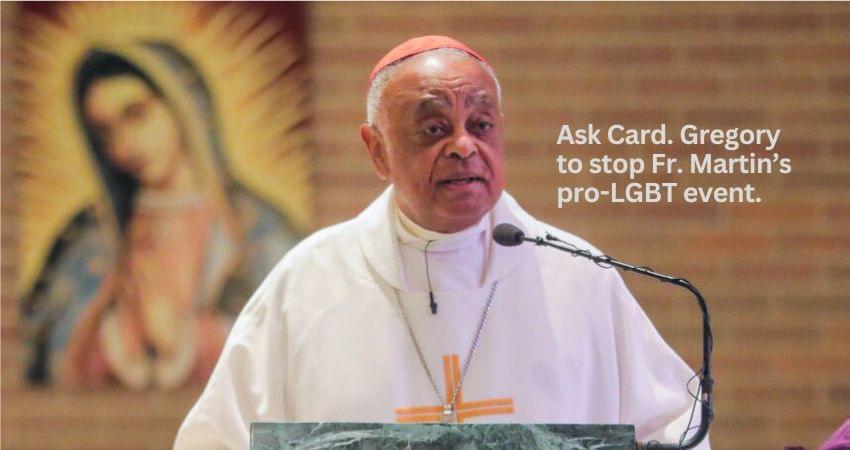
 Protest Fr. James Martin’s Pro-LGBT Summit on Catholic Campus

  • July 09, 2024
SHARE THIS PETITION 

Join faithful Catholics in this prayerful protest to oppose Fr. James Martin’s summit titled “Outreach 2024: LGBT Catholic Ministry Conference” at Georgetown University on August 2-4, 2024.

Not only does Fr. Martin support transgenderism for children, but he also endorses blasphemous “Pride Masses,” blessings for sinful unions, and sacrilegious “rainbow rosaries.” In short, his message is this: “Accept homosexuality. Subvert the Church.”

Unfortunately, Cardinal Wilton Gregory, Archbishop of Washington, D.C., is scheduled to celebrate Mass at the pro-homosexual event.

Who will be speaking?

Speaker #1: Fr. James Martin Invites Blasphemous “Artist”

Fr. William Hart McNichols is one of the keynote speakers. An open homosexual, he produces blasphemous “art,” including one directly against Our Lord titled “AIDS Crucifixion.”

His offensive piece depicts a grotesque Christ-like figure.

In a direct insult, Fr. McNichols’ removed the traditional inscription above the Cross and replaced it with a list of dirty insults against Our Divine Savior. They are too filthy to reprint here.

Speaker #2: Planned Parenthood Donor

Another speaker is Dr. Amy Jill-Levine, a self-proclaimed feminist, professor of Biblical studies, and donor to Planned Parenthood. In fact, Planned Parenthood lists Dr. Levine’s donations in its annual reports.

Her “scholarship” fits Fr. Martin’s agenda perfectly as she claims the Bible never condemned homosexuality.

At the 2023 summit, Fr. Martin featured Sr. Jeannine Gramick, who expressed her support for the Catholic-bashing blasphemous group of male drag queen “nuns” at Dodger Stadium. “I applaud the Sisters of Perpetual Indulgence,” Sr. Gramick wrote. (May 27, 2023)

This is outrageous.

Sign your prayerful protest today.

Ask Cardinal Wilton Gregory to cancel his participation at Fr. Martin’s pro-homosexual summit.

Not only are the summit speakers at odds with the Bible but also against natural law, papal documents, the Fathers and Doctors of the Church, the Catechism of the Catholic Church, and countless saints.

  • Let’s proclaim God’s eternal and unchanging truth.
  • Sign your peaceful protest.
  • And share it.

Contact information: Please be respectful in your communications.

His Eminence Wilton Cardinal Gregory
Archbishop of Washington
Email: archbishop@adw.org
Phone: 301-853-5350

Wednesday, 10 July 2024


Agatha Christie Letter 2.0: The Traditional Latin Mass as a Cultural, as Well as Liturgical, Treasure

COMMENTARY: The cultural argument, which apparently won the day in 1971 with Pope St. Paul VI, may be used against the TLM today.

Traditional Latin Mass celebrated in Rome.
Traditional Latin Mass celebrated in Rome. (photo: Pigama / Shutterstock)

Among traditionalist Catholics in England, the “Agatha Christie” letter is a touchstone of memory, revered as one might an Elizabethan-era maniple preserved in a recusant house. 

So it is unsurprising that the letter be updated for the current controversies about the 1962 Missal, or the traditional Latin Mass (TLM), as it is commonly called by its adherents.

In July 1971, The Times in London published an open letter, or petition, to Pope Paul VI, asking for permission (an “indult”) to continue the TLM in England and Wales. The letter was signed by more than 100 cultural grandees, including novelist Agatha Christie. She was not Catholic, but she had great esteem for Catholic traditions. Other notable signatories included Graham Greene, Kenneth Clark, Iris Murdoch, Joan Sutherland, Yehudi Menuhin and two Anglican bishops (from the dioceses of Exeter and Ripon).

Paul VI, himself a man of great culture, reviewed the signatories and was particularly struck upon seeing Christie’s name. He granted the “Agatha Christie indult,” as it came to be known. Adherents of the TLM point to the letter as a recognition that, as the 1971 letter put it, “the rite in question, in its magnificent Latin text, has also inspired priceless achievements ... by poets, philosophers, musicians, architects, painters and sculptors in all countries and epochs. Thus, it belongs to universal culture.”

This week, a new letter was published in The Times. The initiative was led by Scottish composer Sir James MacMillan. A Catholic, he was commissioned to compose Masses for Pope Benedict XVI’s visit to Britain (2010) as well as an anthem for the funeral of Her Late Majesty Queen Elizabeth II (2022).

MacMillan organized the open letter in response to “worrying reports from Rome that the Latin Mass is to be banished from nearly every Catholic church,” removing from Catholic life what it calls a “magnificent spiritual and cultural heritage.”

Calling this a “painful and confusing prospect, especially for the growing number of young Catholics whose faith has been nurtured by it,” the letter specifically refers to the precedent of the July 1971 letter. 

“The traditional liturgy is a ‘cathedral’ of text and gesture, developing as those venerable buildings did over many centuries,” write the 2024 signatories. “Not everyone appreciates its value and that is fine; but to destroy it seems an unnecessary and insensitive act in a world where history can all too easily slip away forgotten.”

The 48 signatories are from the worlds of culture, academia and politics and include Catholics, Protestants, Jews, agnostics and atheists. Alongside MacMillan are magazine publisher Sir Nicholas Coleridge, pianist Dame Imogen Cooper, former cabinet minister Michael Gove, historian Tom Holland, human-rights campaigner Bianca Jagger, musical composer Andrew Lloyd-Webber, Princess Michael of Kent, soprano Dame Kiri Te Kanawa and journalist A.N. Wilson. It is an impressive list. 

The letter, like its 1971 predecessor, makes an argument from culture, rather than worship generally, or liturgical norms in particular. That nonbelievers signed the letter makes that clear.

In recent years, debates about the traditional Latin Mass have shifted from more specific liturgical matters to that of culture, namely that the TLM creates a certain culture of its own. There is a certain consensus about that. 

Proponents speak of the healthy TLM culture as an alternative to the dominant secular and debauched culture, a secure, confident place in which evangelical energies can be nourished and from which they can be launched. Detractors speak of a narrow subculture, closed in on itself and incubating various regrettable tendencies. 

Damian Thompson — a prominent London journalist and former editor of the Catholic Herald — wrote recently about whether “Pope Francis will kill the Latin Mass.” Thompson is a defender of the traditional Latin Mass and a fierce critic of Pope Francis. 

“How can Rome possibly justify such cruelty?” asks Thompson. 

“One argument used by Francis and his anti-traditionalist circle is that TLM adherents, especially in America, behave like a spiritually superior elite. And there’s some truth in this,” he writes. “The more fervent ‘trads’ have adopted a form of fancy dress: the men wear beards and smoke pipes; their wives dress in conspicuously modest long skirts. They sometimes slip into patronising language that has alienated Catholics who would otherwise be well disposed towards them.”

Thompson thinks that those who wish to restrict the TLM are not so fussed about the Mass itself but precisely the culture it creates. There is some legitimacy in that view. 

When Pope Francis restricted the TLM in 2021, he wrote an accompanying letter to bishops. It is clear that the Holy Father was worried about a certain negative culture developing:

 “An opportunity offered by St. John Paul II and, with even greater magnanimity, by Benedict XVI, intended to recover the unity of an ecclesial body with diverse liturgical sensibilities, was exploited to widen the gaps, reinforce the divergences, and encourage disagreements that injure the Church, block her path, and expose her to the peril of division.”

Instead of the traditional Latin Mass being a place of cultural renewal, such a view holds that the TLM has become a disruptive subculture in the life of the Church. Making a cultural argument in defense of the TLM may thus not be optimal; there may be agreement that it creates its own culture, but disagreement on whether that culture is benign or malign.

The 2024 MacMillan letter is making a rather different cultural argument though. It proposes that, over centuries, like the grand cathedrals that are planted abundantly in England’s green and pleasant land, the traditional Latin Mass is a repository of wisdom, a vessel for ideals and an expression of noble aspiration. It’s an argument deeply resonant with a certain English temperament. 

It might not be viewed in the same way from Rome — or from the New World. The “cathedral” image that the letter employs also invites the observation that English religious culture has a certain genius from maintaining the form after the faith is gone, the style without the substance. 

The great cathedrals of Ely and Canterbury are monuments to the best of English culture, but now are given over to profane raves. The beauty of the external form does not mean an interior integrity. To a certain mindset, fully aware of the doctrinal and moral confusion of the Anglican communion, an argument about English cultural monuments may not resonate positively at all. All the more so when agnostics and atheists are arguing for those monuments.

Indeed, the grandest of the English Catholics who adorned English culture — John Henry Newman, Ronald Knox, G.K. Chesterton — were willing to choose against the formal grandeur of Anglican architecture, ritual and music in favor of the Catholic faith. 

Adherents of the traditional Latin Mass would reply that they are the custodians of the authentic tradition of Catholic orthodoxy. They wish to live the faith integrally within the “cathedral of text and gesture” of the TLM. It’s no doubt a sincere argument for a culture animated by faith. Given the prestige of those making it, notice will be taken. 

But the cultural argument, which apparently won the day with Pope St. Paul VI, may be used against the traditional Latin Mass today.


Fr James Martin Adorns 

the Blessed Virgin with the LGBT Flag


What a bar steward!

The days go by and unfortunately some things never change. There has been a new offense committed against the Virgin Mary, this time by a well-known priest, activist, and campaigner for the homosexual cause in the Church, Fr. James Martin, an American Jesuit, who, for “pride month,” gave a conference in a church in Ohio.

A photo shows Fr. Martin preaching at the ambo, which is decorated with the LGBT banner. On the front of the lectern is an image of the Virgin Mary wearing a dress of the same colors, and also wearing on her chest the symbol of the transgender community.

According to InfoVaticana, which reported the news, “the conference marked the 50th anniversary of one of the first conferences for gay and lesbian Catholics, which took place” in the same church in 1974.

As Giuseppe Nardi of katholisches.info notes, “for James Martin, homosexual activism seems to be the driving force of his life,” and he adds: “It is difficult to make a list of his public manifestations against the doctrine and order of the Church, they are so numerous.”

According to the Vaticanist, “this is only possible because the Jesuit feels doubly protected, on one hand by his close ties with Pope Francis, on the other hand by the Jesuit Order, from which the Pope also comes.”

In this matter, the figure of the Mother of God, of immaculate purity most elevated sanctity after that of Jesus Christ, her divine Son, is used in a despicable manner. Because this flag, whatever the deep intention of the Jesuit, universally represents a vindication of sin, of that sin which St. Paul calls “the sin of ignominy.”

What can be the meaning of the message carried by this figure if not an unconditional blessing of all that this flag and this banner represent? But, unfortunately, is this so surprising? When the Holy See publishes the Declaration Fiducia supplicans, how can it be shocking that the activists consider it a blessing of their sin?

And like Giuseppe Nardi again recalls: “It is Pope Francis himself who appointed Fr. James Martin a Consultor of the Dicastery for Communication in the Roman Curia, who wrote him letters of encouragement, who confirmed his homosexual activism and finally who invited people to read James Martin.”


Tuesday, 9 July 2024

 The Church of England has taken its first steps towards allowing gay members of the clergy to marry.

Gene predicted this.

The Church of England has taken its first steps towards allowing gay members of the clergy to marry.

The General Synod, the Church’s legislative body, voted to pass proposals that pave the way towards a report on the question of same-sex civil marriage ceremonies between members of the clergy or one member of the clergy and a lay person.


Church leaders will now reconvene in February 2025 to discuss the prospect, as well as steps to permit blessings for same-sex couples in so-called “standalone” services, which closely resemble marriage ceremonies.

These would build on proposals agreed in November 2023, when the Synod voted in favour of permitting blessings for same-sex couples during regular church services on a trial basis.

The proposals passed comfortably by 22 votes to 12 in the House of Bishops and by 99 votes to 88 among the clergy respectively.

Among the laity, the vote was much closer, passing by just four votes, with 95 in favour and 91 against.

The proposals were met with widespread dismay among conservative-leaning groups within the Church.

Rev Canon John Dunnett, the national director of the Church of England Evangelical Council (CEEC), said: “I was born in the Church of England. But if the prayers of love and faith bus continues in the same direction, I sometimes wonder whether I will die as a member of the Church of England or not.”

The Rev Will Pearson-Gee, a Buckinghamshire rector, said: “I think it could be a watershed moment.

“They’ve woken up a sleeping giant. Up until now we’ve just been disinterested, but people have been radicalised.”

The Rev Ian Paul, a member of the General Synod and the Archbishops’ Council of the Church of England, said: “It has now become clear and open that there are bishops who do not believe the doctrine of the Church and are determined that it should change.

“They will drive this through no matter what the consequences. They seem to be out of touch with what many in the Church believe, and that this change is not something on which many of us can simply ‘agree to disagree’.”

It comes after more than 25 church leaders last month wrote to the archbishops of York and Canterbury warning that such a change could amount to “unlawfulness” and threatened to create a “parallel province”, a separate autonomous grouping within the Church.

A conservative-leaning group called The Alliance, which describes itself as an informal partnership of leaders from networks in the Church, claims to be supported by 2,000 clergy members.

Threatens existence

One of the signatories to the letter, Tom Middleton, director of Forward in Faith, which represents around 1,000 Anglican clergy, described the split as “potentially the biggest since the Church of England was founded in the aftermath of the Reformation”.

“It threatens the Church of England’s very existence,” he said.

Ahead of Monday’s vote, the Most Rev Justin Welby pleaded for unity between pro-same sex blessing and anti-same sex blessing factions.

“The reality of the church as we live it is always messy,” he told Church leaders gathered in York.

“That the Church flourishes as one is indispensable to the Gospel in this land.

“That the Church flourishes as one is essential to the Anglican community, which like all global churches, is deeply divided and seeking the support of each other.”