Sunday, 19 November 2023


Last Monday I had the pleasure of delivering the opening lecture for the newly-founded Center for Classical Theology. The brainchild of Matthew Barrett, of Midwestern Baptist Seminary, its aim is to reinvigorate Protestantism by reconnecting it to its historical and theological roots in the patristic and medieval periods. Unfortunately, much of modern evangelicalism sorely needs to recover “classical theology”—the term Barrett uses to describe orthodox Christian doctrines as set forth by the creeds, the Great Tradition of theology exemplified by the ancient ecumenical councils, and traditional Protestant confessions such as the Westminster Confession. 

Recent scholarship in both the ancient church and sixteenth- and seventeenth-century Protestantism have exposed an unfortunate problem with large swathes of the conservative, and especially evangelical, Protestant world. Much good work was done over the last century in both articulating a high view of the authority of Scripture and developing more self-conscious and sophisticated theological approaches to biblical interpretation. But at the same time, many Protestants became disconnected from creedal and confessional teaching on the doctrine of God (and thus by inference, from Christology). Many conservative Protestants did not even notice that this was the case, as their understanding of what the creeds and confessions actually claimed was refracted through a biblicist lens that was detached from the history of doctrinal debate behind these documents. 

Hence, doctrines such as simplicity, immutability, and eternal generation have been redefined or have vanished altogether in certain Protestant communities, even as many who played a role in this maintained a verbal commitment to the Nicene Creed or the Westminster Confession of Faith. The conservative criticism of liberal Christians—that they use orthodox words but mean something different—somehow did not apply when the people doing so affirmed the historical resurrection but rejected the basic elements of the classical doctrine of God. 

A recovery of classical theology is thus long overdue for a variety of reasons. The language of confessional Protestantism and orthodox evangelicalism was historically rooted in these classical doctrines. The Reformers and their hearers took it for granted that theology is always to be done in careful dialogue with the past and, as much as possible, in continuity with it. But this is simply counter-intuitive to an evangelicalism shaped more by revivalism of the eighteenth and nineteenth centuries and the fundamentalist-modernist strife of the early twentieth. 

That points toward one of the reasons classical theology and classical theism now seem implausible to many. True to its roots, evangelical Christianity in our modern day is too often impatient with language that seems speculative and abstract and with doctrine that cannot be easily instrumentalized. Hence some evangelicals conclude we must have a God who changes because the Nicene categories for God's immutability seem too deep for Christians to fully grasp and have little immediate payoff in the present. Add to this the new need for God to possess that most important of modern human virtues—empathy—and the God of classical theism would appear to be neither plausible nor useful to modern man. 

Yet the biblical portrait of God in passages such as Job 28 is powerful precisely because it asserts his sovereign transcendence over this world. It is his very otherness that is key, not his empathy or his capacity to change or modify his being. He does not need to become God. He is God. This is one reason why Paul counsels us to focus on the things that are above. And Nicaea and Chalcedon provide us with the categories for understanding how this simple and unchanging God can manifest himself in the flesh.

These doctrines are important. A time of social upheaval and chaos such as ours is likely to send even the most devout Christians into despair unless they can place the terrifying flux of life in the earthly city against the unchanging reality of the sovereign God himself. It is the same with personal suffering. What patient suffering from cancer wants a doctor who has cancer too? They want a doctor who can overcome their illness. That is the God of classical theism. He does not need to suffer as God. He needs to take human flesh and overcome death in that flesh. Classical theology articulates a magnificent doctrine of God and calls us to set aside the concerns of the immediate present for contemplation of the divine majesty as revealed in the person of Christ, a revelation made all the greater when set against the backdrop of the God of classical theism. 

A recovery of classical theology also raises an interesting ecumenical question. Why do Protestants, especially those of an evangelical stripe, typically prioritize the doctrine of salvation over the doctrine of God? If an evangelical rejects simplicity or impassibility or eternal generation, he is typically free to do so. But why should those properly committed to the creeds and confessions consider that person closer spiritually to them than those who affirm classical theism but share a different understanding of justification? 

This is a real issue. At an Association of Theological Schools accreditation meeting I once found myself placed among the “evangelical” attendees. In that group was someone who denied simplicity, impassibility, and the fact that God knows the future—all doctrines that I affirm. Those are not minor differences. Wistfully my eyes wandered to the Dominicans at another table, all of whom would at least have agreed with me on who God is, even if not on how he saves his church. We would at least have shared some common ground upon which to set forth our significant differences. The Reformed Orthodox of the Westminster Assembly would have considered deviance on the doctrine of God to be anathema and, if forced to choose, would certainly have preferred the company of a Thomist to that of someone who denied simplicity, eternal generation, or God’s foreknowledge. Why do we not think the same? The modern Protestant imagination is oddly different from that of our ancestors. 

The Center for Classical Theology is a wonderful step in the right direction for Protestantism. May it help us to recover our roots in Nicaea and in classical theism, understand our confessions more accurately, and think about the nature of our ecumenical discussions more seriously. 

Carl Trueman is a professor of biblical and religious studies at Grove City College and a fellow at the Ethics and Public Policy Center.

First Things depends on its subscribers and supporters. Join the conversation and make a contribution today.

Click here to make a donation.

Click here to subscribe to First Things.

Friday, 17 November 2023


Church of England backs plans for trial blessings of same-sex weddings

General Synod’s narrow vote in favour means services to celebrate gay marriages could be held within weeks

Dedicated church services to bless the weddings of same-sex couples could be held within weeks, after a narrow vote at the Church of England ruling body.

The General Synod backed a plan to hold standalone services of blessings for same-sex couples on a trial basis.

It means that gay Christians will be able to invite family and friends to a special service, which could be held on Saturdays, to bless and celebrate their weddings. Music, readings, confetti and other features would mean such services could look very similar to a standard church wedding.

The proposal for standalone services on a trial basis came in an amendment to a motion that noted progress made by bishops on the divisive issues of sexuality, known within the C of E as Living in Love and Faith. The amendment scraped through by one vote; the amended motion passed by 227 votes to 203.

Steven Croft, the bishop of Oxford, who proposed the amendment, said the “experimental” standalone services would be voluntary and no member of the clergy would be obliged to offer such services.

Last month, bishops agreed to commend special prayers of blessing for same-sex couples for use in existing church services. These are likely to begin before Christmas.

Bishops also agreed last month to begin a two-year process of authorising special standalone services under canon law.

The proposal for trial standalone services means they can begin at the same time as the process of permanent authorisation is under way.

In a joint statement, Justin Welby, the archbishop of Canterbury, and Stephen Cottrell, the archbishop of York – who backed the amendment, said: “We have heard loud and clear, through an extensive debate over two days, the depth of feeling across the church on these hugely important questions.

“While this motion was passed, narrowly, we do not underestimate the depth of feeling and will reflect on all that we have heard as we seek to move forward together.”

Sarah Mullally, the bishop of London and co-chair of the Living in Love and Faith steering group, said: “The truth is – and as we have seen again today – that the Church of England is not of one mind on questions of sexuality and marriage.”

Bishops would now “consider how best to implement” the synod’s decision, she added.

Jayne Ozanne, a campaigner for equal marriage within the C of E, said the decision offered “tiny scraps of hope to LGBT+ people”.

She added: “The C of E remains deeply homophobic, whatever bishops and archbishops may say. I fear that much of the nation will judge the C of E as being abusive, hypocritical and unloving – they are, sadly, correct.”

Daniel Matovu, a barrister and a lay member of the synod, told members that the proposal was “contrary to and wholly inconsistent with God’s word”. He said the Bible made it clear that a male who sleeps with another male cannot enter the kingdom of heaven.

The synod voted against a series of amendments seen by pro-LGBTQ+ campaigners as seeking further delay on the C of E’s glacial moves towards marriage equality. The church has been trying to avoid a split between progressives and traditionalists on the issues for more than 20 years.

Thursday, 16 November 2023


As someone who worked for decades toward the reconciliation of Christians and Jews, I am deeply disquieted by recent statements from church leaders regarding the war now raging between Israel and Hamas.

A statement signed by the patriarchs and heads of churches in Jerusalem calls for “the cessation of all violent and military activities.” It does not even mention Hamas, or the terrorist group's mass slaughter of innocent Israelis that precipitated the current war, let alone condemn it. The statement from the Episcopal Church USA simply “condemns all acts of violence against civilians,” without ascribing any moral responsibility to the terrorist organization. The letter issued by the United Methodist Church states, “we are witnesses to the escalation of violence in the region,” eliding all moral agency and responsibility for the bloodshed. Although the Episcopal and Methodist churches later condemned the Hamas atrocities, they did so with a moral equivalence that blurs the fundamental distinction between Israel, which target murderers and not civilians, and Hamas terrorists, who only target innocent civilians. Even Pope Francis, when he addressed the conflict on October 8, tepidly pleaded, “Please stop the attacks and the weapons,” without mentioning Hamas or its barbarism. The failure of these church leaders to unqualifiedly condemn Hamas’s massacre and to support Israel’s right to defend its citizens is an appalling abdication of moral leadership.

The slaughter of Israelis on October 7 wasn't a natural disaster devoid of moral agency, as the statements imply. It resulted from the careful planning and intentionally barbaric behavior of Hamas terrorists who butchered, beheaded, raped, burned, and kidnapped more than 1,300 Israeli civilians—and then publicly celebrated their savagery. Hamas violently transgressed every law of God and man. President Biden correctly called it “pure unadulterated evil.” Yet shamefully, these church leaders could not bring themselves to unequivocally condemn Hamas by name for its savagery. Has political correctness eviscerated their Christian moral judgment?

We rightly look to our religious leaders to recognize and condemn evil, help defeat it, and inspire us with clear moral judgment. They should be models of courage, like Cardinal Pierbattista Pizzaballa, the Latin Patriarch of Jerusalem, who offered himself in exchange for the release of child hostages held by Hamas. Unfortunately, all these virtues were missing from the statements emanating from these churches. When churches continue to equivocate on this fundamental moral issue, their credibility plummets even further. Can Christianity survive when it “takes a pass” on overt moral barbarism, particularly against its elder brother? The world should see this moral diffidence as a scarlet letter.

All of us love peace and hate war—but that is not enough. The urgent moral question for us all is: What is the proper response to terrorists committed to murdering Israeli citizens and destroying the only Jewish state? It cannot be merely to call for a ceasefire, or to plea for the attacks to end, or to make some twisted false equivalence between Hamas’s violent paganism and Israel's just defense of its citizens in response to Hamas's jihad. 

Hamas’s founding charter stresses that “peaceful solutions are in contradiction to the principles of the Islamic Resistance Movement (Hamas).” It states that “there is no solution for the Palestinian problem except by Jihad,” and quotes the Qur'anic verse “O Moslems, O Abdulla, there is a Jew behind me, come and kill him.” Note that it is Jews, not merely Israelis, that Hamas is committed to killing.

The Hamas onslaught was not about occupation, as these church statements mistakenly allege. The Hamas charter calls for destroying the Jewish state altogether—not just Jewish settlements. Hamas’s murder of Israelis occurred in Israel proper, not in any occupied territory. For Hamas, it is not about Gaza or Ramallah. It’s about Tel Aviv.

Do church leaders think that Hamas will heed its call for “attacks and weaponry to cease”? This is not a serious answer to the present carnage. If Israel ceased its attacks and weaponry, there would surely be many, many more Israeli deaths, as the head of Hamas’s politburo, Ghazi Hamad, promised us. Israelis have long understood that if its Arab enemies laid down their weapons there would be no war, but if Israel laid down its weapons there would be no Israel.

These churches should not believe they will be spared Hamas’s violence. Hamas is the Palestinian branch of the Islamic Brotherhood, which has never extolled pluralism, tolerance, or sympathy toward Christianity. Gaza’s Christian population has plummeted under Hamas rule, from 3,200 in 2007 to less than 1,000 today. Gaza’s only Christian bookstore was burned down and its owner, Rami Khader Ayyad, was murdered soon after Hamas took over in 2007. Hamas’s guiding vision is the Islamist takeover of the entire world, including “treacherous Christianity,” as senior Hamas official Mahmoud Al-Zahar proudly announced recently. 

The church statements tend toward pacifism. If we are pacifistic in the face of Hamas’s unrelenting evil, we will abandon God’s creation to the forces of death and destruction. Jews and Christians should understand this best. Both the Jewish people and the Church survived the Nazi assault because of nations that were not pacifist and committed to physically opposing evil. They were morally responsible, and so must we be.

Condemning Hamas and supporting its defeat is not anti-Palestinian or Islamophobic, as some commentators contend. The war is between Israel and Hamas, not between Israel and the Palestinian people. Hamas is not the Palestinian people and it is an insult to Palestinians to believe that all Palestinians are like Hamas fanatics. They are not. Many yearn for peace and a decent life for themselves and their children, which will only be possible when Hamas is defeated. 

Sadly, we still live in a world where at times we are morally obligated to “destroy the evil in our midst,” as Deuteronomy 24:7 insists. Only then will we merit seeing peace, justice, and life flourish for all God’s children created in his holy image. May we live to see the day that the prophet Micah envisaged when “every person will sit under his vine and under his fig tree, and no one will make us afraid.”

Rabbi Eugene Korn is the author of To Be a Holy People: Jewish Tradition and Ethical Values. 

First Things depends on its subscribers and supporters. Join the conversation and make a contribution today.

Click here to make a donation.

Click here to subscribe to First Things.
Monday, 13 November 2023


So something good can come out of Geordie land!!!

Kudos to Pupils at St Mary’s Catholic Primary School, Cullercoats


The Universe Catholic Weekly | Friday, 10th November 2023 


 AROUND THE PARISHES/EDUCATION 

Pupils at St Mary’s Catholic Primary School, Cullercoats, took part in a charitable venture during its harvest festival to support The Bay Foodbank, collecting a wide range of donated items to help families in the community. 

The event was spearheaded by St Mary’s Mini Vinnies – a group of children in Year 6 who promote charitable causes as ambassadors for their school, a member of the Bishop Bewick Catholic Education Trust. “At St Mary’s we take part in many activities which allow us to put our faith into action,” said deputy headteacher Joanne MacDonald, who was involved in the project with teaching assistant Grainne O’Brien. “One of our annual events is our Harvest Festival. 

The Mini Vinnies led a short assembly to tell the school about the project, and made posters to encourage all families to take part. Mrs MacDonald added that staff support the activity “because it is such a vital part of our role as a Christian community.” “While this is a Mini VInnies project which they organise, this can only be successful if the whole school takes part and supports it,” she said. “Children from Nursery to Year 6 were invited to bring in tins, packets, sweets and chocolate for the foodbank. “Mrs O’Brien and I supported the children by promoting and publicising the event and basically keeping them on track, but the Mini Vinnies sorted the donations and helped pack them for the foodbank.” 

It is not the first time the school has supported the charity, which is based in North Shields and has provided over 45,000 emergency food parcels to more than 10,500 registered clients across North Tyneside and parts of Northumberland since launching in 2012. “We have been supporting the foodbank for several years now, as Mini Vinnies step up to help Bay Foodbank it is local to us and serves our community,” Mrs MacDonald said. “We also make donations of toiletries, sanitary products and household items in December as part of our Advent Angel project. 

“The children were amazed by how much food was in the hall and how it would be used to help people who really needed it. “The Mini Vinnies then helped our caretaker load his car with the donations, and he kindly dropped these off on our behalf."

Friday, 10 November 2023


Myrtle Thornberry R.I.P.  Memorial?


I am thinking of establishing an online memorial to Myrtle Thornberry. Any readers interested in assisting with this project?


Myrtle Thornberry R.I.P.  Victim of The Clique

Wednesday, 8 November 2023

THE MOST VIEWED EVER POST ON THIS BLOG...


Wednesday, 9 February 2022


I have not heard anything of Annie for years. My feeling is that she has passed to the Lord. I doubt if she could ever have recovered from the terrible sufferings inflicted by the Clique.

LEST WE FORGET

6 comments:

  1. I certainly recall the dreadful manner in which the TES clique mercilessly hounded dear Miss Baker off the forum. Quite obscene!

    Back in 2006 it was still possible to begin threads of any type, before the Wokist Clique had the forums closed down for good. Take this snapshot from my server, 3rd February 2006 from the Opinion forum, and see who was last to post. No surprise.

    The prophet mohammed was a homosexual
    Pages [ 1 2 ]pedagog 19 03 Feb 2006 21:21 selwyn

    Reply
    Replies
    1. So in February 2006 he was still calling himself Selwyn. The Duke of York showdown took place in November 2006 and that his when he changed his moniker to Detterling.

  2. Yes, and I well recall the photographs you posted of your meeting with of the clique leader who came flanked by his female bodyguards (the Sooty puppet from Islington, the other one of the hardened Scottish lasses. Mr Detterling wasn't quite the same 'man' after that little affair where you put him to rights.

    Reply
  3. Keep it up you "two", and this blog will be an even bigger laughing stock than it already is.

    "The Duke of York showdown took place in November 2006":

    no, Gene, the showdown never took place because you bottled out and never turned up. You have kept up that lie for sixteen years, during which time your pathology has grown more and more florid.

    "Yes, and I well recall the photographs you posted of your meeting with of the clique leader who came flanked by his female bodyguards (the Sooty puppet from Islington, the other one of the hardened Scottish lasses. Mr Detterling wasn't quite the same 'man' after that little affair where you put him to rights."

    More nonsense: there were no photographs of the meeting, because Gene bottled out and didn't turn up. The pictures were of Charles Hawtrey wearing a Cub Uniform, an emblem of Gene's sexual proclivities still too beastly to invite analysis.

    You'll be telling us about the assisted suicide thread next. What empty lives you must lead if you spend time not only revisiting the turgid lies you concocted all those years ago, but thinking it worthwhile to post them again, not to mention libels about fictitious suicides and pictures of books that never existed.

    It amuses me greatly that Gene still hasn't realised just how much the content of this blog is out of his own control. Well over ninety percent of it is simply stolen and passed off from professional magazines and websites, and the rest arises from his endless insistence on re-fighting old battles that he lost years ago, and which no-one except him cared about even at the time. "How to cheat and still lose" - Gene's life in a sentence.

    That reminds me, Gene - date, place and verdict of the Myrtle Thornberry inquest, if you please?

    And "Contact details please so that my lawyer can be in touch" was Rob Steadman's catch-phrase,not mine. I imagine the young lady who was the subject of his professional misconduct hearing said something similar to him at the time.....

    Reply
  4. You are all hot air Mr Dertterling, just like that impotent opposition Labour leader the clique aspire to; and yes, Jeremy Corbyn would outperform your saviour.

    Reply
  5. One of these days, Sir Henry, you might get around actually to answering a point put to you instead of fending it off with this kind of vague, windy waffle based on whatever souffle of lies and double-standards has currently engaged your shallow, befuddled mind.

    Gene Vincent is being punished for what he is simply by being who he is, and his psychosis, now galloping, will see him in a mental hospital sooner rather than later.

    You, on the other hand, are the worst kind of intellectual traitor: a fairly intelligent man who has not only actively chosen to be stupid, but has also chosen to champion a man whose idea of fun is to write filth about buggering other men's wives, signing it off with "chortle, chortle, tee hee hee". Anyone who esteems a man like Gene Vincent is, like him, a cunt.

    And, judging from this post, you are too drunk to write intelligibly at only 2130 of an evening. Says it all.

    Reply


Shortly after the 2014 Russian annexation of Crimea, I noted in this column and elsewhere that the entire episode—including the fouling of the public space by the aggressor’s genocidal threats and endless disinformation—suggested something of what the 1930s must have been like. A brazen dictator with a talent for rabble-rousing bewitches his own people and paralyzes the political will of those who might be able to deter him. Well-meaning (and not-so-well-meaning) souls make excuses for the aggressor, while his slick propagandists tell lie after lie about his intentions and the purported wickedness of those in the aggressor’s crosshairs. “It couldn’t happen again,” too many say; “the world learned its lesson in the Great War.”

Of course, it did happen again. And the world bled more profusely because of the myopia of those who could not see what was right in front of them.

More recently, a critic of my views on the Russian invasion of Ukraine and the imperative of American support for that beleaguered country bemoaned my use of the tired “World War II analogy.” To which I replied, it’s only “tired” if it’s wrong. Which it manifestly wasn’t in the period before and after the Russian invasion of February 2022. And it isn’t now. 

For the Nazi Anschluss of Austria, the Munich cave-in of Britain and France, and the subsequent destruction of Czechoslovakia—all crucial moments in the run-up to World War II—coincided with the Kristallnacht of November 9–10, 1938: the violent assault on Jewish homes, synagogues, and properties during the “Night of Broken Glass” that presaged the exterminationist anti-Semitism of the Holocaust. On that night of horrors, the cry “Kill the Jews!” rang out across Germany. Now, the same cry is being heard across Europe and the United States, amplified by “Gas the Jews!” in Sydney, Australia.

About all of which, some lessons from the Catechism of the Catholic Church may help concentrate minds that need concentrating.

“Sin is an act contrary to reason. It wounds man’s nature and injures human solidarity” (1872).

“The root of all sins lies in man’s heart. The kinds and the gravity of sins are determined principally by their objects” (1873).

“To choose deliberately—that is, both knowing it and willing it—something gravely contrary to the divine law and to the ultimate end of man is to commit a mortal sin. This destroys in us the charity without which eternal beatitude is impossible. Unrepented, it brings eternal death” (1874).

If divine law and human reason condemn hatred of anyone who is “Other” simply because of who he or she is, then even more so do they condemn the irrational and too-often lethal hatred of the People to whom God first made his promises—promises, the Second Vatican Council taught, of which God has never repented (see Nostra Aetate 4). Jew-hatred that leads to cries of “Kill the Jews!” and “Gas the Jews!” is as clear an example of a deliberate choice that “destroys in us the charity without which eternal beatitude is impossible” as one can imagine. It is loathsome. It is a gangrenous wound eating away at everything from higher education to politics. It cannot be tolerated, and those who advocate such barbarities should not be tolerated either. 

For Christians to engage in any form of anti-Semitism is to add further blows to the smitten back of Christ, tied to the Pillar of Flagellation. It is to press more thorns upon his bleeding brow. It is to pound more nails into his hands and feet. It is to thrust another spear into his side. For he was and is, eternally, the Son of David as well as the Son of God, and to scorn his kinsmen is to scorn him. 

There is no excuse—none—for the wave of Jew-hatred that has washed across the Western world like an acid bath. Anti-Semitism is usually a sign of social and cultural rot, and this latest outbreak of an ancient social disease is no exception. Western culture and society are being rotted out from within; is it any wonder that some of the worst of the recent Jew-baiting has taken place on elite campuses, where nihilism, cynicism, and soul-withering secularism reign supreme? (Any parent planning to spend a half-million dollars to send a son or daughter to an Ivy League university or some other intellectual cesspool really should think again.)        

The hour is late. The threats are growing. Wake up. And take a first step toward sanity by standing in solidarity with those whom John Paul II called our “elder brothers” in faith. 

George Weigel’s column “The Catholic Difference” is syndicated by the Denver Catholic, the official publication of the Archdiocese of Denver.

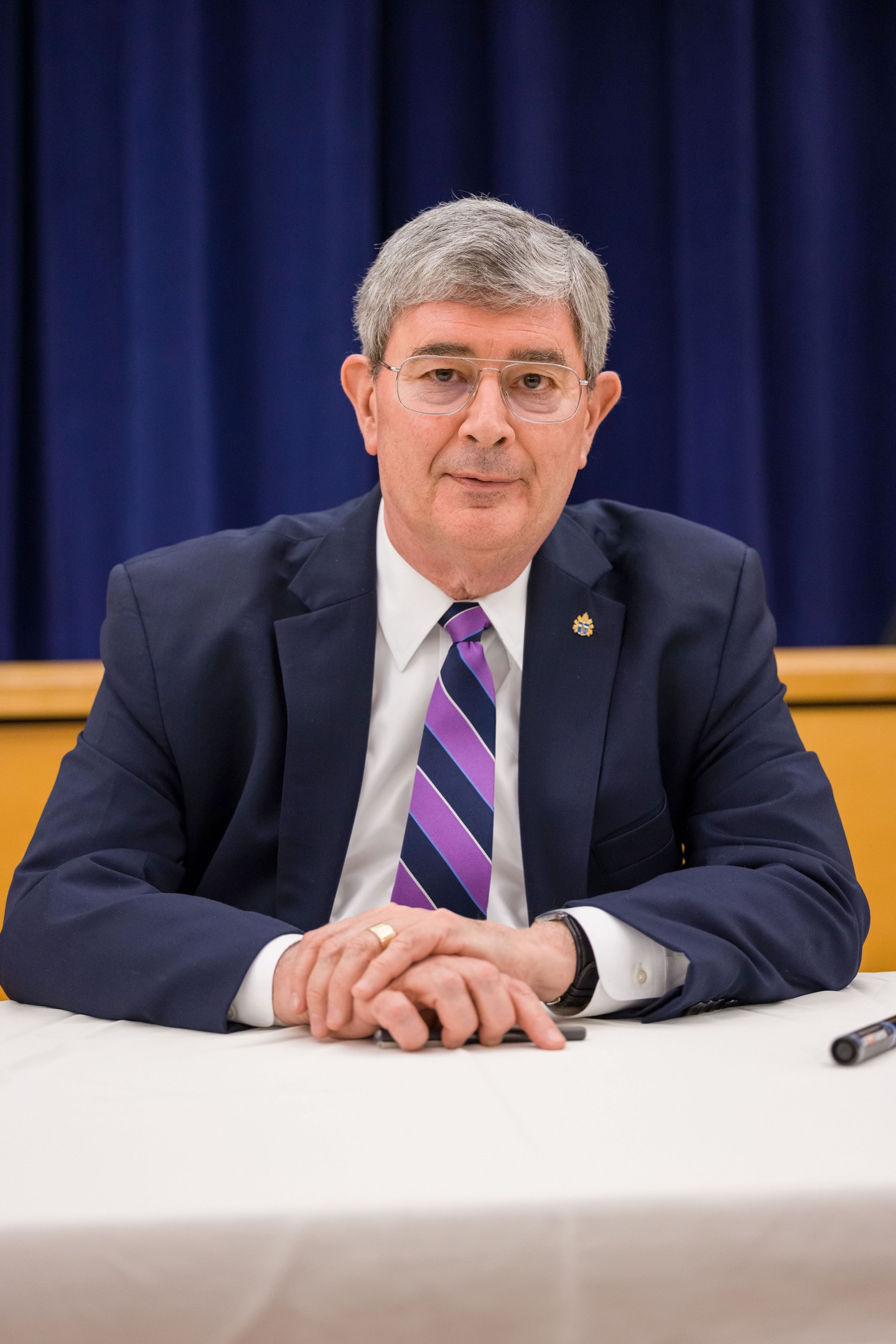
George Weigel is Distinguished Senior Fellow of Washington, D.C.’s Ethics and Public Policy Center, where he holds the William E. Simon Chair in Catholic Studies.

First Things depends on its subscribers and supporters. Join the conversation and make a contribution today.

Click here to make a donation.

Click here to subscribe to First Things.