CONSEQUENCES
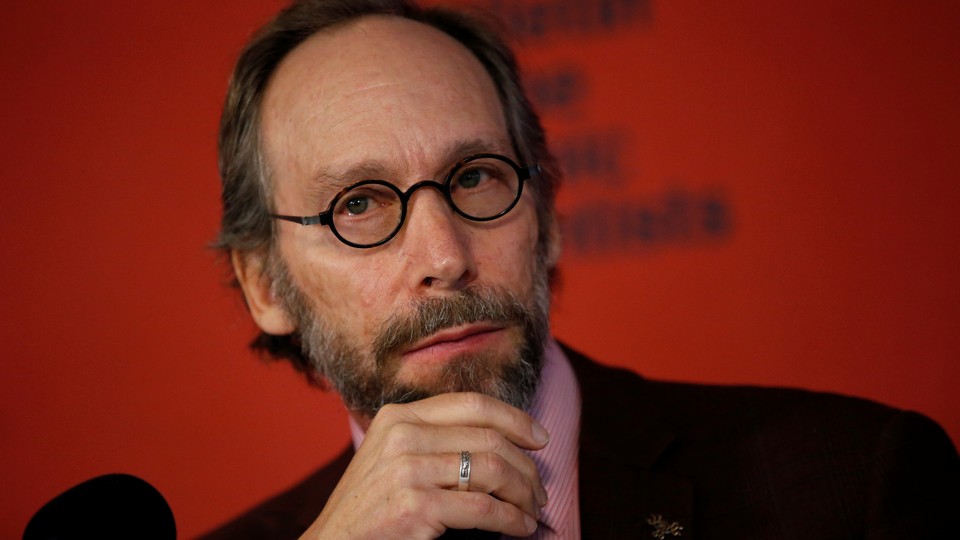
In April, a theoretical physicist showed up at conference in California about the search for extraterrestrial life in the universe.
In one way, his presence was likely. Lawrence Krauss is a prominent scientist, author of several best-selling books, and a prolific lecturer known for his lively and engaging style. He’s not a household name like Neil deGrasse Tyson and Bill Nye, but he starred in a documentary alongside fellow atheist-scientist Richard Dawkins, and his lectures on cosmology regularly rack up thousands of views on YouTube—no easy feat for a physicist trying to popularize science.
In another way, it was surprising. Two months before the conference, several women had accused Krauss of sexual misconduct, describing behavior that went unchecked for over a decade. By the time Krauss stepped foot on Stanford’s campus for the gathering, he had been banned from three universities, removed from multiple speaking events, and was under a formal investigation by Arizona State University, his primary affiliation. But Krauss had denied the allegations, and refused to withdraw from public life. “He chatted with peers. He ate with prestigious scientists. In the conference hall, he sat in front, where there were two rows of cloth-covered tables for VIPs,” Jason Davis, a science writer who was there, reported. “He even challenged a nasa engineer after one talk, declaring a proposed propulsion drive to be based on bunk physics.”
Some attendees were flabbergasted by Krauss’s appearance, and chastised the Breakthrough Initiative, the host of the conference, for admitting an alleged harasser in the midst of an investigation of inappropriate behavior in a professional setting. Breakthrough later told Krauss to avoid its events until the investigation was over.
That investigation concluded this week. According to BuzzFeed News, which first reported on Krauss’s alleged sexual misconduct in February, Arizona State found evidence to support several allegations: that Krauss grabbed a woman’s breast at a meeting; that he groped another’s thigh; that he told an employee he would buy her birth control so she wouldn’t inconvenience him with maternity leave; that he made suggestive comments about a student’s attire; and that he suggested a threesome to a female job candidate at the Origins Project, Krauss’s flagship program at Arizona State.
Arizona State removed Krauss as leader at the Origins project. But the school not fire Krauss from his role as professor, even though the dean of its college of liberal arts and sciences recommended that they should. Instead, the two parties brokered an agreement. Arizona State will end its disciplinary process, and Krauss will retire from the university at the end of the academic year in May. He will continue to earn his annual salary of $265,000 until then. Krauss continues to deny the allegations.
The allegations against Krauss emerged several months after news reports of rampant sexual harassment and assault by Harvey Weinstein sent shockwaves through the public and prompted the exposure of other powerful figures and misconduct, in Hollywood and beyond. Krauss is the most well-known of the small pool of scientists, from cancer researchers to geologists, who have been accused of sexual misconduct and faced some consequences.
Krauss’s story has mostly followed that of other alleged perpetrators in the year since the Weinstein reports. But it has also illustrated a distinct brand in the #MeToo movement, one that arises when the accuser is not a Hollywood producer, a well-known actor, a television-famous journalist, or C-suite executive, but a scientist.
Scientists are unique among this larger group. They occupy a distinct cultural role as declarers of truth. They demand evidence they can see for themselves. They may, as in Krauss’s case, decide to handle allegations of sexual misconduct as a hypothesis to be investigated, dissected, and proven.
Krauss criticized Arizona State’s handling of the allegations, saying that the university didn’t examine “all evidence, including the evidence I had prepared.”
“The nature of the review process I experienced included incomplete access to evidence and accusations during the investigation, no opportunity to cross-examine witnesses or be represented by a lawyer during the investigation interviews, and no option to directly appeal the subsequent determinations made by the investigators.”
Sexual-misconduct cases, however, don’t fit neatly into the framework that governs rigorous scientific inquiry. “If there’s one thing we’ve learned from the #MeToo movement, it’s that so much of understanding injustice is experiential and rooted in anecdotal evidence. For hardcore freethinkers, that’s a problem, because personal testimonies can’t be verified or tested in an empirical way,” Ashley Naftule wrote in The Outline after the allegations against Krauss became public. “And if something can’t be measured, calculated, or observed, it may as well not exist—even though studies of sexual harassment in science reveal the opposite to be true.”
Some scientists, especially vociferously atheist scientists like Krauss, pride themselves in their ability to rise above certain biases, in their work and in social systems at large. They believe that science, as a concept, will safeguard against them.“Science itself overcomes misogyny and prejudice and bias. It’s built-in,” Krauss said last year during a promotional event for one of his books.
It’s outrageous to claim scientists, hard as they might try, are immune to biases. In fact, scientists’ fierce belief that they are exempt from such pitfalls risks blinding them to the possibility that there may be a chance, however small, that they’re not. In the wake of the allegations, Krauss acknowledged that his demeanor may have “made people feel intimidated, uncomfortable, or unwelcome,” and recognized that “the current movement makes clear that my sensitivity, like many others’, can be improved.”
But in his attempt to explain the slew of allegations against him, Krauss flouted his field’s own guidelines and categorically dismissed any potential explanations other than the one he had: that he was famous. “It is common knowledge that celebrity attracts all forms of negative attention from many different angles. There is no pattern of discontent revealed here that suggests any other explanation,” Krauss told BuzzFeed News.
Krauss subscribes to the adage made famous by another science popularizer, Carl Sagan, that “extraordinary claims require extraordinary evidence,” and he appeared to treat the Arizona State investigation as such. This wasn’t the right approach, according to Melody Hensley,one of his accusers. Hensley, at the time a volunteer at the Center for Inquiry, where Krauss was an honorary board member, told BuzzFeed News that Krauss forcibly kissed her and tried to remove her pants after a work event in 2006. Her allegation and those of others “weren’t extraordinary claims,” she said. “These things happen to women all the time.”
Krauss has refused to stay out of the public eye since the Arizona State investigation began. His statement in response to the university’s conclusion suggests that will remain the case. “My experience over the past seven months has led me to surmise that even following such an outcome, I would no longer encounter a working environment at ASU that is conducive to continuing my active teaching, research, and service activities,” he said on Sunday. “I look to the future for new and different challenges and opportunities.”
Here, Krauss’s story rejoins the narrative of others in similar positions, that of the potential comeback. Several men who had been accused of abusing their positions of power and sexually harassing female employees earlier this year have already begun to plot their returns.
Many science organizations have distanced themselves from Krauss this year, but it is not unfathomable to consider that he may find himself on stage again next year. Even though Arizona State found evidence of his sexual misconduct, it did not formally reprimand him. Krauss, as well as people who may want to hire him, can accurately say that, beyond what was reported in the press and detailed by the university, he was not formally sanctioned or terminated in relation to the allegations.
That some men, particularly high-profile ones, have reemerged from the cloud of the #MeToo movement, and with some success, is not surprising. It is another chapter in a very old tale, in which, as my colleague Megan Garber has written, “these men are seen as invaluable because the stories they tell are still understood to have disproportionate worth.” Their transgressions, the reasoning goes, matter little in the face of their successful bodies of work.
This is the culture that raised many of the alleged harassers of this moment. It includes not only Krauss, but also the scientists he idolized, like the theoretical physicist Richard Feynman.
Feynman was a brilliant thinker and a Nobel laureate. He was also, by many accounts, a lech, and well known for his poor treatment of women. Krauss was well aware of this, but it was secondary to Feynman’s scientific legacy. “Showmanship, while contributing to the Feynman lore, was not important to his work however. Neither was his fascination with women, which emerged later,” Krauss wrote in Quantum Man: Richard Feynman’s Life in Science, his 2011 biography of the scientist. “The ability to concentrate, combined with an almost superhuman energy that he could apply to a problem, was.”
Quantum Man is a tremendous exercise in hagiography. Krauss documents Feynman’s bad behavior, but couches it in language that removes any responsibility the scientist may have possessed.
He had continued an intense long-distance courtship with her, and she was causing another woman in Ithaca to lash out at him in jealousy.
And:
He often stayed with friends, usually married ones, and these visits frequently ended badly as a result of his sexual improprieties.
And:
When he spent a year in Brazil, he actually devised a set of simple rules for seducing women, including prostitutes, at bars. He became famous for seducing women at conferences abroad.
Krauss failed to mention that in this game, Feynman considered women who did not put out after he bought them drinks as “worthless bitches.”
It is strange to read Quantum Man now, as waves of women continue to come forward to tell their versions of male behavior that went long unchecked, that existed only through carefully constructed whisper networks, that, if they hadn’t said anything, could be diluted into the silly actions of a brilliant and edgy man. It feels like a time capsule, a snapshot of unbridled adoration for geniuses in a time long before #MeToo. But it remains a cautionary tale, not just for women, or just for men, but for everyone, that some stories can be left behind in favor of others. That some evidence, even when it is corroborated and convincing, can still be dismissed and ignored.


