Saturday, 30 September 2017

Who’s funding Ireland’s abortion lobby?

Who’s funding Ireland’s abortion lobby?


Numerous international groups are trying to influence Ireland into legalising abortion

The great and the good internationally have a big interest in the outcome of Ireland’s looming abortion referendum, planned for next year. They want Irish voters to erase from their constitution the so-called Eighth Amendment, which gives the unborn child the same right to life as every other human being.
Abortion is only permitted in Ireland when the life of the mother is at real and substantial risk. This amendment was inserted into the constitution following a referendum in 1983 which passed by a two-to-one margin.
Ever since then secular liberal opinion has been bent upon overturning that referendum. When liberals lose a referendum, they do not take no for an answer and Irish liberals have found plenty of allies abroad in their quest for change.
Among those allies is the Canadian prime minister Justin Trudeau, various United Nations committees, including the UN Human Rights Committee and the UN Committee against Torture (yes, torture), in addition to the billionaire George Soros.
Through his Open Society Foundations, the Hungarian-born Soros has already provided three pro-abortion groups in Ireland, including Amnesty International’s Irish branch, with a combined total of around $400,000 (£295,000). The other two groups are the Irish Family Planning Association and the Abortion Rights Campaign.
A leaked document from the Open Society Foundations revealed the reasons behind the funding. It said it was so that the three groups could “work collectively on a campaign to repeal Ireland’s constitutional amendment granting equal rights to an implanted embryo as the pregnant woman”.
It continued: “With one of the most restrictive abortion laws in the world, a win there could impact other strongly Catholic countries in Europe, such as Poland, and provide much needed proof that change is possible, even in highly conservative places.”
That pro-abortion groups in Ireland are receiving foreign funding has received very little media coverage and almost no political reaction. This is despite journalists and politicians showing a permanent interest in alleged foreign funding of Irish pro-life organisations. The lack of curiosity in foreign funding of pro-choice outfits says a lot about the double standards of the Irish media and many politicians.
In any event, the reason the Open Society Foundations gives for providing the funding – namely that turning a once strongly pro-life country into a pro-abortion country would serve as an example to other countries – is also the reason why Justin Trudeau and the UN see fit to comment on our pro-life law.
When Trudeau met the new Irish prime minister, Leo Varadkar, in Canada recently, he brought up the Eighth Amendment and indicated that Ireland should repeal it in the name of “human rights”. There is no indication that he met with any resistance from Varadkar or that the Taoiseach criticised Canada’s extremely permissive law, which allows abortion for any reason right up to birth and gives scant conscience protections to doctors and nurses.
Varadkar describes himself as “pro-life” but favours repeal of the Eighth Amendment where a woman’s health is considered to be at risk. This ground will be very familiar to British readers who know it has led to abortion on demand in their country and almost 200,000 terminations per annum.
The UN has regularly been putting its oar in, encouraged by Irish pro-abortion groups. Ireland, like Britain, is a signatory to numerous UN treaties, and again like Britain, must periodically appear before this or that UN committee to report on how well it is implementing various treaties.
Again and again we are told that we must permit abortion. These UN committees are very ideologically biased. They have long since been co-opted by the pro-abortion Left and they are more than happy to dance to whatever tune Irish abortion groups choose to play. The committees never consider the rights of the unborn child. They pretend that whatever UN treaty or convention they are charged with overseeing permits abortion. This is despite abortion getting no mention in any UN treaty or convention. These same committees then give the false impression that their opinions carry a legal weight they simply do not have.
Depressingly, Irish governments tend to tip the hat to these committees and treat them with a wholly undeserved deference. This suits the present government, of course, because it wants to see our pro-life law overturned. It is therefore convenient for it to pretend to the Irish people that “we are letting ourselves down” in the eyes of the international community, led by the UN, and that the UN is somehow the unbiased and objective arbiter of morality. In fact, the UN acts as a sort of Magisterium to those of a secular liberal persuasion. It cannot be questioned. The UN has spoken, the matter is closed.
Why are these international figures really so determined to see us change our abortion law? The charitable explanation is that they genuinely believe in the right to abortion and that the child in the womb has few if any rights. Many do obviously believe this.
But the less charitable explanation is that they know that Ireland’s law, and Ireland’s still reasonably strong pro-life culture, is a standing rebuke to the abortion laws and the pro-choice culture that exists in practically every other Western country, including Britain.
In the UK, one pregnancy in every five ends in abortion. In Sweden, it is one in four. The Irish rate is about one in 18 pregnancies, even allowing for the roughly 3,500 Irish women who travel to Britain each year to have an abortion. In other words, Ireland shows that when a country has a highly restrictive abortion law, far fewer abortions take place even when a near neighbour permits abortion and women can easily travel there.
But surely, some say, our abortion law means that more women die in pregnancy? This is not the case. The Irish maternal death rate is somewhat lower than the British one.
Against this, you may have read about the tragic death of Savita Halappanavar who died in an Irish hospital in 2012 after being refused an abortion. But it transpired that she died of sepsis and the hospital had not spotted the deadly infection until it was too late. If it had known she had sepsis, it could have ended the pregnancy, which was miscarrying in any case. In British hospitals pregnant women also die from sepsis on rare occasions. Britain’s very permissive abortion law does not save them.
Given that the Irish law is such a challenge to the abortion regime in most Western countries, you can see why big international players want Ireland to change its law. The Irish law has saved the lives of countless unborn babies while also protecting the lives of pregnant women. That is a win-win. Ireland should be proud of its law. Other countries should be ashamed.
Will we be able to resist internal and external pressure to change our pro-life culture? We are likely to know by next summer because the referendum will have taken place by then.


David Quinn is a columnist with The Sunday Times and The Irish Catholic. He is the founder and director of The Iona Institute (ionainstitute.ie)
This article first appeared in the September 29 2017 issue of the Catholic Herald. To read the magazine in full, from anywhere in the world, go here

This is Why Bob Dylan’s Genius is Biblical


This is Why Bob Dylan’s Genius is Biblical

Image result for bob dylan 1966
BOB DYLAN ... 1966


Blogs  |  Sep. 28, 2017


Dylan’s art is often informed by Scripture—and the idea of returning to the sources for insight and progress is itself a biblical idea.
“I can hear a sweet voice gently calling
Must be the Mother of our Lord.”

—Bob Dylan,
Duquesne Whistle (2012)
I first discovered Bob Dylan in 1976 while rummaging through a satchel of cassette tapes owned by my cousin, Peter Casella, who had inadvertently left it at my parents’ home. The album was Bob Dylan’s Greatest Hits. I was 15 years old at the time, with my music listening habits dominated by the great pop acts of the late 1960s and mid-1970s: Wings, the Eagles, Fleetwood Mac, Elton John, Stevie Wonder, the Beatles, the Byrds, Elvis Presley. I was not prepared for Dylan.
Because somebody had already listened through Side One, I plopped the cassette into the machine and began with side two, which starts with Mr. Tambourine Man. I had heard the Byrds’ Beatle-beat, Wrecking Crew, highly abridged version of the tune. So, I expected to hear from Dylan something similar. But it wasn’t even close. His performance just knocked my socks off. It had a sound I had never heard before, but yet it seemed as familiar as Happy Birthday or God Bless America. Or as Izzy Young would put it, by “writing about contemporary ideas in traditional forms” he sounded “current and old at the same time.” Central to Dylan’s “sound” were the words and his cadence while singing them. I could not believe that anyone could do something like that in popular music. I know that some of the old Tin Pan Alley lyricists were accomplished wordsmiths, but could any of them really have pulled off anything like this:
Though I know that evenin’s empire has returned into sand
Vanished from my hand
Left me blindly here to stand but still not sleeping
My weariness amazes me, I’m branded on my feet
I have no one to meet
And the ancient empty street’s too dead for dreaming
After returning the satchel to my cousin, I forgot about Dylan until late August 1978 when I was driving through Utah on my way to Pocatello, Idaho. I happened to be listening to a radio station that every weekday selected an entire album to be played during the lunch hour. On that day it was Bob Dylan’s Greatest Hits. As I listened, I recalled my initial hearing of the album two years earlier, and wondered why I had not explored Dylan’s larger body of work. That was quickly remedied.
About a year later, Dylan released the album, Slow Train Coming (1979). It was evident from the songs’ lyrics that Dylan had undergone a profound religious conversion to evangelical Christianity. This caused quite a stir in popular culture and the entertainment press. Many were scandalized, largely because of what Dylan had represented to the counterculture movement of the 1960s. He had pretty much written the songs that would become the unofficial anthems for social change in America, even though Dylan himself bristles at the “spokesman of a generation” moniker. (These songs include Blowin’ in the Wind, The Times They Are A-Changin’, Only a Pawn in the Game, Masters of War and Chimes of Freedom.) To embrace Evangelical Christianity, which by 1979 was beginning to be associated with the religious right, was a bridge too far for many of Dylan’s most devoted fans.
This, of course, was not the only time he had ticked people off (or, at least, surprised them).
In the mid-1960s, after releasing two albums that included several folk songs that were appropriated by the civil rights and anti-war movements (clumsily labeled “protest songs”), Dylan moved on to pen more abstract, surreal and “stream of consciousness” compositions, among them Mr. Tambourine Man, Gates of Eden, My Back Pages and It’s Alright, Ma (I’m Only Bleeding).
He showed up at the 1965 Newport Folk Festival with the Paul Butterfield Blues Band and “went electric,” much to the chagrin of the folk music purists in the audience who booed him. A year after releasing the double-album masterpiece, Blonde and Blonde (1966), for which Dylan used some of the finest studio musicians to help create what he would call that “thin, wild mercury sound,” he released John Wesley Harding (1967), an album that seems pared-down and basic in comparison to its predecessor. It includes many biblical and religious allusions that Dylan biographers speculate were the result of regular Bible reading he had taken up at the time.
Although often considered a man of the political left, Dylan wrote in his 2004 autobiography, Chronicles: Volume One, that in the 1960s his favorite politician was Barry Goldwater. In 1969, he gravitated to country-western music and released Nashville Skyline. And in the past of couple of years he has released albums consisting exclusively of standards from what some call The Great American Songbook.
Behind these (and other) seemingly inscrutable transformations is a consistent theme, which I like to call, “Bob Dylan’s biblical genius.” I think Izzy Young caught a glimpse of it when he first heard Dylan’s first compositions and said that they sounded both “current and old at the same time.”
There is in Dylan’s artistic journey a continual return to the sources: Scripture, the folk tradition, American standards, Great Books, etc. For Dylan, these are not merely museum pieces to be dusted off so that we can appreciate (and perhaps admire) our primitive ancestors. Rather, they are, as he said of St. Augustine, “alive as you or me.” They serve as both guidelines and raw material from which one can compose new lessons from perennial truths. This requires that one deny the modern fetishes of moral innovation and cultural debunking while at the same time rejecting the traditionalist reflex to be skeptical of all change and dissent. This is precisely what I believe Dylan is doing in his so-called “protest songs.”
In his early days, he clearly connected the progressive cause of civil rights to a return to those biblical ideals of justice and fairness that everyone, down deep, knows are true. So much so that they are “blowin’ in the wind,” “the first one now will later be last,” and for those who suppress the truth, “like Pharaoh's tribe they'll be drownded in the tide, and like Goliath, they'll be conquered.”
Dylan’s most recent album of original material, Tempest (2012), takes its name from Shakespeare’s play and includes a song about the sinking of the Titanic (“Tempest”) that serves as a metaphor for the hubris of the modern world and the divine judgment that is sure to follow:
The captain, barely breathing
Kneeling at the wheel
Above him and beneath him
Fifty thousand tons of steel

He looked over at his compass
And he gazed into its face
Needle pointing downward
He knew he lost the race

In the dark illumination
He remembered bygone years
He read the Book of Revelation
And he filled his cup with tears
Dylan’s genius is biblical, not simply because his art is often informed by Scripture, but because the idea of returning to the sources as a necessary condition for insight and progress is itself a biblical idea: “Do not think that I have come to abolish the law or the prophets; I have come not to abolish but to fulfill” (Matthew 5: 17). “So then, brothers and sisters, stand firm and hold fast to the traditions that you were taught by us, either by word of mouth or by our letter” (2 Thessalonians 2:15)
On Nov. 3, Columbia Records is releasing, Trouble No More (2017), a boxed set of live recordings and studio outtakes from Dylan’s so-called ‘Christian era” (1979-1981), the period that included Slow Train Coming and two subsequent albums in which he sings explicitly of his newfound faith. This extraordinary collection will no doubt revive questions about Dylan’s personal journey, whether or not he still identifies as a Christian.
As a Catholic, I certainly hope he does. But as a fan, I am content with sitting back and listening to his biblical genius. 
 
Francis J. Beckwith is a professor of Philosophy and Church-State Studies at Baylor University. His most recent book is Taking Rites Seriously: Law, Politics, and the Reasonableness of Faith (Cambridge University Press, 2015), winner of the American Academy of Religion’s 2016 Book Award for Excellence in the Study of Religion in the category of Constructive-Reflective Studies.

Tuesday, 1 August 2017

Sunday, 30 July 2017

How one priest saved countless souls in the First World War

How one priest saved countless souls in the First World War


Fr William Doyle showed staggering courage at Passchendaele

Like so many caught up in the conflict that came to be known as the Great War, Fr Willie Doyle was buried where he fell, without a marker, just another casualty among millions. He might have been forgotten; however, it proved not to be the case.
Before his death, he had requested that his private papers be burned. Thankfully, his wishes were ignored. The discovery of the papers, and their subsequent publication as part of a biography published in 1920, were a surprise to those who had known him.
After days spent giving retreats, hearing confessions and, above all, saying Holy Mass, his spiritual notebooks revealed another dimension of Fr Doyle. Hours were spent at night in long watches in front of the Blessed Sacrament, praying for the sanctity of priests. Then there was the frequent use of the discipline (whip), immersion in cold lakes, and nocturnal, barefoot pilgrimages in reparation of sins. All this was hidden from view, but, importantly, with the knowing approval of the Jesuit’s spiritual director. And then there was his less dramatic daily “war” on self: for instance, the “Butter Tragedy” – some days butter on his toast, others not, just one example of a constant spirit of mortification in everyday matters.
The personal papers revealed an intense inner life that edified some. Others deemed his mortifications too harsh, his prayer life too extreme; and yet, this was a man with a reputation unlike that of any gloomy ascetic. He was a much loved, affable priest, a perpetual prankster. This paradox only seemed to deepen the mystery surrounding Fr Doyle.
Willie Doyle was born in Dublin on March 3, 1873. His parents were both well-to-do and devoutly religious. Four of their seven children entered some form of religious life. Having been educated in both Ireland and England, Willie entered the Society of Jesus.
Finally, he was ordained in 1907, and soon after was assigned to the Jesuit mission to parishes throughout the British Isles. From the start he excelled as preacher and confessor. Crowds flocked to him, but only after his death was the secret of his “success” revealed: penance.
When war broke out in 1914, Fr Doyle volunteered immediately. He understood that, with thousands on their way to death, a priest was needed for what would prove to be the decisive hour for many souls, with all lost or gained, and for all eternity.
In 1915, he landed in France with the Royal Irish Fusiliers. From then on, he marched every mile alongside these soldiers – forgoing all privileges that his officer rank afforded him. By the end, these battle-hardened troops would come to love their Padre. It was no surprise, as he suffered as much as they did. Through barbed wire, and in spite of bullets, shells and gas, Fr Doyle sought out the dying, who often lay terrified and alone in mud-filled battlefields, administering the last rites, bringing Viaticum.
For his bravery, Fr Doyle was mentioned in despatches and recommended for the highest award for gallantry, the Victoria Cross. He was passed over, deemed by some to have had a triple disqualification: Irish, Catholic and Jesuit. It was to make little difference. His eyes were on an altogether greater prize: the sanctity and the salvation of the men in his charge.
As if the dangers and privations of the Front were not enough, throughout it all Fr Doyle continued his own inner “war”. When possible, in those flooded, fetid trenches, with the sounds of hell reverberating all around, the priest, with a pyx containing the Eucharist around his neck, spent hours on his knees adoring the Prince of Peace.
His letters home to his widowed father reveal the strain of it all as he marched on through the bloodstained fields, with names later synonymous with suffering: Loos, the Somme, Passchendaele … Like his comrades, he was shot at, shelled and gassed, narrowly missing being killed on numerous occasions, his only rest being in the same rat-infested trenches. Despite his brother officers’ pleas, he refused to leave the Front, determined to remain until the end.
On August 16, 1917, during the seemingly never-ending Passchendaele offensive, Fr Doyle was desperately trying to drag a wounded comrade back to safety from No Man’s Land. He was blown to pieces by a German shell. Unlike the many to whom he had given a Christian burial, his remains were hastily interred in a makeshift communal grave.
As the 100th anniversary of his death draws near, it is worth recalling that on the Western Front alone an estimated 40,000 military personnel converted to the Catholic faith. No doubt, this was due in no small measure to the exemplary service of Catholic chaplains – holy men such as Fr Willie Doyle.
KV Turley is a writer and filmmaker. He is the author of Fr Willie Doyle & World War I: A Chaplain’s Story (CTS)
This article first appeared in the July 28 2017 issue of the Catholic Herald. To read the magazine in full, from anywhere in the world, go here

Monday, 24 July 2017

Orange Order calls on Protestants not to use the phrase 'RIP' 

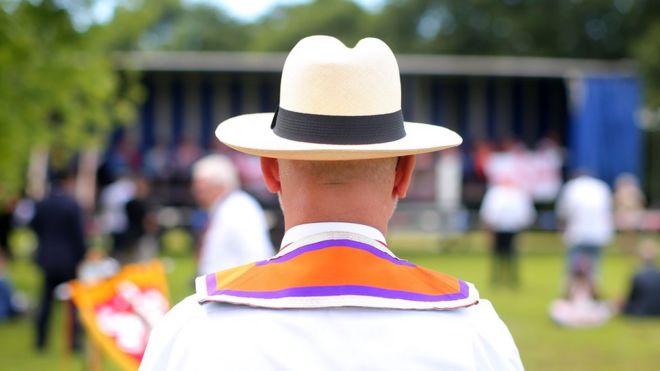
An Orangeman in the demonstration field in Belfast
Image caption The Orange Order dates from the 17th century battle for supremacy between Protestantism and Catholicism
The Orange Order has asked its members to stop using the term 'RIP' to express grief or sympathy after a death.
It said the phrase is unbiblical, un-Protestant, and a form of superstition connected to Catholicism.
RIP is an abbreviation of 'rest in peace' or in Latin, 'requiescat in pace'.
In a publication marking the 500th anniversary of the Reformation, the order called on Protestants to stop using the phrase.

Wallace Thompson, secretary of Evangelical Protestants Northern Ireland, wrote a Facebook post on which the article was based.

'Prayers for the dead'

He told the BBC's Talkback programme: "Observing social media, we have noticed that the letters RIP are used a lot by Protestants, and by some evangelical Protestants."
Mr Thompson explained that for him, 'RIP' is a prayer and he did not encourage prayers for the dead.
"From a Protestant point of view, we believe, when death comes, a person either goes to be with Christ for all eternity, or into hell.
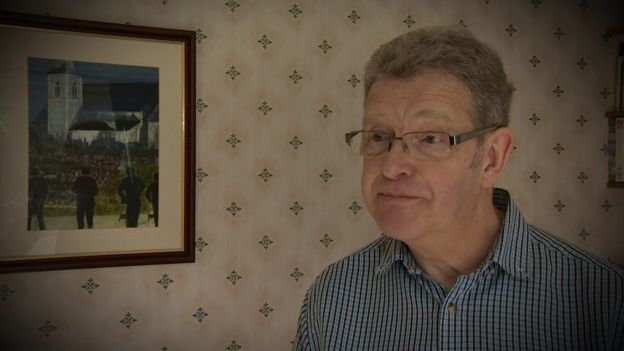
Wallace Thompson
Image caption Wallace Thompson believes that the phrase 'RIP' is effectively a prayer for the dead and therefore un-Protestant
"That's what we believe the gospel to be and in this 500th anniversary year of the Reformation, I think Luther, when the scales fell off his eyes, realised that it was all by faith alone, in Christ alone, the decision is made during life, on this earth, so that when death comes it has been made and no decision has been made after death," he said.

'Remembrance'

Speaking on the same programme, former Presbyterian moderator Dr Ken Newell said he did not use the phrase very often.
"I think when people use [RIP] in social media, there's a remembrance and a good wish in it, almost a blessing," he said.
He disagreed that people are praying for the dead when they used the phrase.
"If folk in the Orange Order want to take this line that's perfectly up to them, they are making a good point.
"I think ordinary people have not worked out the issues. This comes out of the human heart," he added.
In response to a request for a spokesperson of the issue, the Orange Order referred the BBC to comments made by the county grand master of County Fermanagh Grand Orange Lodge, Stuart Brooker, in the Impartial Reporter newspaper.
In it he said: "I think the message in the article is very clear and well put together, and I couldn't add anything further to it.
"This article clearly explains why we as Protestants, and members of the Orange Institution, shouldn't use the term 'RIP'.
"It also reminds us that if we need guidance in any matter, we should refer to what the bible teaches."
The Orange Order is the largest Protestant organisation in Northern Ireland.
It regards itself as defending civil and religious liberties of Protestants and seeks to uphold the rule and ascendancy of a Protestant monarch in the United Kingdom.

What a bolus of nutters!
GENE

Sunday, 23 July 2017

The cycling legend and devout Catholic who risked his life to protect Jews


The cycling legend and devout Catholic who risked his life to protect Jews

Gino Bartali won the Tour de France twice and defied Mussolini. He also helped a cardinal to save Jewish lives in the 1940s
If Chris Froome triumphs this Sunday in the final stage of the Tour de France, he will have more than confirmed his place among the greats. But there is one record that he won’t have broken: for the longest time span between victories. That is held by the Italian legend Gino Bartali, who won in 1938 and 1948. He was also known as “Gino the Pious” because of his passionate devotion to his Catholic faith.
Bartali’s most lasting accomplishment, however, was one few people know about. During the Second World War Bartali helped Jews hiding in Tuscany and Umbria escape detection by the Nazis and Fascists. Bartali secretly sheltered a family of Jews in an apartment he owned and he travelled between Florence and Assisi, transporting false identity documents hidden in the frame of his bicycle. In both his humanitarian work and his cycling, Bartali’s Catholic faith was the cornerstone of his life at all of its critical junctures. As he put it: “My faith in God, my heartfelt love for religion, have always given me the strength to overcome all the things that were first thought impossible.”
From a young age, religion played a pivotal role in Bartali’s life. Born into a humble labourer’s family living in a working-class hamlet on the outskirts of Florence, Gino became involved in devotional life early on. At the age of 10 he joined the lay group Catholic Action and remained involved throughout his life. Formed in 1867, Catholic Action organised a wide range of activities for young boys and men, ranging from prayer meetings and Bible classes to summer camps and athletic associations.
Catholic Action became even more important to Gino after the first big tragedy rocked the Bartali household. In an amateur race in Turin, soon after Gino had won his first Giro d’Italia in 1936, Gino’s younger brother, Giulio, raced in rainy, slippery conditions. On a precarious downhill descent Giulio was hit by a car that had either missed or ignored instructions about the race. Doctors operated on Giulio, trying to save his life, but the 19-year-old died a few days later.
Gino was devastated and quit cycling. As he grieved for his lost brother his way of viewing the world transformed. Already an active Catholic, he devoted himself further to the Church and turned to his faith to ground him in the world. At Catholic Action meetings he began taking a more visible role, speaking frequently to young boys at meetings, explaining the role of his faith in his success. In their family home, Gino built a small chapel and dedicated it to Giulio so that the Bartalis would have a private place to offer daily prayers for the repose of Giulio’s soul. With few other career options, Gino made the difficult decision to return to cycling. Through prayer he found a new motivation: he would race to honour his brother’s memory.
As Bartali reached the summit of his sport in 1938, his faith came into the glare of the political spotlight in Europe. In a stunning victory, Bartali won the Tour de France in 1938. By this point, Mussolini’s Fascist government tried to use every Italian athletic victory as proof of the strength of the Fascist ideology. In this environment, it was expected that athletes, particularly those competing abroad, would dedicate their victories to Mussolini. Bartali behaved very differently after his Tour win. Instead of thanking Mussolini, he thanked his fans in his victory speech and the next day he was photographed taking his victor’s bouquet to a local church in Paris, where he laid it at the feet of the Madonna. The Fascist regime took note. Just a few days later Mussolini’s press office sent a secret missive to newspapers throughout the country (which Mussolini controlled at this time), and ordered them to avoid any discussion of Bartali’s personal life – including his religion – in any news articles about his cycling.
Bartali, like so many other young men of his era, saw his life upended by World War II. At a moment when his future appeared uncertain, his faith served once more as an important pillar in his life. In the early days of war, when he was conscripted into the army, it offered him an inviting escape from the dreariness of military life and his growing frustration with Mussolini’s government. “I plunged myself into reading the lives of the saints. I frequently read St Anthony, St Catherine, St Thérèse of Lisieux,” he said.
By the autumn of 1943, when the German army occupied Italy, Gino was challenged like never before. As Jewish refugees flooded into Florence, hoping to escape deportation to camps, they turned to the Archbishop of Florence, Cardinal Elia Dalla Costa, for help with shelter, food and false identity documents. The cyclist and the cardinal had been friends since well before the war through the Catholic community; Dalla Costa had married Bartali and baptised his son. Dalla Costa was a spiritual mentor to Bartali, but his request was a very perilous one. He was asking Bartali to risk his life for a community of strangers, and if Bartali was caught his own life would be endangered, not to mention those of his wife and young son.
Bartali understood the dangers involved but he also knew his conscience would not let him stand idly by. As one fellow member of the resistance put it: “One made the choice to be on the side of the Fascists or to defend the people.” Bartali mustered his courage through prayer and made his decision to help.
After the war, Bartali struggled to re-establish himself as a cyclist. As he returned to the Tour de France in 1948, he performed poorly in the first half of the race. Many journalists declared that Il Vecchio (“the old man”), as Bartali was known because he was 10 years older than most of his competitors, had no chance. But Bartali showed the power of his resolve once more.
On the 13th stage, hampered by a more than 21-minute disadvantage behind the race leader, Bartali felt his legs surge beneath him. Not only did he make up much of the lost ground, he also pulled into the lead of the race the next day. A few days later, as Bartali was preparing at his hotel for one of the final stages of the competition, he was surprised by a visitor. It was an emissary from the pope who had appeared to give Bartali a special medal, telling him that “His Holiness wishes that you win the Tour, as a loyal and athletic champion”.
Off the bike and in the years following his retirement, Bartali’s faith would continue to be a source of happiness. In the autumn of 1947, Pope Pius XII referenced Bartali in an address to a crowd at St Peter’s Square when he linked Bartali’s battles on the bike to the larger moral battle to lead a virtuous life. Bartali had the honour of meeting Pope Pius XII, and later met popes John XXIII and Paul VI.
In his early 80s, as Gino’s health began to fail him, he shared his wishes for his final arrangements with family members. He requested a traditional funeral Mass and asked to be buried in the brown robes of the Carmelites, of which he was a lay member. On the afternoon of May 5 2000 Bartali quietly passed away. News of his death was broadcast on Italian television and Pope John Paul II joined those in mourning, hailing Bartali as a “great sportsman”. A few years later, Cardinal Tarcisio Bertone, the Vatican Secretary of State, commended Bartali’s “great strength” and “great character”. Giorgio Goldenberg, the surviving member of the Jewish family who Bartali sheltered in one of his apartments during the war, offered his own appraisal of the cyclist’s legacy in 2011. “There is no doubt whatsoever for me that he saved our lives,” he said. “He was a hero and he is entitled to be called a hero of the Italian people during the Second World War.”

This is an adapted version of an article which first appeared in 2012. Road to Valour, Gina Bartali: Tour de France Legend and Italy’s Secret World War Two Hero by Aili McConnon and Andres McConnon is available for purchase online.

Gene's blog returns. And Detterling? The news may not be good.

Gene's blog returns. And Detterling? The news may not be good.

Ahoy! there me hearties! Shiver me timbers if it isn't good to be back. Yes Gene's blog is back in business - and what delights are in store.

Image result for Ahoy there me hearties


And Detterling I hear you ask? I have a sinking feeling that the news may not be good. I fear that Detterling may have died. He hasn't been seen or heard of since 13th July. And whether on the TES website, Gene's blog or his own blog such a lengthy disappearance is unprecedented. He had posted last year that he has serious health issues and wasn't expecting to live much longer.

If he has died God rest his soul. Okay, we had our battles, but deep down we had the ultimate respect for each other. I treasure great memories of the barbed exchanges between myself and the old phony. My favourite? Undoubtedly this one from the TES Opinion Forum:

Detterling: I know that you probably despise me Gene

Gene: Well if I ever gave it any thought I probably would.

So we will not now see his memoirs published - not I guess that there was ever any real chance that this would ever happen. But, I guess that the fantasy of their publication was comforting to him

You know I think that Detters was becoming influenced by my writing style and my approach to writing - particularly in respect of the searing honest displayed in such works as the account of my life as a young man: HOW COULD I HAVE BEEN SUCH A PRAT?

But every cloud has a silver lining as they say and Detterling's demise means that the coast is clear and Gene's blog returns. And, as I said, what treats and delights are in store!