By Sean Coughlan BBC News education correspondent
 Godot's 60th: The University of
Reading archive shows the first night Pic: Roger Pic
Godot's 60th: The University of
Reading archive shows the first night Pic: Roger Pic
So why are we still waiting for Godot? How has Samuel
Beckett's play grown from a tiny avant garde performance in Paris to become part
of the West End theatre coach party circuit?
It's 60 years since Samuel Beckett's play Waiting for Godot received its
premiere in the Theatre de Babylone in Paris.
The first public performance, in its original French form of En attendant
Godot, drew an audience of high-brow Parisians, taking in the latest
experimental theatre.
"All the thousands who claimed they were there could never have been at the
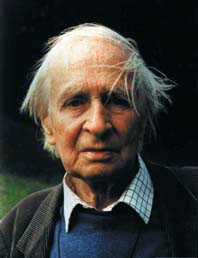
premiere. There weren't enough seats," says James Knowlson, Beckett's friend and
official biographer.
They also couldn't have realised that this play, beginning its
shoestring-budget run on 5 January 1953, was going to be seen as one of the
pivotal moments in modern drama.
International
appeal
So why has Waiting for Godot proved so durable? How has Beckett's work
outlasted the other iconoclasts and angry young writers of the 1950s and
1960s?
"I would suggest the answer lies in its ambiguities. So much is suggested
rather than explicitly stated," says Prof Knowlson.
 A programme from Godot's first
setting at the Theatre de Babylone in Montparnasse, Paris
A programme from Godot's first
setting at the Theatre de Babylone in Montparnasse, Paris
"People can read into it what they want to read into it."
This openness to interpretation has helped the play to avoid becoming dated,
he says. For a play that's about the passing of time, it's curiously
timeless.
It asks all the big philosophical questions - about life and death and the
uncertain purpose of what goes on in between - but in a way that isn't limited
to a particular place or era.
And the play has acquired a remarkable record for being performed in very
different international settings. No disaster or civil strife is complete
without its own Godot.
It was performed in Sarajevo under siege in the 1990s, in South Africa it was
seen as a critique of apartheid and in the wake of Hurricane Katrina a
performance in New Orleans was seen as an emblem of the city's wait for
recovery.
Inmates in San Quentin prison in California saw it as their own story in a
famous production in the late 1950s.
Prof Knowlson's friendship with Beckett has also created a rich and
unexpected legacy for his university, the University of Reading, which now holds
the biggest archive of Beckett-related material in the world.
From the early 1970s, the playwright began giving manuscripts and notes to
Prof Knowlson, stuffed into bags, boxes and suitcases. And this Beckett
International Foundation has grown to become the definitive European collection
for researchers.
"He adopted us," says Prof Knowlson - although the attention-shunning writer
was never persuaded to visit the archive in person.
As Waiting for Godot reaches its 60th anniversary, the university has
artefacts and pictures from the original performances.
'Something extraordinary'
It's also a reminder of how easily the play might not have happened at
all.
 Samuel Beckett at the BBC
recording a series of his plays in 1977
Samuel Beckett at the BBC
recording a series of his plays in 1977
There were no famous faces or big funders to back the play. Instead it
depended on the actor and director Roger Blin to hustle for cash and a venue -
and once it had begun it relied on word of mouth for survival.
None of the original cast are still alive - and the theatre itself shut down
a few years after staging Beckett's play.
In an interview with French television in the 1960s, Roger Blin suggested the
initial power of the play. When Beckett showed him the script: "I said to
myself: This is something extraordinary and it must be put on."
Another playwright who was enlisted in the search for funding fervently
promised Blin: "I will defend this play to the death."
It was still proving controversial when the first English version of the play
was performed two years later in London, directed by a 24-year-old Peter
Hall.
Harold Pinter, also then in his twenties, saw Beckett as the the "most
courageous, remorseless writer going", while reviewer Bernard Levin described
Waiting for Godot as "a remarkable piece of twaddle".
Not a 'miserabilist'
Prof Knowlson is himself now one of the most important living links with
Beckett.

He could be very convivial, very witty, very good company,
with a great sense of humour
And he recognises that the continuing interest in
Beckett's writing is wrapped up in the fascination with the enigmatic character
of the author. His photogenic alienation has become a kind of literary
brand.
But Prof Knowlson argues against the view of Beckett as a "miserabilist".
"He could be very convivial, very witty, very good company, with a great
sense of humour.
"But there was an element of depression and despair that was part of his
life, particularly after the war when he was deeply involved in writing the
novels."
He says that Beckett's idea of a happy Christmas would have been a solitary
occasion.
"He would have been preferably on his own and writing. He hated that kind of
thing."
The underlying humour is also part of the continuing appeal of Waiting for
Godot, he argues. It's often a peculiarly bleak comedy of resistance, but the
thread of humour is always there to leaven the gloom.
It's now a commonplace to see Waiting for Godot described as one of the most
important plays of the 20th Century - with its reputation gathering momentum
rather than fading away.
The kind of movie actors who would have reached the career point of wanting
to be in King Lear now want to shuffle across the stage in Godot.
Design conscious
A key reason for this growing resonance with audiences, Prof Knowlson says,
is the visual appeal. Beckett's strong images appeal to a design-conscious,
visually-literate culture.
"They have this strong visual element. I've become much more conscious of the
filmic quality."
 A handbill advertising the
first run of Waiting for Godot
A handbill advertising the
first run of Waiting for Godot
Prof Knowlson says that he increasingly believes there is a direct link
between the plays and Beckett's interest in painting.
"He was passionately involved in painting, not just that he loved to be with
painters, but he was a real expert on 17th Century Dutch painting."
"He knew these pictures so well, he was so engrossed in these scenes. It
seems to me that these pictures are really echoed in Waiting for Godot."
Beckett's life was changed by the success of Godot - the international impact
of the play helped him to win the Nobel Prize for Literature.
His publisher John Calder also recalled how the enigmatic Godot could haunt
his creator.
He recounted how he had once met an anxious Beckett getting off a flight at
Heathrow airport. When the plane doors had closed on the runway in Paris,
Beckett had heard the loudspeaker announcing: "Captain Godot welcomes you on
board."
"I wondered if my destiny had caught up with me at last," Beckett had told
his publisher.
The Beckett International Foundation at the University of Reading will
hold a series of seminars on Samuel Beckett and Waiting for Godot in April
2013.