Friday, 13 July 2012

Hank Williams’ Lost Concert Recordings Set For October Release

Hank Williams’ Lost Concert Recordings Set For October Release


Nowadays, it’s pretty easy to download a live album by a contemporary band, but, unless you were born decades ago, you’d be out of luck if you wanted to experience the vibrancy of Hank Williams’ live performance — until now.
Hank Williams: The Lost Concerts Limited Collector’s Edition, featuring the only two Hank concerts reputed to be recorded, will be released October 2. The concerts were recorded only six weeks apart in 1952, less than a year before the songwriter’s death. At the time, tape recording was expensive and rarely done, but lucky for us, a radio DJ in Buffalo, New York, and a promoter in Pennsylvania, decided to capture the unscripted and intimate performances in their respective hometowns.
In between the songs, Hank shares personal anecdotes about himself, his band members and his songs. “The studio recordings and juke box masters can’t touch the reality of his genius as manifested in these shows,” says daughter Jett Williams.
The collection will also feature the only known live recording of “Are You Walking and A Talking,” along with a rare radio interview conducted on September 14, 1951.
Here is the tracklisting from the two shows:
Niagara Falls, New York: April 25, 1952.
1.      Comedy with Hank and the Drifting Cowboys
2.      I Can’t Help It
3.      Jerry Rivers and the Drifting Cowboys: Orange Blossom Special
4.      Why Don’t You Love Me
5.      Are You Walking and A Talking
6.      The Funeral
7.      Hey Good Looking
8.      Cold, Cold Heart
9.      Lovesick Blues
Sunset Park, West Grove, PA: July 13, 1952.
10.  Introductions
11.  Hey Good Looking
12.  Comedy with Hank and the Drifting Cowboys
13.  Jerry Rivers and the Drifting Cowboys: Fire On The Mountain
14.  Lonesome Whistle
15.  Jambalaya
16.  Long Gone Lonesome Blues
17.  Half As Much
18.  I Saw The Light
19.  Lovesick Blues
20.  Interview: Hank interviewed by Mack Sanders, KFBI, Wichita, Kansas, September 14, 1951.

Thursday, 12 July 2012

Why I’m glad I saw Auschwitz

Why I’m glad I saw Auschwitz

There are some things that are simply evil in themselves, and never to be justified

By Fr Alexander Lucie-Smith on Monday, 9 July 2012


An icon of evil seared into the public consciousness AP Photo


One of the places I visited on my recent trip to Poland was Auschwitz. My original idea was not to go, but in the end I did go on an organised tour, and I am glad (that is not the right word, I know, but I can think of no other) that I went. The Auschwitz tour, which over a million visitors a year take (one can hardly call them tourists) is educational.
It is always revelatory to visit a place that you have heard much about, and of which you have seen many pictures. The reality is never the same. First of all, there was no such single entity as “Auschwitz”, but rather a complex of camps, some forty-eight in all; but the tour is restricted to Auschwitz I and Auschwitz II (also known as Auschwitz-Birkenau). The first is the one with the well-known Arbeit Macht Frei over the gate; the second is the one with the haunting railway line passing through a gateway.
Auschwitz I was smaller than I expected, which makes one realise just how overcrowded it must have been; the brick buildings, originally army barracks before they were taken over by the Nazis, are now given over to various explanatory exhibitions. These are understated, and all the better for that; the objects displayed are stark and eloquent. Most people I know mention the huge pile of shoes. I was more struck by the ocean of chamber pots which the deportees had brought with them, which spoke of a perfectly reasonable expectation that their lives were destined to continue after deportation. Those chamber pots tell us that for the victims, as for ourselves, their fate was unimaginable.
Because the Holocaust is something that transcends words – for nothing can describe this horror – Birkenau, which is essentially a large desolate space, is starkly eloquent too. Most of the wooden huts have disappeared, leaving their ghostly outline against what is now a field full of wild flowers and grasses. The gas chambers were destroyed by the retreating Nazis and are now piles of ruins. The surviving huts are terrible beyond belief, unfit for human habitation, originally conceived as stabling for horses. Here too the overcrowding and the attendant filth and disease must have been unimaginable. Now, there are hardly any people, and so the grass and the flowers have grown where once there was only a sea of mud, or a desert of dust.
Birkenau contains the memorial to all those who died in the camp complex. It is a collection of huge stones, vaguely reminiscent of the work of Henry Moore, the significance of which I found rather hard to understand. Somewhat to my surprise there is not much memorialisation at either site, which strikes me as correct. After all, the whole site is a memorial.
I was interested by what our Polish guides had to say when they took us round. Their words were, I think, well-judged. One of the very first things we were told was that though now in Poland, the Auschwitz camps were set up on territory that had been annexed to the Third Reich, and that all the local Polish inhabitants had been expelled from the area. At that time there was no Polish government. In other words our guides wanted to make sure that everyone understood that this was not a “Polish death camp”. But it saddened and surprised me that anyone could think that in the first place.
The second thing our Polish guides did was to draw a moral conclusion from the visit to the camps. This again surprised me, as we are often cautioned about not instrumentalising the Holocaust and using it to make points. But I was glad of what they said, which was to the effect that racism and xenophobia are on the increase, and that we need to guard against trends that might lead to similar crimes in the future.
Auschwitz poses a huge moral question, namely “Why?” Why on earth did the Nazis do this, something completely against all humanity and all reason? And along with the “Why?” comes the reasons why these things should not have been done – why these actions were so wrong. Put simply, there are moral absolutes. There are some things that are simply evil in themselves, and never to be justified, no matter how strong the temptation, how pressing the excuse. The impression I took away from Auschwitz was this: that if we abandon the idea of moral absolutes, this is what will happen to us. And the frightening thing is that already many of the guardians of our culture have in practical terms abandoned moral absolutes.
So, I am glad I went to Auschwitz, as it teaches an important moral lesson, one that we all need reminding of; others will perhaps have other reactions; but this was mine. And I would urge all who have the chance to go there too.

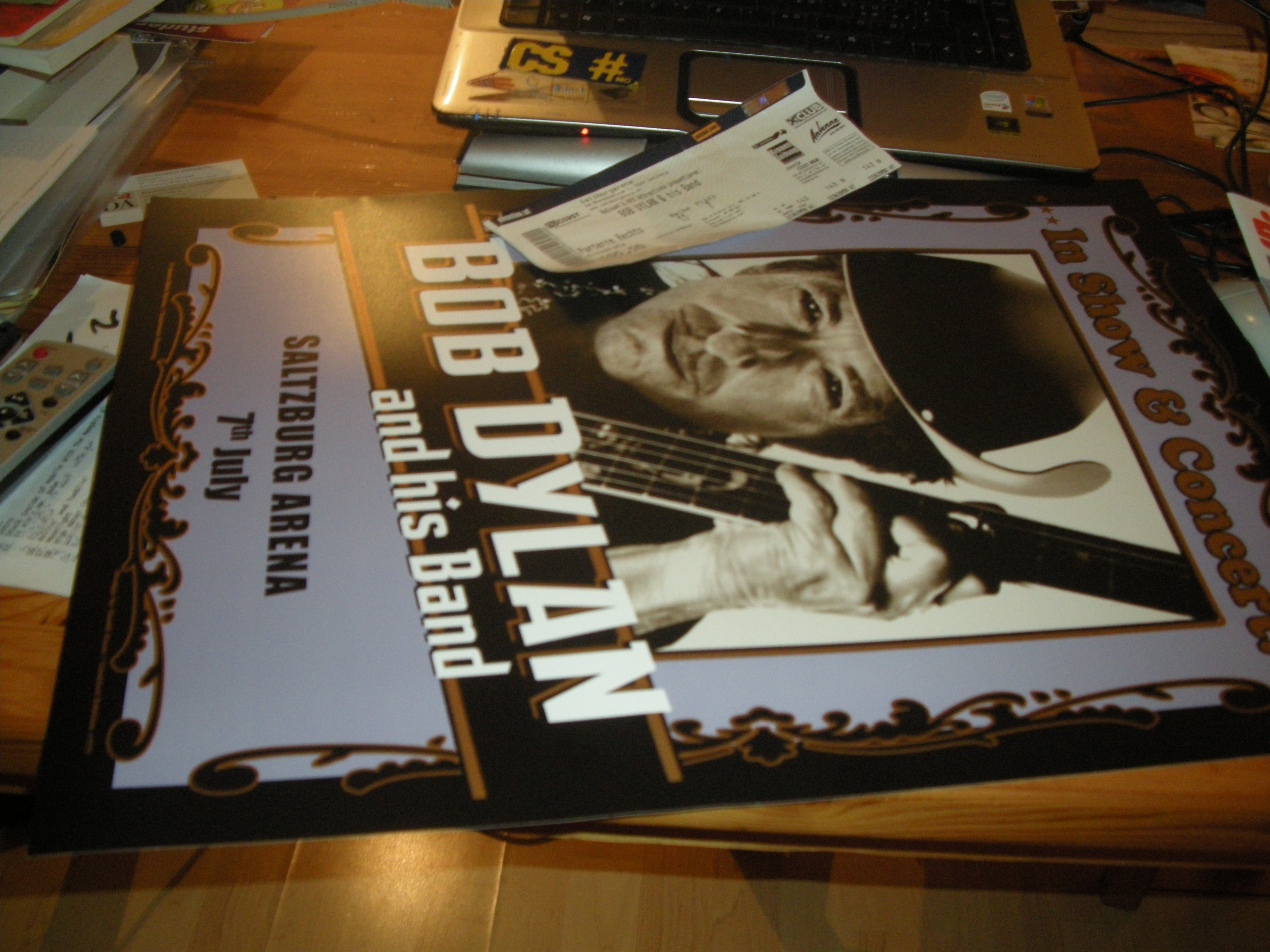
Someone with a hat and an harmonica has got a hold of my heart. A review of Bob’s gig in Salzburg, 7th July 2012

Someone with a hat and an harmonica has got a hold of my heart. A review of Bob’s gig in Salzburg, 7th July 2012

by felicitamodna82


A very nice evening in Salzburg, almost a perfect show, which is not something granted at all if you consider that I have seen/heard 15 concerts already and that my beloved blue-eyed bad boy is giving a show almost every day. Dylanite-infected people know it: sometimes you are just scared that expectations and reality will not match, or that he is in a bad mood. This time I had absolutely no expectations and I barely read something on Expecting rain and watched something on You Tube (the Bonn gig, great stuff!) 2 days before the event.
Anyway,  I wasn’t “touring” with Bob but just going to this single event, located outrageously 4 minutes on the motorway from my flat. And Bob is Bob. I was curious about the Grand piano and just a little worried that the set list could turn out to be boring. Nevertheless, I agree with many people on the ER Forum: a boring set list does not necessarily mean a bad and boring show. This was the case for this Salzburg gig. All songs I already heard, but in a new version: I don’t regret having paid the 105,50 euros plus some more for ticket office royalties plus 4 euros for the parking lot. (yes, that was the price).

The venue


Salzburg Arena, here we are!


I am not a huge fan of the Salzburg Arena. Austrian venues are not my favourite ones in general: seated places, strict security, unjustifiably high prices (twice as in Germany and in Italy, the bordering countries, all of them in the EU. Why?). Sure: the Arena is easy to find: there is a dedicated motorway exit, and a bus drives you from the centre and makes you hop off right by the entrance as soon as the driver gets the message from the Salzburger Lokalbahn “The crazy hippies and/or rockers are coming, switch to the concert-mode route!”. My experience here in 2008 was not good, anyway. I got a row right in the middle and I remembered a bad acoustic and/or sound. The 2008 bootleg and the 2012 experience actually proved me somehow wrong, and I still don’t know why. It could be that in 2008 my place was particularly unlucky, or that my mood was sooooo bad from the University seminar and from the storm, or that something has been changed. I remembered a parquet-ish floor cover and yesterday I noticed that it was white. Who knows? (if you have any idea, just say something in the comments :-) )
Salzburg would be a nice location for an outdoor concert, but the weather here tends to be quite bad. I had a lot of luck the first two years here, with long, warm and mostly dry summers. From 2010 on summers got back to the usual crap. I suggested on the ER forum that he could play in Leopoldskron, or in Hellbrunn, or in the Fortress, or on the Cathedral square, or even on a meadow in Grödig/Fürstenbrunn/Glanegg with the Untersber on the background. But this could lead either to a lucky gig with a magnificent background or to a catastrophe that would double the Udine 2001 experience: a disaster for which no joke about “Thunder on the mountain” or “A Hard rain is gonna fall” would make something to improve the mood. A  flirting with disaster that you probably won’t manage to escape.
My short way to the concert…
No way. Each time I tell my self: “This is the last one”. I was serious about it in November. I even got a new job. But this is not my fault: he came to Salzburg! This time, I admit, I have been honest with myself. I will see him again, as soon as possible.
Thanks to the earthquake in Modena my rock summer has been messed up and I missed the Boss in Florence. Going home with a seismic sequence and with everybody still scared and nervous wasn’t a good idea, so I had to postpone my stay at home and consequently missed the gig. Two journeys would have meant paying twice for transports and using too much holidays, allo of which would have resulted in shortage of money and time to me, since I did not manage to marry a rich, gorgeous and gentleman Austrian widower and still have to work. This also made me skip the usual “spiritual preparation”, which consists mainly of  permeating the atmosphere around Salzburg with the whole discography of the Duluth boy and with some bootlegs that I mysteriously found on my hard disk, thus contributing to the cultural and musical education of my neighbours and suggesting my front neighbour that he needs better loudspeakers in order to hear his/her opera tunes.

My outfits never happen for a simple twist of fate!!!

Boots of Mexican leather
Emotions are always there, buried somewhere, and I caught up with them by taking the usual 4 hours in order to choose an outfit and by driving without thinking for the 4 minutes to the Arena. I got a lot excited all of a sudden. And think that I saw him in November!
A lot of catching up to do. Arriving and meeting up
I arrived around 5 PM and soon the buses arrived as well. Some people were already there, more than it was in November for the Mark&Bob concert at 3 PM. Most important of all, I finally met  Federica again, aka the “girl with the sign”!!! I was so glad to meet her after so many years. She remembered me very well from my “almost groupie” years. I had a lot of catching up to do with her about the “Italian hard-core fans” group. I got in touch with many others hard-core fans from all around the world. I socialised a lot in Innsbruck as well, but – you know – finding the “right ones” is a completely different thing. Along with having the right ticket, parterre  and not some damn lodge, 11th row, of course!
I really miss being in that sort of “family” which is the “wanna-be-on-the-rail” part of the audience. I know I enjoyed my part of being on the road in my early twenties, but the Bob I got to see and hear then was not as good as this Bob of the last months.
Anyway, the “family” was one again there, including a lot of Italians who were not complete unknowns.
Shortly before 18:30 a crowd started to gather near to the gates. I noticed how some people seemed to come right out the “Salzburger Festival House”, judging from their outfits and their attitude. That could only mean business. Not that I hate classical music and that I didn’t enjoy my two concerts at the “House” (suckers!!! I have my acquaintances as well :-P ) , but this was Bob and not a Karajan memorial or a Simon Rattle with orchestra. Different way of enjoying the whole thing. No way that kind of attitude was going to ruin our evening. This opinion was shared by many of us and we consequently planned some moves.
The concert
Shortly before 8 PM, plans for the conquering of the rail were made. I checked out my place, where actually somebody else was sitting. I stated that I would have taken my place in case I didn’t make it to the rail. You should have seen the fear and the disgust on the faces of all other people from the row!!! Federica suggested that I somehow sit in the 10th row middle with other true fans, just to make the thing smoother and just to be sure to have a better place in case our plan failed. As soon as the light went out, Federica started the run and we all followed. The security was really aggressive but I noticed almost all of us resisted. Here is to mention the fact that Freddy warmly and sweetly encouraged everything to stay there and to resist because nothing was going to happen. She really has a good heart! So, after a few seconds during which I was sure we would have been brutalised as I was told that happened in Ancona 2000, the situation was cleared. We were on the rail! And Bob was there, 2 meters away from us!
A lot of people from the wanna-be-high-society of Salzburg will be pissed off, but I am very proud of the way we stayed together and held the rail in front of the stage although the security screamed and pulled!!!!  Thanks, Federica, for the encouragement and for giving me the first row after 8 songs :-) I was right where the grand piano was, first behind Federica, then on the rail!
I made acquaintance with the Grand Piano, which wasn’t there in November, and I saw again the Academy Award and Bob’s face (my VIP lodge in November was great for the sound but not for everything else). Bob entered wearing a white hat with a golden stripe. I loved his white and black shoes, very 40s, but as far as the jacket is concerned he has to wear either a more tailored one or a smaller size. Bob, the fact that you are over 70 and that you are not an underwear model by profession doesn’t allow you to disappoint us heterosexual girl fans! We want to appreciate you and your figure no matter what!
I have to repeat a lot of what I said for the November performance: this new chemistry with Charlie instead of the previous tense relationship, Bob’s moves and enjoyment instead of his mostly antisocial and stuffy attitudes that characterised his 2001-2008 performances are an acquired value for any set list. This is very important if we consider that there was no song I never heard before. So, Bob’s moves, expressions (oh, I missed them!!), piano riffs (I almost thought of throwing the organ away, just to be sure…!!) were the highlights of the evening. I would also say the chemistry  in the band further improved, a fact which was remarkably clear – according to my humble opinion – in the exchanges among Charlie, Stu and Bob.
My favourite arrangements were Don’t think twice (a song I adore), Every grain of sand  and Tangled up in blue ( a song which bored me to death for a long period and yet yesterday caught me completely in trance). Another great version was the melancholic Can’t wait instead of the more rhythmic one I usually heard. Tweedle Dee: I just love that song, so it was nice hearing it again (after my 2002 tour and Salzburg 2008, of course!).  I didn´t expect Visions of Johanna: it was nice hearing it again! Talking about songs which are not new to be heard: Highway 61, with Bob trusting himself and the piano. Bob, the harmonica and the piano were the protagonists of the show: he experimented his riffs and solos and a lot of moves. Almost perfect in every note (I am a perfectionist, sorry for that :-) ) and move. The band was presented during All along the watchtower, which was performed nicely. The only critic from my side  is: Bob, my dearest, I cannot hear Like a rolling stone and Blowing in the wind anymore, I am sorry. I even yawned during BITW!!! (shame on me!!!). Unless he performs like this, I would prefer to hear, who knows, Knocking on heaven’s door? Why not have Stu and Charlie embarrass Slash in a G’n'R-ish version and Bob getting more female appreciation than Axl in his good, old  days? (the latter being probably already the case, at least in the bad girls club, a bunch of nice gals who would beat the average Axl-infatuated girl from 20 years ago without even trying :-) ).
There is an ongoing discussion about the new “thing” during High water, the crowd making a sort of controtempo shout or a dialogue with Bob’s harmonica. I don’t mind it at all, but I am not a huge fan of participation during Bob’s performances. I sense the boy likes to “do it” his own way and I tend to like it that way.
Little update about the lights: no “Eye” on the background, only lights and spots. It took some time to me to notice it! (I had to watch a video from Bad Mergentheim with the Eye making its display on the stage to remember it…). I must say: it was pleasant, and the crew did a good job with the lights. I have no idea if it was a technical issue or a precise choice. What do you think?
I had the impression that apart from true fans the audience sucked. I didn’t notice any felt participation during LARS, for example. I am totally fine with that, as stated above, because I hate hearing people singing along with “Him”, but …geez…move your ass a little, do something, don’t get melted with the chair! Maybe I am wrong?
The venue was everything but full. Accurate research from my side (in other words: some facebook gossiping) explained the very small audience with the great amount of peasant and village parties on the same week end. I went to the ATM prior to the show and witnessed a carriage loaded with people in Trachten, who were staring at my not-so-typical outfit :-) A local radio deliberately ignored Bob’s concert after listing Bryan Adams (who played there on the 6th) and those feasts as the highlights of the week end!! Could you believe it? There is no religion anymore! :-)
Another remark to the audience, especially to the youngsters: I understand that the excitement of uploading your own video made with your expensive i-Phone and of sharing it with the world within minutes is too much to resist, but why do it when leaning on the rail, where inevitably the security comes every 2 minutes and asks you politely to stop? It is quite annoying for you and for us, old people who just want to enjoy His Bobness. Thank you for your understanding. We already have good tapers, let them do their own job!
For the “bad girls club”: Bob making moves while sitting at the piano, opening his legs in my direction. Bob’s eyes. Bob’s sweat. Bob’s expressions. Boy, I swear that when I came home I was damn hungry, even though I had my Frankfurter with Semmel right after the show. I am not a smoker, so I usually get very hungry (and then sleepy) after…you know what…! I really felt like I had sex with Bob! I think the excitement of being 2-3 meters away (with him opening his legs in that not so gentlemanly but definitely not unpleasant way) from him made the trick to my brain. Who knows, maybe in the ocean of sweat I was floating in I even smelled him!  :-)
Little update, always for the bad girls: I forgot to write that I totally approve Charlie’s new look with the beard!!!!
Can’t wait to see what I will see next! Is my rock summer over? Will I ever meet Bob? Will I stop seeing him, as I promise every time to my bank account and to my ? Will I fly to the States to see him?
I leave you with a few pics. The ticket is dedicated to the tapers (do a good job!!! ;-) , especially to the one who then took the picture of me with my mobile, see below) and to the people who “mysteriously” got a front seat card “in the first  minutes of the on-line sale” while I got an 11th row  and then had to deal with my big fat Modenese ass instead.
More info about the concert from more serious people than me – then, further below, my pictures:


Ticket, poster and notebook to post the usual nonsense on the web

Beatles: “Anytime At All” (1964)

Beatles: “Anytime At All” (1964)

http://www.youtube.com/watch?v=gibDQej6QNE 


BOOM!: Ringo Starr’s forceful drumbeat provides an abrupt, attention-grabbing introduction for “Any Time at All,” a Hard Day’s Night track that was never released as a single, but stands as an extraordinary example of the Beatles’ gift for creating sophisticated yet catchy songs.


“Any Time at All” originates from June 2, 1964, when principal writer John Lennon brought the rough draft into Abbey Road Studios. That afternoon, The Beatles first recorded seven takes of the rhythm track, then Lennon’s lead vocal. After breaking to record two more songs, they returned to the song in the evening. They recorded four more takes, overdubbing piano, guitar, and vocals. According to the Beatles Bible website, the track was mixed for mono on June 4; this mix was discarded, and new stereo and mono mixes were completed on June 22.
As is typical of many Lennon/McCartney compositions, Lennon and Paul McCartney did not sit side by side, writing the music and lyrics. Instead, Lennon wrote the song on his own. In his 1980 Playboy interview, Lennon explained that the tune was “an effort at writing ‘It Won’t Be Long’ — same ilk: C to A minor, C to A minor with me shouting.” By this time, Beatlemania was in full swing, which meant that their manager Brian Epstein, and their label wanted to fully exploit their (erroneously) presumed fleeting fame. Therefore, in between shooting A Hard Day’s Night scenes, the foursome would quickly pen songs and record in the studio late into the evening. This tight time limitation led to “Any Time at All” being released in a relatively unfinished state. When Lennon presented the song to the group, he lacked lyrics for the middle eight. McCartney suggested a series of piano chords, with the intention of writing additional lyrics over them. As the deadline loomed, however, the band and producer George Martin abandoned this plan and left in just the piano-infused middle eight.
Despite leaving it “unfinished,” the Beatles otherwise carefully crafted this hidden treasure. After that pound of the drums, Lennon and McCartney alternate between the refrain’s lyrics:
Any time at all,
Any time at all,
Any time at all,
All you’ve gotta do is call
And I’ll be there.
Lennon’s slightly raspy voice lends the song a sharper rock edge, while McCartney’s higher but clear tones keeps it from becoming too suggestive.


The rest of the lyrics aren’t particularly novel — they describe a man telling his lover that “if you’re feeling sorry and sad, I’d really sympathize. Don’t you be sad, just call me tonight,” that “there is nothing I won’t do” to make her happy. “When you need a shoulder to cry on, I hope it will be mine. Call me tonight, and I’ll come to you,” Lennon sings. George Harrison’s lead guitar, layered over acoustic guitars, clearly influenced the Byrds, who would meld the Beatles’ electric guitars with soft folk strumming just a year later. McCartney’s piano and Harrison’s guitar lines interweave with each other in the bridge, returning to Lennon’s almost screaming vocal on the refrain. Bringing the song full circle, the conclusion is signaled by Starr’s strong drumbeat followed by the guitar reverb gradually fading out.
Like “It Won’t Be Long,” “Any Time at All” combines the Beatles’ patented backbeat, searing voices, memorable refrain, and distinctive beginnings and conclusions. Why didn’t Parlophone/EMI release the track as a single? After all, it has all the ingredients of a solid hit. The answer remains a mystery, but “Any Time at All” is an underrated track from the Mop Top era.

Wednesday, 11 July 2012

Speedy Gonzales ... Pat Boone

Speedy Gonzales ... Pat Boone

 
Songwriters: HESS, DAVID / KAYE, BUDDY / LEE, ETHEL

SPOKEN: It was a moonlit night in old Mexico. I walked alone between some old
adobe haciendas. Suddenly, I heard the plaintive cry of a young Mexican girl.

You better come home, Speedy Gonzales
Away from tannery row
Stop alla your a-drinkin'
With that floozie named Flo
Come on home to your adobe
And slap some mud on the wall
The roof is leakin' like a strainer
There's loadsa roaches in the hall

Speedy Gonzales, why don'tcha come home?
Speedy Gonzales, how come ya leave me all alone?

SPOKEN in a male Mexican accent: "Hey, Rosita-I hafta go shopping downtown
for my mudder-she needs some tortillas and chili peppers."

Your doggy's gonna have a puppy
And we're runnin' outta coke
No enchiladas in the icebox
And the television's broke
I saw some lipstick on your sweatshirt
I smelled some perfume in your ear
Well if you're gonna keep on messin'
Don't bring your business back a-here

Mmm, Speedy Gonzales, why don'tcha come home?
Speedy Gonzales, how come ya leave me all alone?

SPOKEN in a male Mexican accent: "Hey, Rosita-come queek-down at the cantina
they giving green stamps with tequila!!"
"Speedy Gonzales"
Single by Pat Boone
Released1962
Recorded1962
GenrePop
Writer(s)Buddy Kaye, Ethel Lee, David Hess
The song was popularised in the United States as a 1962 single by Pat Boone.[2] The Boone version peaked at the #6 Billboard Hot 100 position in 1962 during a total chart run of 13 weeks, doing better in many national charts in Europe, where it sold a million copies.[3] The female voice ("La-la-la...") on this song was of Robin Ward.[3] It also incorporated Mel Blanc voicing Speedy Gonzales as he did in the Warner Brothers cartoons.
Other English language versions
  • Speedy Gonzales was also covered by The Wurzels on their 1975 album The Wurzels Are Scrumptious
  • In English but with Cantonese spoken section: "墨西哥女郎" by The Fabulous Echoes featuring Tang Kei Chan (鄧寄塵)(Hong Kong, 1965)
  • In 1969 the song was recorded by the Hep Stars and became their last single[4]
  • In 1977, Charo and the Salsoul Orchestra made a cover on the album Cuchi Cuchi
  • In 2002, the Belgian band Swoop had a hit with a cover version
Other language versions

Photos of China's past

 Photos of China's past

Historical photographs are rare in China, mostly destroyed in the Cultural Revolution. But now the country's pictured past is being reclaimed.

China's photographic record begins only in the 1970s because nearly all earlier pictures were destroyed. The ones that survived are mostly outside China, and a major effort is now under way to bring them together online, says Mary Ward-Lowery.
Twelve years ago a student from Peking University knocked on Robert Bickers' door.
He'd come, he said, to study Keats, but he knew Professor Bickers was a historian, a specialist in Sino-British relations at Bristol University.
The student had been given a travel grant to come to the UK, with specific instructions to find historical photographs of Peking University. "Because we don't have any," his Chinese professors told him.
Old photograph fever is currently sweeping China. A new and intense appetite for images of the country's past has resulted in a publishing phenomenon - sales of books of historical photographs have rocketed.

Nanking Road, Shanghai, 1925

Such photographs are exceptionally rare in China. The turbulent history of the 20th Century meant that many archives were destroyed by war, invasion and revolution. Mao Zedong's government regarded the past as a "black" time, to be erased in favour of the New China. The Cultural Revolution of the late 1960s finished the job.
"If you were at all savvy," says Bickers, "you realised early on that you had to destroy your own private family records, before the Red Guards came and found evidence of your bourgeois, counter-revolutionary past, when you might have drunk coffee in a café bar, à la mode."


Holiday snapshots, studio portraits of weddings and babies, all were dangerously incriminating. So people destroyed their own family collections, rubbing out over 150 years of photographic history in the process.
But now China is opening its horizons, looking to the West and to the past, to reclaim its cosmopolitan history.
After the Tiananmen Square protests of 1989, Chinese leaders concluded that young people did not fully appreciate what the Communist Party had done for China, so they began an ambitious new policy of historical education, the Patriotic Education Movement. The craze for old photographs is partly a by-product of this movement.
But such photographs are not to be found in China. They are in the attics and wardrobes of foreigners - many British - whose families once lived and worked in China and who took their photographs safely out of the country when they left.
Bickers is leading a project to collect the photographs and make them freely available. It started when he put online a list of 2,000 British policemen who had worked in the Shanghai Municipal Police.
Relatives contacted him to find out more, attaching photographs. Bickers was astonished. "There were photos of Chinese society, culture and people that I have never seen before. I had never seen anything like them," he says.


Four women in Chinese clothes, Hong Kong These women were pictured in 1910 Hong Kong


Now the photographs arrive from all sorts of people and places, ranging across every possible subject and every part of China.
The British - businessmen, missionaries, customs officers and police - were everywhere, even in remote places where very few people even possessed a camera.
Some collections, like those of Tita Hayward and Audrey Gregg, record a childhood of privilege and frivolity spent mostly in the company of servants, as their parents attended to business and a hectic social life.
There are unintentionally controversial photographs by policeman William Armstrong, depicting plump and contented peasants in the 1920s, whereas communist propaganda suggested they were starving and unhappy.
G Warren Swire's collection records the trading interests of John Swire & Sons. His photographs of warehouses and dockyards might be thought dull were it not for Swire's careful - and beautiful - compositions and the fact that most of these landscapes no longer exist.
Rapid urban development in China has meant that historic buildings and neighbourhoods have been swept away and replaced with skyscrapers. They exist now only in people's memories or in these photographs.


China Navigation Company ship on Whangpoo River, Shanghai, c.1906. Few photos exist of shipping in Shanghai in the early 1900s


One of the treasures of the collection, however, is a set of photographs taken by a Chinese politician and diplomat, Fu Bingchang. Fu was a talented amateur photographer and his subjects just happen to include the Kuomintang elite.
When the Nationalist government fell in 1949, Fu was sent into exile but before he left he arranged for his papers to be smuggled to France.
Fu never saw them again but in the early 70s, his son Johnny received a phone call from Fu's former secretary, Chen Ding, inviting him to his house in St Cloud, the Paris suburb where he'd lived for the past 20 years.
Johnny discovered a dozen leather suitcases full of photographs, diaries and paintings, an incredible treasure trove, a gift from his father.
"I was 12 years old and living in Macao when the Japanese attacked," recalls Johnny, now 83 and living in Lancashire in the UK.
"We had to run away because of my father's position. We had to walk for seven days non-stop, drinking water from paddy fields.
"I was lucky to be alive, lucky to carry the clothes on my back, so we were very lucky to be able to salvage the photos."

Fu Bingchang and Sun Ke (son of Sun Yat-sen), 1948-9 Fu Bingchang (left) was a senior diplomat and keen photographer

Bickers calculates that one British person in 10 has some historical connection to China and he wants their photographs to add to the online collection.
"These photos are an inadvertent legacy of that period of national humiliation, of British supremacy in China.
"I feel strongly that this is an act of historical restitution, giving back to China something that's now here, that was taken."

Tuesday, 10 July 2012

Medjugorje: priest warns of excessive celebrity focus

Medjugorje: priest warns of excessive celebrity focus


Media over-covered football manager Roberto Mancini’s visit to Medjugorje, says former editor-in-chief of Radio Mir Medjugorje and head of the information centre. Medjugorje may not be subjected to a celebrity and advertising style, Fr. Mario Knezovic writes in Franciscan magazine.

fra fr mario knezovic priest medjugorje
Fr. Mario Knezovic during a Mass in Medjugorje. For several years, the Franciscan priest headed the parish information centre, and served as editor-in-chief of Radio Mir Medjugorje


Medjugorje is modest and silent, and this atmosphere is at odds with excessive media coverage of famous people’s visits, a former head of Medjugorje’s information centre states.
Fr. Mario Knezovic, who further served as editor-in-chief of Radio Mir Medjugorje, was particularly struck by media behavior when football manager Roberto Mancini visited:
“The first day, the entire front page. Inside, three pages of text and photos. The second day, half of the cover and two pages inside. The third day, two pages again. One would think that something big is happening. Turns out a football manager has come on pilgrimage to Medjugorje” Fr. Mario Knezovic writes in Nasa Ognjista, a Croatian Catholic magazine.
roberto mancini football manager visit visits visted medjugorje march 29 30 2012
Football manager Roberto Mancini followed by reporters in March, during the first of his two visits to Medjugorje in 2012
“The news of the arrival of Roberto Mancini turned into a sensation, as if no one else are coming to Medjugorje during the year. Why this fascination with “ordinary mortals”? Certainly his arrival should be followed, recorded and published about, but not in exceeded measure as in this case.”
To Fr. Mario Knezovic, part of the core identity of Medjugorje is being challenged by recent years’ more frequent celebrity visits.
“Medjugorje can not tolerate to be subjected to an advertising and celebrity style. This world is modest and silent. Those who deny that do not realize that Our Lady herself wanted to stand back and point to Jesus” he writes.


Fr. Mario Knezovic

Fr. Mario Knezovic next points to a column he wrote in the recent issue of Glasnik Mira, the magazine published by the parish of Medjugorje.
“I wrote that every story has a quiet hero who is not destined for this. Some exist and become a part of the story with the motive of recruiting other heroes. Such a story we meet in Medjugorje. “Little” people’s stories often come across as the biggest when we view them with eyes of honesty” he writes in Nasa Ognjista.